 how-to
Emergency Structural Evaluation for Homes: 2026 Guide
Table of Contents
- What Is an Emergency Structural Evaluation for Homes?
- Signs of Foundation Failure: When to Call Immediately
- Step 1: Perform a Safe Visual Inspection
- Step 2: Document Damage for Insurance Claims
- Step 3: Hire a Licensed Professional Engineer
- Emergency Structural Engineer Cost: What to Expect
- Step 4: Understand the Evaluation Report and Next Steps
- Frequently Asked Questions
Last Updated: September 27, 2026
What Is an Emergency Structural Evaluation for Homes?
An emergency structural evaluation for homes is a rapid, professional assessment of a building's structural integrity after sudden damage or the discovery of serious warning signs. It answers one urgent question: is this house safe to occupy right now?
At Florida Foundation Repair, we field calls every week from homeowners who waited too long to act. Some were lucky. Others weren't.
A standard inspection looks at the whole house over days. An emergency structural evaluation works differently. A licensed professional engineer checks load-bearing components, foundation settlement, framing stability, and the load path within hours.
The goal is simple: find out whether the structure is sound or in danger of failing. Here's what most guides get wrong. They treat all foundation cracks as equally urgent. They aren't. Some cracks are cosmetic. Others signal active structural failure.
Below, we'll show you exactly how to tell the difference, what to document, and when to call a professional before the damage gets worse.
Signs of Foundation Failure: When to Call Immediately
The clearest sign of foundation failure is a crack you can fit a coin into, paired with a door that no longer closes. Any one sign alone may be minor. Two or more together usually means trouble.
Watch for these warning signs of foundation failure:
- Cracks wider than a quarter inch
- Doors and windows that stick or won't latch
- Floors that slope or feel springy
- Ceilings that sag or bow
- Walls pulling away from the frame
- Gaps around exterior doors
One sign is a question. Three signs is a call.
Cracks, Sagging, and Sticking Doors
Cracks tell a story if you know how to read them. Hairline cracks in drywall are common and often harmless. Stair-step cracks in brick or block are not.
Sagging ceilings and sticking doors point to movement in the structure. When a door sticks in summer but works in winter, that's seasonal swelling. When it sticks year-round, the frame has shifted.
Foundation Settlement and Shifting Earth
Foundation settlement happens when soil beneath the home compresses or moves. Shifting earth makes it worse. Water intrusion softens soil. Soil erosion carries it away. Both leave the foundation unsupported.
This matters more in areas with karst geology, where underground voids can open without warning.
Step 1: Perform a Safe Visual Inspection
A safe visual inspection means looking without touching. You are gathering information, not fixing anything. Never enter a space that feels unsafe.
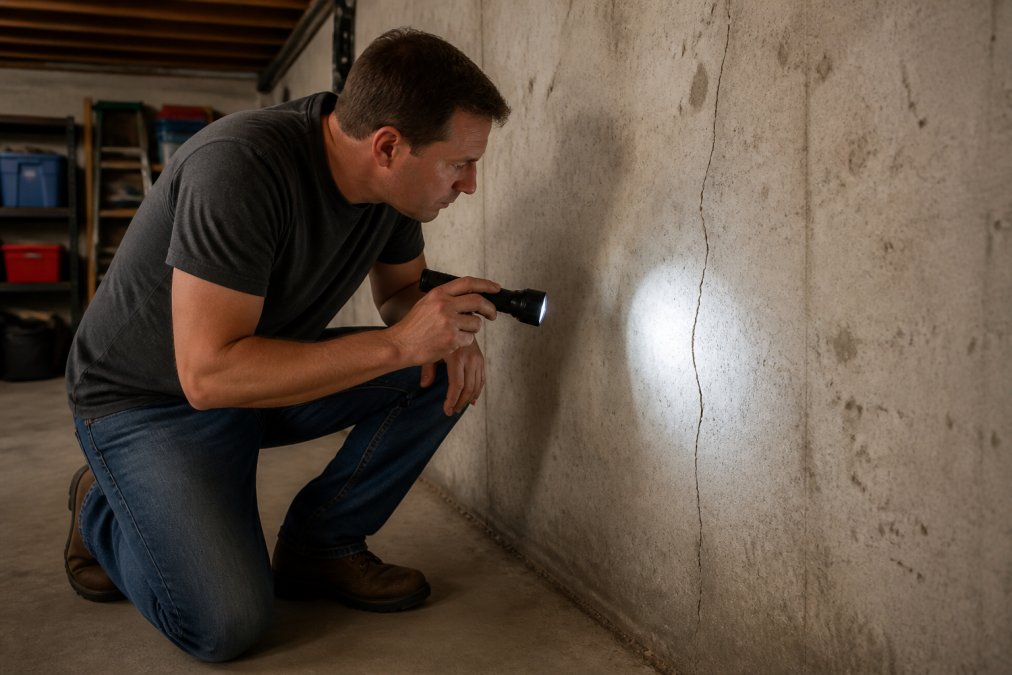
- Walk the perimeter and note every crack
- Photograph cracks next to a coin for scale
- Check for wall bowing or lateral movement
- Look for water stains or soil erosion near the foundation
- Note any floor deflection inside
- Test every door and window
- Check the building envelope for gaps
Step 2: Document Damage for Insurance Claims
Good documentation is the difference between a paid claim and a denied one. Insurance documentation needs dates, scale, and context.
Your documentation should include:
- Date and time of each observation
- Photos with a ruler or coin for scale
- Notes on whether damage is new or worsening
- Receipts for any emergency repairs
- A copy of your structural report once you have one
Step 3: Hire a Licensed Professional Engineer
Only a licensed professional engineer (PE) can legally confirm structural failure in most states. A contractor can spot problems and recommend repairs. An engineer signs and seals the findings, and that sealed document is what carries weight with lenders, insurers, and code officials.
Schedule Structural Evaluation →
How to Verify a License Before You Book
Every state maintains a public licensure lookup through its board of engineering. Ask for the engineer's name and license number, then verify three things:
- Active status, the license is current, not expired or suspended
- Discipline, the license is in civil or structural engineering, not a related field
- Standing, no public disciplinary actions on record
What Happens During the On-Site Evaluation
An emergency evaluation is not a walkthrough. It is a structured investigation, usually completed in one to three hours depending on home size and access. Expect the engineer to work through these stages:
- Exterior perimeter survey, grading, drainage, foundation walls, and any visible crack patterns
- Interior room-by-room check, floors for deflection, walls for plumb, ceilings for sag, doors and windows for square
- Crawlspace or basement inspection, footings, piers, joists, beams, and moisture conditions
- Attic and framing review, rafters, ridge beams, and load-path continuity from roof to foundation
- Crack mapping, measuring width, orientation, and whether the crack is active or dormant
- Load-path analysis, tracing how weight moves from the roof down to the soil and identifying where it breaks down
What the Written Report Should Contain
A usable structural report is more than a summary. It should include:
- The engineer's sealed signature and license number
- A description of observed conditions with photo references
- An opinion on structural stability and occupancy safety
- A classification of findings by severity (cosmetic, monitor, repair, urgent)
- Recommended remediation with sequencing
- Any limitations or areas not accessible during the visit
Verify an engineer's license through your state board
What to Do in the First 60 Minutes
Most guides jump straight to hiring. But the first hour after you notice serious damage is its own decision point. Here is a practical triage sequence:
- Minutes 0-10: Get everyone out of any room showing active movement, sagging, or a widening crack. Do not retrieve belongings.
- Minutes 10-20: Shut off gas at the meter if you smell gas or hear hissing. Shut off water at the main if you see active leaking near the foundation.
- Minutes 20-40: Photograph everything from a safe distance. Do not enter a crawlspace or attic that feels unstable.
- Minutes 40-60: Call your insurance carrier's claims line and open a file. Then call a licensed engineer.
Emergency Structural Engineer Cost: What to Expect
Most homeowners searching this term want one thing: a number. The honest answer is that emergency structural engineer cost varies widely by region, home size, and urgency, but a framework is more useful than a refusal to estimate.
Typical Cost Ranges
Across most markets, a licensed professional engineer's structural evaluation for a single-family home generally falls into these bands:
- Routine inspection (scheduled weeks out): commonly a few hundred dollars for a basic visual evaluation and short letter report
- Emergency or same-week evaluation: typically higher, reflecting after-hours or expedited scheduling
- Evaluation with a full sealed engineering report: higher still, because the report requires analysis, drafting, and the engineer's professional seal
- Evaluation plus geotechnical testing: the widest range, since soil borings, lab work, and a separate geotechnical report are involved
What Drives the Price Up or Down
- Square footage and complexity, more rooms, more framing, more time on site
- Foundation type, slab, crawlspace, basement, and pier-and-beam each require different access and methods
- Accessibility, a finished basement with no visible foundation wall limits what can be observed and may require additional investigation
- Urgency, same-day and after-hours calls carry a premium
- Report requirements, a one-page letter is cheaper than a full sealed report with remediation sequencing
- Soil or geotechnical work, borings, lab testing, and a separate report add cost
- Travel distance, rural properties often pay more for the engineer's time on the road
How to Compare Quotes Without Getting Burned
When you collect quotes, ask each engineer the same four questions:
- What is included in the base fee, site visit only, or site visit plus written report?
- Is the report sealed and signed?
- Are geotechnical or lab fees separate, and what is the typical add-on?
- What is the turnaround time from visit to delivered report?
Why Some Firms Offer Free Evaluations
Some foundation repair contractors offer free structural evaluations as part of a repair bid. That can be useful, but understand the trade-off: a free evaluation from a repair company is a sales visit, not an independent engineering opinion. If you need a sealed report for insurance, a lender, or a legal matter, you generally need an independent licensed engineer, and you should expect to pay for it.
Step 4: Understand the Evaluation Report and Next Steps
A structural report is your roadmap. It tells you what's wrong, how serious it is, and what to do next. Read it carefully before you sign anything.
Your next steps depend on the findings:
- Minor issues: monitor and repair as scheduled
- Moderate settlement: stabilize the soil before it worsens
- Serious structural failure: act immediately, and limit occupancy
Frequently Asked Questions
How much does an emergency structural assessment cost?
Costs vary based on your location, the size of the home, and the complexity of the issue. Most licensed professional engineers charge an hourly rate or a flat fee for a site evaluation. Because pricing depends on the scope of the emergency assessment and travel requirements, you should request a specific quote from your chosen provider.
What should I do immediately if I suspect structural failure?
Evacuate the area if you see sagging ceilings, wall bowing, or hear creaking sounds. Do not attempt to fix the issue yourself. Once safe, contact a licensed professional engineer for an emergency structural evaluation. Document any visible damage with photos from a safe distance to support insurance documentation later.
Who is qualified to perform a structural integrity inspection?
Only a licensed professional engineer (PE) with experience in structural or geotechnical engineering should perform this inspection. In Florida, these experts understand local karst geology and building code compliance. General contractors cannot provide the stamped structural report often required for insurance claims or real estate transactions.
Can a structural engineer really stabilize soil that has already shifted?
Yes. Modern methods like non-invasive polyurethane injection can stabilize soil and lift foundations even after significant movement. The key is a thorough site evaluation to determine the load path and soil conditions. This approach restores load-bearing capacity without the disruption of traditional excavation.