 how-to
Foundation Repair for Waterfront Homes: 2026 Guide
Table of Contents
- Signs of Foundation Failure in Waterfront Homes
- How Seawall Repair and Reinforcement Stabilizes Shoreline Soil
- Helical Piers for Waterfront Properties: Deep Foundation Systems That Hold
- Polyurethane Injection for Soil Stabilization: A Non-Invasive Approach
- Concrete Leveling and Slab Repair in Coastal Environments
- Insurance, Liability, and Climate Risks for Waterfront Foundations
- Conclusion
- Frequently Asked Questions
Last Updated: September 30, 2026
Signs of Foundation Failure in Waterfront Homes
Foundation repair for waterfront homes starts with recognizing the warning signs early. Waterfront properties face constant stress from tidal movement, soil saturation, and salt exposure. Catching problems before they spread saves thousands in structural restoration costs.
Settlement Cracks and Foundation Shifting
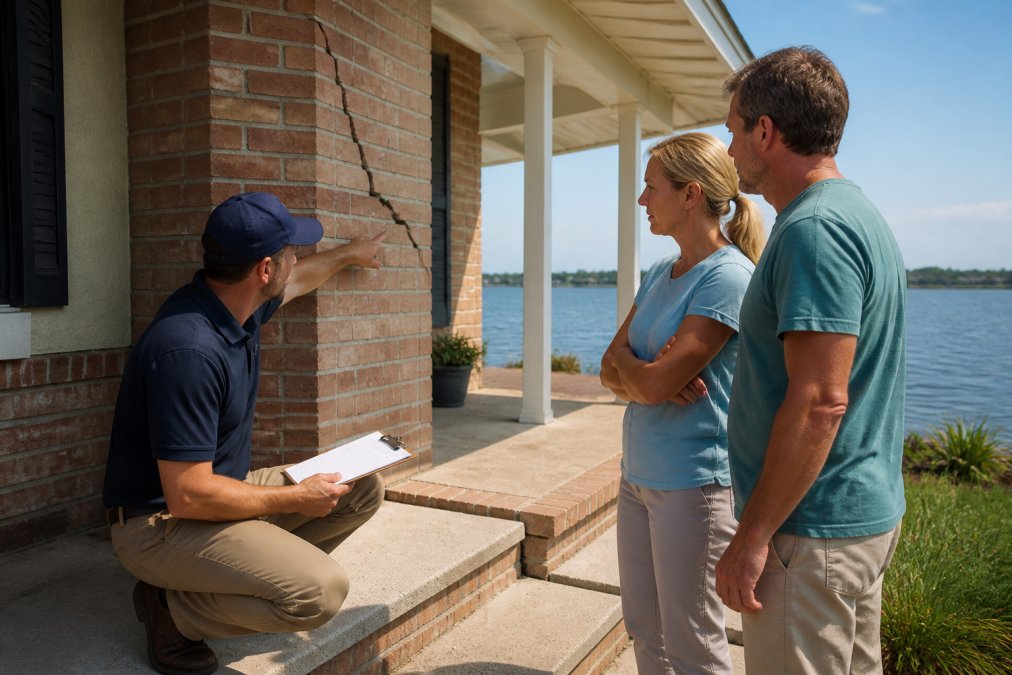
Diagonal cracks near window corners and doors signal foundation settlement. These aren't cosmetic issues. They indicate the soil beneath your home is moving.
Watch for:
- Stair-step cracks in brick or block walls
- Doors that stick or won't latch properly
- Uneven floors that slope toward the water
- Gaps between exterior walls and window frames
Foundation shifting happens gradually. By the time cracks are visible inside, the problem has been developing for months.
Saltwater Corrosion and Moisture Damage
Saltwater corrosion attacks concrete and steel reinforcement in ways freshwater never does. Chloride ions penetrate concrete pores and corrode embedded rebar, causing it to expand and crack the surrounding material.
Moisture damage compounds the problem. Waterfront homes sit in constant humidity. Crawl spaces stay damp. Wood framing rots. Concrete spalls.
The American Society of Civil Engineers infrastructure report notes that coastal structures face accelerated deterioration compared to inland counterparts.
How Seawall Repair and Reinforcement Stabilizes Shoreline Soil
A seawall is not a decorative edge, it is the retaining structure that holds your building pad in place. When it fails, the soil it was holding migrates toward the water, and your foundation loses bearing support from the side. That is why seawall repair and reinforcement is often the first line of defense in foundation repair for waterfront homes.
The Load Path: How a Seawall Protects a Foundation
A functioning seawall does three jobs at once:
- Retains soil behind the wall so the building pad keeps its lateral support.
- Breaks wave energy before it scours the shoreline and pulls sediment out.
- Controls the water table immediately adjacent to the structure, which limits cyclic saturation and drying of the supporting soils.
When any of those three functions degrade, the foundation does not fail on its own, it fails because the soil around it is leaving.
Common Seawall Systems and How They Fail
| Seawall Type | Typical Material | Common Failure Mode |
|---|---|---|
| Sheet pile | Steel or vinyl | Corrosion at the waterline, loss of tieback tension |
| Gravity wall | Concrete or stone | Tilting from hydrostatic pressure and toe scour |
| Crib wall | Timber or concrete | Rot or spalling of the facing, internal soil loss |
| Bulkhead with tiebacks | Steel with deadman anchors | Anchor creep, corrosion of the tie rod |
Steel sheet piling in brackish or salt water corrodes fastest in the splash and tidal zone, where alternating wet and dry cycles and chloride exposure attack the metal. Vinyl and concrete alternatives avoid that specific failure mode but have their own limits, vinyl can deflect under heavy surge loads, and concrete can spall when embedded rebar corrodes.
Tiebacks, Deadmen, and Anchoring
Most modern seawalls are not just pushed into the ground, they are anchored back into stable soil with tie rods connected to deadman anchors buried inland. If the tie rods corrode or the deadman shifts, the wall rotates outward, soil escapes behind it, and the foundation loses lateral support. Reinforcement work often means re-tensioning or replacing tiebacks rather than rebuilding the entire wall.
Repair vs. Replacement: A Practical Threshold
A common pattern among coastal contractors is:
- Repair when the wall is plumb, tiebacks still hold tension, and damage is limited to isolated panels or the cap.
- Reinforce when the wall is sound but the soil behind it has begun to migrate, grouting, compaction, or additional anchors can restore the load path.
- Replace when the wall has rotated past a few degrees, tiebacks have failed, or scour has undermined the toe.
Fixing the wall without addressing the soil behind it rarely holds. The two systems have to be repaired together.
Helical Piers for Waterfront Properties: Deep Foundation Systems That Hold
Helical piers for waterfront properties transfer structural loads to stable soil layers deep below the surface. These deep foundation systems work where surface soils can't support the weight.
How helical piers work:
- Steel shafts with helical plates are driven into the ground
- The plates bite into load-bearing strata
- Brackets connect the piers to your existing foundation
- The system lifts and stabilizes settled areas
Piling installation typically reaches depths of 15 to 30 feet, depending on soil conditions. A subsurface investigation determines the right depth for your property.
Schedule Structural Evaluation →
| Foundation Solution | Best For | Disruption Level | Typical Timeline |
|---|---|---|---|
| Helical piers | Severe settlement, load transfer | Moderate | 2-5 days |
| Polyurethane injection | Minor to moderate settlement | Minimal | 1-2 days |
| Concrete leveling | Slab issues, void filling | Moderate | 2-4 days |
| Seawall reinforcement | Shoreline erosion | Moderate | 3-7 days |
Polyurethane Injection for Soil Stabilization: A Non-Invasive Approach
Polyurethane injection for soil stabilization offers a less disruptive alternative to traditional underpinning. This method injects expanding foam into voids and weak soil zones.
The material expands to compact surrounding soil and fill empty spaces. It also creates a moisture barrier that reduces water infiltration.
Benefits over excavation:
- No heavy equipment tearing up your yard
- Faster completion with less mess
- Immediate results as foam expands
- Works in tight spaces where rigs can't reach
Florida Foundation Repair uses polyurethane injection engineered for the state's karst geology. This approach addresses the limestone dissolution that creates sinkhole risks.
Concrete Leveling and Slab Repair in Coastal Environments
Concrete leveling and slab repair in coastal areas requires understanding hydrostatic pressure. Water tables fluctuate with tides, pushing against slabs from below.
Common coastal slab problems:
- Cracked driveways and walkways
- Sunken garage floors
- Uneven pool decks
- Interior slab settlement
Insurance, Liability, and Climate Risks for Waterfront Foundations
Most guides on foundation repair for waterfront homes stop at the repair itself. The harder questions, who pays, what gets disclosed, and whether the repair will still be viable in twenty years, are where waterfront owners actually lose money. This section covers what the other guides skip.
What Standard Policies Actually Cover
Homeowners insurance is built around sudden, accidental events. Foundation problems caused by long-term soil movement, settlement, or gradual water intrusion are typically excluded under an earth movement exclusion. That exclusion usually names settlement, subsidence, and erosion explicitly.
Documentation That Changes the Outcome
An engineer-led inspection report is the single most useful document a waterfront owner can hold. It does three things:
- Establishes the cause of the damage, which determines whether an exclusion applies.
- Establishes the date the condition was first observed, which matters for claims and for disclosure.
- Establishes repair scope, which insurers and buyers both rely on.
Disclosure and Liability During a Sale
Most states require sellers to disclose known material defects, and a known foundation issue is almost always material. Selling without disclosure exposes the seller to post-closing claims. On the buyer's side, a foundation evaluation before closing is the standard way to convert an unknown risk into a negotiated number.
Climate and Rising Water Tables
Repairs that ignore long-term water trends tend to fail early. Two forces matter most:
- Rising water tables keep supporting soils saturated more of the year, which reduces bearing capacity and accelerates corrosion of embedded steel.
- More intense storm events drive higher surge and scour loads against seawalls and shoreline soils.
Conclusion
Waterfront foundations face relentless pressure from saltwater, shifting soil, and fluctuating water tables. Waiting for problems to worsen only increases repair costs and risks.
Frequently Asked Questions
What are the signs of foundation failure in homes near water?
Look for diagonal cracks wider than 1/8 inch in drywall or brick, doors and windows that stick, sloping floors, and gaps around exterior trim. Waterfront homes also show tide-line staining, crumbling mortar, and rust stains from saltwater corrosion. Foundation settlement often accelerates after storms or seasonal water table fluctuations. An engineer-led inspection can confirm whether these signs point to soil erosion, hydrostatic pressure, or deeper structural issues before they worsen.
Will homeowners insurance cover foundation repair for waterfront homes?
Most standard policies exclude foundation repair caused by soil erosion, settlement, or poor maintenance. Coverage may apply if the damage stems from a sudden event like a burst pipe or storm surge. Flood insurance through the National Flood Insurance Program sometimes covers foundation damage from rising water, but not gradual erosion. Review your policy and request a written structural evaluation to document the cause before filing a claim.
How do helical piers for waterfront properties differ from concrete leveling?
Helical piers are steel shafts screwed into load-bearing soil or bedrock to support and lift a foundation, making them suited for deep, unstable waterfront ground. Concrete leveling raises sunken slabs by injecting material underneath, which works for minor surface settlement but does not address deep soil movement. Waterfront homes with ongoing erosion usually need helical piers or polyurethane injection rather than slab leveling alone.
Can you live in a waterfront home during foundation repair?
In most cases, yes. Non-invasive methods like polyurethane injection for soil stabilization involve small holes drilled through the slab and typically take one to three days, with minimal dust and noise. Helical pier installation is more involved but still allows occupancy once the crew secures the work area. Your contractor will tell you if any room needs to be cleared or if utilities must be temporarily shut off during the job.