 ultimate-guide
Is Polyurethane Foundation Repair Permanent? 2026 Guide
Table of Contents
- What Is Polyurethane Foundation Repair and How Does It Work?
- How Does Polyurethane Soil Stabilization Work?
- How Long Does Polyurethane Foundation Repair Last?
- Polyurethane vs Epoxy Foundation Crack Repair
- Polyurethane Foam Foundation Repair Cost: What Affects Your Quote
- When Polyurethane Is a Permanent Fix vs. a Temporary Patch
- Warranty, Environmental Impact, and DIY Limitations
- Frequently Asked Questions
Last Updated: September 25, 2026
What Is Polyurethane Foundation Repair and How Does It Work?
Polyurethane foundation repair is the process of injecting a two-part expanding polymer beneath a settled slab or footing to fill voids, compact loose soil, and lift the structure back toward level. At Florida Foundation Repair, we use this method because it addresses the cause of settlement rather than just the crack you can see.
The material starts as two liquid components.
How Does Polyurethane Soil Stabilization Work?
The foam works by filling voids and increasing the load-bearing capacity of the soil beneath your foundation. A technician drills small injection ports, then pumps the resin in lifts, monitoring elevation as the slab rises.
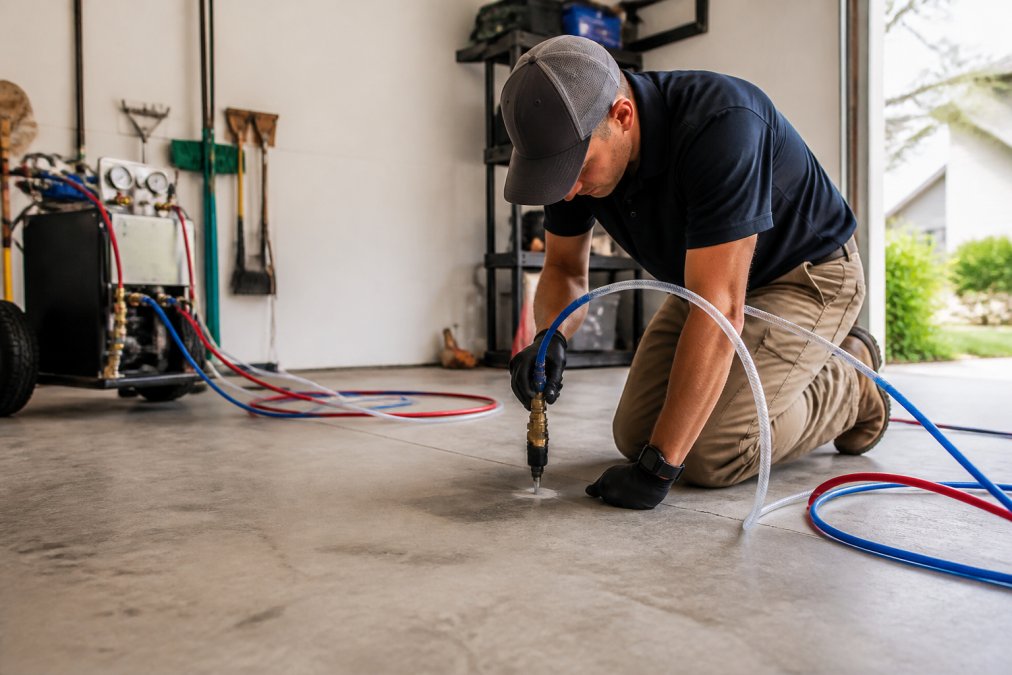
Here is the sequence in practice:
- A site assessment maps the settled areas and identifies void locations.
- Injection ports are drilled, usually no wider than a dime.
- Resin is injected in controlled volumes, expanding to fill voids and compact loose subgrade.
- Elevation readings are taken after each lift to confirm the slab is moving as intended.
- Ports are patched, and the crew cleans up. Most residential jobs finish in a day.
How Long Does Polyurethane Foundation Repair Last?
The honest answer: the foam outlives the problem it was injected to solve, but only if the problem was diagnosed correctly. Polyurethane foam itself is chemically stable, does not rot, and is not a food source for soil organisms. The material is rarely the weak link. The soil around it is.
What actually degrades a polyurethane repair over time
Four mechanisms drive long-term performance, and they are worth naming precisely:
- Soil chemistry interaction. This is the factor most guides skip. Highly acidic or highly alkaline soils can attack the polymer matrix over long periods, and soils with high sulfate content are a known concern for buried materials. Clay soils that swell and shrink with moisture cycles keep loading and unloading the foam, which is a fatigue problem rather than a chemical one. Sandy, well-drained soils tend to be the most forgiving. A soil test before injection tells you which environment you are working in.
- Hydrostatic and drainage conditions. Foam is hydrophobic, it repels water rather than absorbing it, but it cannot stop water from reaching the soil around it. Poor grading, a failed downspout, or a high water table reintroduces the moisture that caused the settlement in the first place.
- Load changes. A new addition, a heavier roof, or a change in how the slab is used can exceed what the original design anticipated. The foam does not fail; it is simply asked to carry more than it was sized for.
- Installation quality. Underfilled voids, missed injection points, or injection that stops short of the load-bearing strata leave the problem half-solved. The material performs exactly as designed, the design was just incomplete.
The soil-chemistry angle most articles miss
Two foundations can receive identical foam and behave differently for one reason: what is in the ground around them. Expansive clay cycles with the seasons and works the foam like a slow pump. Organic soils continue to decompose and settle no matter what is injected into them. Saturated soils keep the polymer under constant moisture exposure. None of these are foam failures, they are soil failures the foam was asked to compensate for.
What "permanent" realistically means here
A polyurethane repair can reasonably be called permanent when the cause was treatable soil, the injection reached the right depth, and the water that drove the settlement was addressed. It is temporary when the cause is something the foam cannot touch, a leaking pipe, ongoing erosion, or organic soil that keeps moving. The material does not expire on a schedule.
Polyurethane vs Epoxy Foundation Crack Repair
These two materials solve different problems, and confusing them is expensive. Polyurethane vs epoxy foundation crack repair comes down to movement: epoxy is rigid, polyurethane flexes.
| Factor | Polyurethane | Epoxy |
|---|---|---|
| Best for | Active cracks, soil voids, slab lift | Stable, non-moving cracks |
| Flexibility | Remains flexible | Rigid after cure |
| Water behavior | Hydrophobic, repels water | Seals, but can shear |
| Typical use | Void filling, soil stabilization | Crack sealing in stable walls |
| Movement tolerance | Handles ongoing movement | Fails if the crack reopens |
Polyurethane Foam Foundation Repair Cost: What Affects Your Quote
Polyurethane foam foundation repair cost varies widely because no two foundations fail the same way. Pricing depends on how much foam is needed, how many injection points are required, and how far the slab has settled.
The variables that move a quote most:
- Total square footage of the affected area
- Number of injection ports and depth of injection
- Whether soil stabilization is needed alongside slab lift
- Site access and any prep work required
- Whether a structural engineer's evaluation is included
When Polyurethane Is a Permanent Fix vs. a Temporary Patch
Polyurethane is a permanent solution when the cause of settlement is treatable soil and the injection reaches the right depth. It is a temporary patch when the cause is something the foam cannot touch.
Schedule Structural Evaluation →
Here is the distinction that matters:
Permanent when:
- Settlement comes from soil voids, loose fill, or compaction
- Water intrusion is addressed at the same time
- Injection reaches the load-bearing strata
- A qualified installer verifies lift with elevation data
Temporary when:
- The cause is a leaking pipe, poor drainage, or ongoing erosion
- Only the visible crack is treated, not the soil beneath
- The soil is organic or constantly saturated
- The wrong material is used for the failure type
Warranty, Environmental Impact, and DIY Limitations
Three things separate a professional repair from a hopeful one: what the warranty actually covers, what the material does to the environment, and where the line sits between a homeowner project and a structural one.
What a "lifetime warranty" actually covers
The phrase is used loosely across the industry, so it pays to read the fine print before you sign. A limited lifetime warranty on foundation work typically covers the workmanship and materials for as long as you own the home, not the soil, not the drainage, and not the structure itself.
What is commonly covered:
- Re-injection or re-leveling if the treated area settles again under unchanged conditions
- Material defects in the resin
- Labor to return the slab to its documented target elevation
What is commonly excluded:
- New settlement caused by water the homeowner failed to manage (grading, gutters, downspouts)
- Changes in load, additions, heavier roofing, new structures
- Soil movement from causes outside the treated area
- Damage from plumbing leaks, tree roots, or nearby excavation
- Transferability limits, many warranties are non-transferable or transfer only once
Environmental impact and groundwater
Polyurethane injection uses far less material and creates far less waste than excavation-based methods. There is no spoils pile, no hauling, and no landscaping to replace, which is a real environmental advantage over trench-and-pier approaches.
DIY limitations, and the structural threshold
- Foam is appropriate for slab settlement, void filling, and soil stabilization where the cause is treatable soil and the structure is otherwise sound.
- Foam is insufficient when the foundation has failed structurally, cracked or bowing foundation walls, a footing that has rotated or separated, or settlement driven by a failing retaining system. These require underpinning, piers, or wall anchors, not injection.
- Foam is insufficient when the cause is ongoing and unfixable, a leaking pipe that will not be repaired, active erosion, or organic soil that keeps decomposing.
For a licensed structural engineer's take on foundation performance and soil behavior, the American Society of Civil Engineers foundation guidance is a solid reference. The U.S. Geological Survey karst terrain resources explains why certain ground conditions make settlement more likely. And the Federal Emergency Management Agency guidance on foundation and flood risk covers how water and soil interact around a structure.
Frequently Asked Questions
How long does polyurethane foundation repair last?
The polyurethane material itself does not degrade or shrink over time, and manufacturers typically rate it for 50 years or more. The real variable is the soil beneath it. If the cause of settlement, such as poor drainage or soil erosion, is not corrected, new movement can occur. A proper site assessment and a transparent warranty are what turn a material lifespan into a reliable repair lifespan.
Which is better for repairing concrete cracks, epoxy or polyurethane?
Epoxy is stronger in compression and works well for structural cracks in concrete walls or slabs that need load-bearing capacity restored. Polyurethane is flexible, expands, and resists moisture, making it the better choice for cracks that may still move or where water intrusion is a concern. For foundation settlement caused by soil issues, polyurethane injection into the soil is the more appropriate fix.
How much does it cost to repair a foundation with polyurethane injection?
Pricing depends on the size of the affected area, the number of injection points, soil conditions, and whether structural lifting is needed. Quotes vary widely because some contractors include a full geotechnical assessment and warranty while others do not. Request a detailed written estimate that lists the scope, materials, and warranty terms so you can compare fairly.
Does polyurethane foam shrink over time in foundation repair?
No. Polyurethane injection foam is designed to expand and then cure into a stable, closed-cell structure that does not shrink. Unlike some older grout materials, it also resists moisture absorption, which matters in areas with high water tables or hydrostatic pressure. This dimensional stability is one reason it is considered a long-term solution when the underlying soil issue is addressed.