 how-to
How to Identify Sinkhole Activity: 7 Warning Signs
Table of Contents
- What You'll Need Before You Start Checking
- What Sinkhole Activity Looks Like in Florida's Karst Terrain
- Step-by-Step: How to Identify Sinkhole Activity Around Your Home
- Signs of Foundation Settlement vs Sinkhole: How to Tell the Difference
- Geotechnical Sinkhole Testing: What Professionals Look For
- Is Sinkhole Repair Covered by Homeowners Insurance?
- DIY vs. Professional: What You Can Check Yourself and When to Call an Expert
- Preventative Maintenance and Regional Risk: Protecting Your Foundation Long-Term
- Frequently Asked Questions
Last Updated: September 18, 2026
What You'll Need Before You Start Checking
Spotting sinkhole activity early comes down to knowing what to look for and where. Most homeowners miss the first signs because they appear slowly in places no one checks. Gather a few basics first:
- A flashlight for crawl spaces and closets
- A tape measure to track crack widths over time
- A camera or phone to document changes with dates
- A notepad to log when you first noticed each sign
- Your home's age and any prior repair records
What Sinkhole Activity Looks Like in Florida's Karst Terrain
Sinkhole activity is the gradual or sudden movement of soil into underground voids, causing the ground surface to shift, crack, or collapse. Florida sits on thick layers of limestone that dissolve over time, creating karst topography: hidden cavities, channels, and weak spots.
How Limestone Dissolution Creates Void Space Underground
Limestone dissolves when slightly acidic water moves through it. Rain picks up carbon dioxide as it falls, and that mild acid eats away at the rock over millennia, leaving a network of void space below the surface. Soil and debris slowly wash into those gaps until the ground above drops.
Three things speed this up:
- Groundwater pumping that lowers the water table
- Stormwater runoff that concentrates flow in one area
- Heavy rain after a long dry spell
Step-by-Step: How to Identify Sinkhole Activity Around Your Home
Walk your property in a set order, inside, then outward, and document everything.
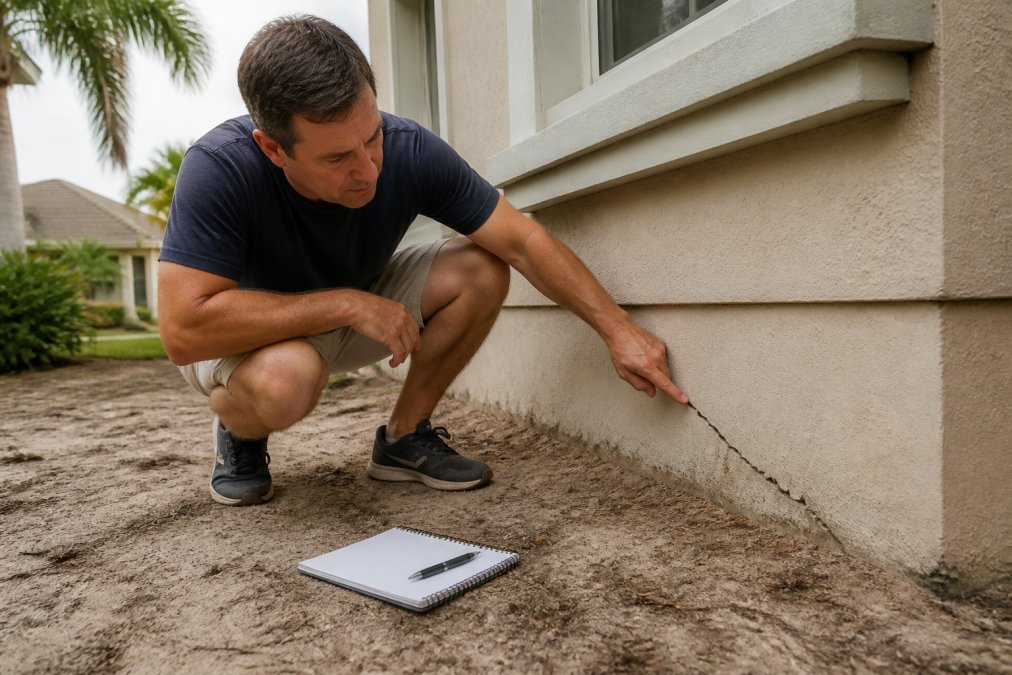
- Check interior walls and ceilings for new cracks.
- Look at doors and windows for sticking or misalignment.
- Inspect the exterior foundation for diagonal cracks.
- Scan the yard for depressions or soft spots.
- Trace where stormwater flows after rain.
- Note any fence posts, trees, or poles that lean.
- Measure and date every crack you find.
Interior Warning Signs: Foundation Cracking, Nail Popping, and Slanted Floors
The first clues usually show up inside. Foundation cracking along walls and ceilings is the classic sign, especially stair-step cracks in block walls.
Watch for:
- Cracks wider than a credit card
- Doors or windows that stick in one season and not another
- Floors that feel soft or springy
- Cabinets pulling away from walls
Exterior Warning Signs: Depression, Fissures, and Stormwater Runoff Changes
Outside, the ground tells the story. A circular depression in the yard, even a shallow one, deserves attention. So do fissures: cracks in the soil, driveway, or pool deck.
Look for:
- A sunken area near the foundation
- Cracks in the driveway or sidewalk
- Fence posts or trees that suddenly lean
- Water pooling where it never did before
Signs of Foundation Settlement vs Sinkhole: How to Tell the Difference
The signs of foundation settlement vs sinkhole damage look similar at first, but they behave differently. Settlement happens when soil compresses under a home's weight, common, gradual, and often manageable. Sinkhole activity is driven by soil washing into an underground void, so it tends to be sudden and localized.
| Feature | Foundation Settlement | Sinkhole Activity |
|---|---|---|
| Speed | Slow, over years | Sudden or rapid |
| Pattern | Even, widespread | Localized, one area |
| Ground signs | Minor cracks | Depression, fissures |
| Doors/windows | Stick slightly | Jam or fail to close |
| Best next step | Monitor and repair | Professional evaluation |
Geotechnical Sinkhole Testing: What Professionals Look For
Geotechnical sinkhole testing uses instruments to map what's happening below the surface, since a trained eye can't see underground voids. Three methods do most of the work.
Ground-Penetrating Radar, Soil Borings, and Resistivity Surveys
Ground-penetrating radar sends radio waves into the ground and reads the echoes, spotting voids, density changes, and buried debris without digging.
| Method | What It Finds | Best For |
|---|---|---|
| Ground-penetrating radar | Voids, density changes | Fast, non-invasive scan |
| Soil borings | Soil type, compaction | Confirming conditions |
| Resistivity surveys | Water, loose zones | Mapping underground water |
Is Sinkhole Repair Covered by Homeowners Insurance?
This is the question most homeowners ask second, right after "is that a sinkhole?" Coverage depends on your policy form, deductible structure, and state insurance code, none of which you can eyeball from the yard.
Why Standard Policies Often Exclude Sinkhole Damage
Most unendorsed homeowners policies treat earth movement, earthquakes, landslides, settlement, and sinkhole collapse, as an exclusion, so a policy that pays for a burst pipe may deny a claim for a floor that dropped two inches overnight.
Sinkhole coverage is usually added one of three ways:
- A separate endorsement attached to the base policy, with its own premium
- A statutorily required offer in states that mandate insurers make sinkhole coverage available
- A stand-alone policy written specifically for the peril
The Deductible Trap
Sinkhole deductibles are frequently a percentage of the dwelling's insured value rather than a flat dollar amount. A 10% deductible on a home insured for $300,000 means $30,000 out of pocket before the insurer pays a dollar, which changes the math on filing at all.
Ask your agent three questions in writing:
- Is sinkhole coverage on my policy, and is it an endorsement or a stand-alone?
- Is my sinkhole deductible a flat amount or a percentage of dwelling coverage?
- Does the policy require a professional geological report before it will open a claim?
How to Document Damage for an Adjuster
Insurers deny claims for lack of proof far more often than for lack of coverage. Build the file before you call.
- Date-stamped photographs of every crack, depression, and misaligned door, taken with a ruler or coin for scale
- A crack log with width measurements taken at the same marked points every two to four weeks
- A written timeline of when each sign first appeared and what the weather was doing that week
- Receipts and reports from any engineer, geologist, or contractor who has already looked at the property
- Your policy declarations page with the sinkhole endorsement highlighted
State Law Changes the Answer
Sinkhole insurance is regulated at the state level, and rules vary enough that advice from two states away may not apply. Some states require insurers to offer sinkhole coverage and set minimum claim standards; others leave it to the market, and a few require a licensed professional, often a geologist or professional engineer, to confirm the sinkhole before a claim proceeds.
What to Do If Your Claim Is Denied
A denial is not always final. Common grounds include the earth-movement exclusion, failure to meet the policy's sinkhole definition, or insufficient documentation. You can request the policy language the insurer relied on, submit a supplemental report from an independent professional engineer, and file a complaint with your state insurance regulator.
State insurance department consumer guides and complaint portals
The Bottom Line
Find your policy, read the exclusions section, and get the three answers above from your agent in writing. Then start the photo log today, the documentation you build now is the claim file you'll need later, whether or not you ever file.
DIY vs. Professional: What You Can Check Yourself and When to Call an Expert
There is a real line between monitoring and panicking, and most homeowners cross it in the wrong direction, either ignoring a growing crack for a year or calling an engineer over a hairline shrinkage crack in new drywall.
What You Can Safely Do Yourself
Self-inspection is about observation and record-keeping, not diagnosis. You are building a timeline, not reaching a conclusion.
- Measure crack widths at marked points with a tape measure or crack gauge, and record the number and date
- Photograph the same locations on a fixed schedule, every two weeks is a common interval
- Test doors and windows monthly and note any change in how they close
- Walk the yard after rain and note where water pools or the ground feels spongy
- Check the exterior foundation line for new diagonal or stair-step cracks
When Monitoring Is Enough
Monitoring is the right call when a sign is stable, cosmetic, and explainable by something other than soil movement:
- A hairline crack that has not changed width in three months of measurement
- Seasonal door sticking that appears in humid months and resolves in dry ones
- Minor settlement cracks in a home less than two years old, which is common as backfill consolidates
- A single shallow depression in a garden bed that holds water but shows no cracking nearby
When to Call a Professional
Call a licensed professional engineer or geotechnical firm when any of these are true:
- A crack widens measurably between two readings, even an eighth of an inch over a month matters
- A depression appears suddenly or deepens noticeably, especially near the foundation
- Doors or windows jam in a way they did not before, particularly over days rather than seasons
- A fence post, tree, or utility pole leans or drops without an obvious cause
- You can see the bottom of a void or a hole opens in the ground
- Damage appears after heavy rain following a dry spell, which is a classic trigger pattern
- Your insurer requires a professional report before it will process a claim
When It Is an Emergency
Some situations do not wait for a scheduled appointment. Treat these as immediate safety issues:
- A hole or void has opened in the ground near the home, driveway, or utility lines
- The structure is visibly tilting, or you can see daylight through a new gap
- A wall, floor, or ceiling has cracked suddenly and widely
- You smell gas, see a broken utility line, or notice water main damage near a depression
- A vehicle, deck, or outbuilding has partially dropped
What a Professional Evaluation Actually Involves
Knowing the process helps you judge a quote. A legitimate evaluation includes a site visit, a review of your documentation, at least one non-invasive subsurface method, and a written report with findings and recommendations. Ask for the report in writing and confirm the evaluator's credentials, in most states, a licensed professional engineer or geologist.
The Practical Rule
If a sign is stable, cosmetic, and measurable, monitor it. If it is growing, sudden, or accompanied by ground movement, it belongs to a professional. If it threatens safety or utilities, it is an emergency. When in doubt, document first and call second, your records make the professional's job faster and your insurance file stronger.
Preventative Maintenance and Regional Risk: Protecting Your Foundation Long-Term
Prevention beats repair every time, and the steps cost far less than fixing a failed foundation.
Keep water away from your home:
- Clean gutters so runoff flows away
- Extend downspouts several feet from the foundation
- Fix leaks in irrigation and plumbing
- Avoid over-watering near the slab
Frequently Asked Questions
How do you know when a sinkhole is coming?
There is no single early warning that a sinkhole is about to open, but clusters of signs matter. Watch for new foundation cracking, doors that suddenly stick, windows that no longer close flush, and small circular depressions in the yard. Fissures in driveways or pool decks and tilting fence posts also point to soil instability. If you notice two or more of these at once, treat it as sinkhole activity until a geotechnical evaluation says otherwise.
Does homeowners insurance cover a sinkhole on your property?
Coverage depends on your policy and your state. In Florida, insurers must offer sinkhole coverage, but it is often added as an endorsement rather than included in a standard policy. Some policies only cover catastrophic ground collapse, not the slower settlement that precedes it. Review your declarations page, document all damage with photos and dates, and contact your insurer before hiring a contractor so the claim process stays clean.
Is there a way to detect sinkholes before they open?
Yes. Geotechnical sinkhole testing can find underground voids before the surface collapses. Ground-penetrating radar, soil borings, and resistivity surveys map changes in soil density and moisture. These methods are most useful when you already see surface clues like foundation cracking or depression. A licensed geotechnical engineer interprets the results and can recommend stabilization, such as polyurethane injection, before damage spreads.
Who should I contact if I suspect sinkhole activity?
Start by contacting your homeowners insurance company to open a claim and ask about their preferred evaluation process. Then hire a licensed geotechnical engineer or a foundation specialist experienced with karst topography to perform an on-site assessment. Avoid signing with a repair contractor before the cause is confirmed, because settlement from clay soil and true sinkhole activity need different fixes. Keep all reports and photos for your records.
Catching sinkhole activity early is the difference between a small fix and a major structural repair. Florida Foundation Repair offers free emergency structural evaluations and non-invasive polyurethane injection engineered for the state's karst geology. Every job is backed by a limited lifetime warranty and handled by licensed, insured experts. Schedule a structural evaluation with Florida Foundation Repair and protect your foundation before the next rainy season.