 how-to
Hydrostatic Pressure Foundation Damage and How to Fix It
Last Updated: October 27, 2026
Quick Summary
You fix hydrostatic pressure foundation damage by moving water away from the foundation first, using soil regrading, downspout extensions, and clear gutters, then adding drainage such as an exterior French drain or an interior perimeter drain with a sump. Bowing walls and horizontal cracks need a structural repair, not drainage alone.
- Hydrostatic pressure pushes inward from every side, and the base of the wall takes the hardest hit.
- Signs include efflorescence, damp wall bases after rain, and cracks wider at one end.
- Start with grading, gutters, and downspout extensions for damp wall bases after heavy rain.
- Water at the wall-floor joint during wet seasons usually calls for an interior perimeter drain with a sump.
- Call a professional for bowing walls, cracks wider than a hairline, or water that returns after every storm.
Table of Contents
- What Hydrostatic Pressure Does to a Foundation
- Signs of Hydrostatic Pressure Damage in a Basement
- How to Reduce Hydrostatic Pressure Around a Foundation
- Foundation Drainage Solutions That Move Water Away
- Foundation Waterproofing Methods for Wet Walls
- Polyurethane Injection Foundation Repair for Cracked Walls
- Step-by-Step Repair Sequence and When to Call a Professional
- Schedule a Structural Evaluation Before the Next Storm Season
- Frequently Asked Questions
What Hydrostatic Pressure Does to a Foundation
Hydrostatic pressure is the force that water in saturated soil pushes against anything holding it back, and against a foundation it pushes inward from every side. Poured concrete walls can bow inward, hairline cracks can widen, and basement floors can heave upward. The soil around a foundation is not solid ground. It is a sponge, and when that sponge fills, the water has nowhere to go but against your walls.
How Groundwater and Saturated Soil Build Pressure
Water tables rise after heavy rainfall. Soil that normally drains slowly becomes saturated, and the spaces between soil particles fill with water. That water carries weight. As the water table climbs above your footing, the pressure on your foundation walls increases with depth, so the base of the wall takes the hardest hit. Clay-heavy soils make it worse because they hold water instead of letting it pass. The pressure builds quietly over days, then releases as cracks, seepage, and wall movement. Storm season compresses months of this into weeks.
Signs of Hydrostatic Pressure Damage in a Basement
The telltale signs of hydrostatic pressure are water seeping through wall cracks, white chalky stains on concrete, damp walls near the floor, and cracks that run horizontally or diagonally. Bowing walls and a basement floor that feels uneven point to the same cause. Water finds the weakest point and works at it.
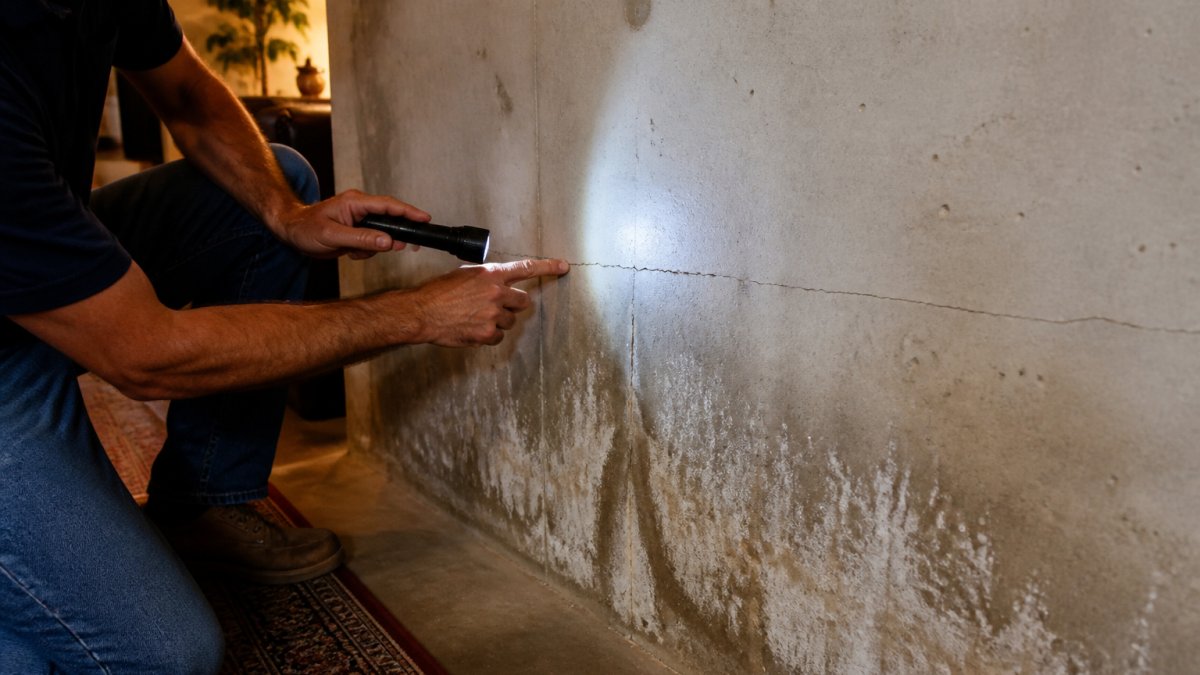
Watch for these signals:
- White powder or crust on concrete walls, called efflorescence
- Damp patches low on the wall after rain
- Cracks wider at one end than the other
- Walls that lean inward at the top
- Musty smells that return each summer
Telling Hydrostatic Pressure Apart From Plumbing Leaks and Condensation
A plumbing leak may show up in one spot, while condensation can bead on cold surfaces. Hydrostatic pressure may follow rainfall and leave mineral stains. These signs alone do not establish the source of water.
How to Reduce Hydrostatic Pressure Around a Foundation
You reduce hydrostatic pressure by getting water away from the foundation before it soaks in. Soil grading, downspout extensions, and clear gutters do more than most homeowners expect. The goal is simple: slope the ground so water runs off, and give roof water a path far from the walls. According to FEMA guidance on foundation drainage, proper surface drainage is a first line of defense against water intrusion. Regrade soil so it falls away from the house, extend downspouts several feet from the wall, and fix low spots where water pools.
Foundation Drainage Solutions That Move Water Away
Drainage is the first line of defense because it removes water before it can load the soil against your walls. Different drainage systems intercept water at different points in its path toward the foundation. The appropriate approach depends on where the water is coming from.
| Solution | Where It Intercepts Water | Best For | Relative Cost | Effort |
|---|---|---|---|---|
| Soil regrading | Surface runoff before it soaks in | Mild seepage, low spots, negative slope toward the house | Low | Low |
| Downspout extensions and gutter work | Roof water at the discharge point | Roof runoff dumping near the wall | Low | Low |
| Surface swales and yard drains | Sheet flow across the yard | Yards that pool or slope toward the foundation | Low to moderate | Moderate |
| Exterior perimeter French drain | Groundwater in the soil outside the footing | Saturated soil, high water table, repeated exterior seepage | Moderate to high | High (excavation) |
| Interior perimeter drain with sump | Water that has already entered the basement | Chronic seepage at the wall-floor joint, active water entry | Moderate | Moderate |
| Sump pump alone | Collected water in a pit or basin | Active water entry where a collection point exists | Low to moderate | Low to moderate |
How Each Drainage Layer Works
Surface grading and downspouts. Soil grading and downspouts can direct water away from the foundation. Clogged gutters can send roof water down the wall.
Exterior perimeter drains. A French drain is a drainage method used to collect and redirect groundwater. Its suitability depends on site conditions.
Interior perimeter drains. An interior drain is a drainage method intended to manage water at the wall-floor joint.
Sump pumps. A sump pump is used to remove collected water.
Choosing by Symptom and Severity
Water patterns can be one consideration when evaluating drainage options:
Schedule Structural Evaluation →
- Damp wall base only after heavy rain, no standing water: start with grading, gutters, and downspout extensions; escalate to an exterior drain if it persists.
- Water at the wall-floor joint during wet seasons: an interior perimeter drain with a sump is usually the right fit.
- Standing water on the floor or a sump that runs constantly: size the pump and basin to the inflow, and confirm the discharge line is not recycling water.
- Bowing walls or horizontal cracks: drainage alone will not correct structural movement; pair drainage with a structural repair.
What Drives the Cost
Drainage estimates can depend on project scope and site conditions. Ask for the scope and warranty terms in writing.
Foundation Waterproofing Methods for Wet Walls
Waterproofing methods address water at or through a wall. The appropriate approach depends on the wall and the source of moisture.
Match the Method to the Wall and the Symptom
| Method | How It Works | Best For | Limits |
|---|---|---|---|
| Exterior membrane | Sheet or fluid-applied barrier on the outside face of the wall | Poured concrete or block walls with exterior access | Requires excavation; highest cost and disruption |
| Interior sealants and coatings | Surface coating that resists moisture migration | Damp walls, minor vapor transmission | Manages moisture; does not block active flow |
| Crystalline coating | Crystals grow into concrete pores and capillaries to resist water passage | Poured concrete walls with dampness | Needs a clean, sound substrate; not a crack filler |
| Crack injection (polyurethane or epoxy) | Resin fills and seals a crack from inside | Non-moving cracks in poured concrete | Moving or structural cracks need reinforcement, not just filling |
| Polyurethane injection for voids and soil | Expanding resin fills voids and stabilizes surrounding soil | Voids, loose soil, slab and wall movement | Requires diagnosis of the void location |
How to Tell Which One You Need
- Water at the cove joint rather than through the wall: the problem is collection, not the wall face, so an interior drain is the better spend.
Verify the Repair Worked
After waterproofing work, you can recheck the same spots for new efflorescence or damp patches. If water returns, seek an evaluation.
The U.S. Environmental Protection Agency notes that controlling moisture at the source protects indoor air quality and structural materials. That is why waterproofing and drainage are evaluated together: one blocks water at the wall, the other keeps water from loading the soil in the first place.
Polyurethane Injection Foundation Repair for Cracked Walls
Florida Foundation Repair offers non-excavative polyurethane injection technology, engineered for Florida's karst geology, for soil stabilization and structural lift. The company states that the work can restore load-bearing capacity and create a waterproof barrier with minimal disruption. If you are weighing this against older methods, see how polyurethane injection compares with concrete underpinning. Homeowners often ask whether the fix lasts; our guide on whether polyurethane foundation repair is permanent answers that directly. And if you are wondering how messy polyurethane foundation injection really is, the short answer is: far less than excavation.
Step-by-Step Repair Sequence and When to Call a Professional
Here are general steps to consider, from first sign to final check:
- Document the damage. Photograph cracks, stains, and damp spots. Note when they appear.
- Get a professional assessment. A structural evaluation can help assess the property.
- Choose the repair. Consider the assessment and foundation type.
Call a professional when you see bowing walls, cracks wider than a hairline, doors that stick suddenly, or water that returns after every storm. Those point to structural movement, not a simple leak. If you are unsure whether your situation is urgent, our guide on when to request an emergency structural evaluation walks through the warning signs. The American Society of Civil Engineers maintains standards that guide structural assessments, and a qualified inspector applies them.
Schedule a Structural Evaluation Before the Next Storm Season
Florida Foundation Repair offers emergency structural evaluations, non-excavative polyurethane injection engineered for Florida's karst geology, and a limited lifetime warranty. The company is licensed and insured in Florida (CGC# 1526152). Schedule your structural evaluation.
Frequently Asked Questions
What is hydrostatic pressure, and how can it damage a foundation?
Hydrostatic pressure is the force water exerts against a surface when it builds up in saturated soil. After heavy rainfall or a rising water table, groundwater can exert pressure against foundation walls and basement floors. A professional evaluation can assess whether water pressure is contributing to observed foundation concerns.
Can hydrostatic pressure cause foundation cracks?
Hydrostatic pressure can be a concern when foundation cracks are present, but crack appearance alone does not establish the cause or severity. A professional evaluation can assess the condition and appropriate next steps.
Is interior or exterior waterproofing better for hydrostatic pressure?
Exterior and interior waterproofing approaches differ. The appropriate option depends on the property and the source of water; a professional evaluation can help assess the situation.
Can polyurethane injection repair hydrostatic pressure foundation damage?
Florida Foundation Repair offers non-excavative polyurethane injection technology for soil stabilization and structural lift. The company states that the work can restore load-bearing capacity and create a waterproof barrier with minimal disruption. A structural evaluation can assess whether this approach is suitable for the property.
Water always finds the weakest point, and it will keep finding it until you fix the cause. A structural evaluation tells you exactly what you are dealing with, and a targeted repair protects your foundation for the long run. Florida Foundation Repair brings permanent soil stabilization, structural lift, and a waterproof barrier with minimal disruption to your property. Get started with Florida Foundation Repair and schedule your structural evaluation today.