 comparison
Polyurethane Injection vs Concrete Underpinning
Table of Contents
- Polyurethane Injection vs Concrete Underpinning: A Side-by-Side Comparison
- How Each Method Works: Resin Injection vs Footing Extension
- Concrete Underpinning Process: Excavation, Piers, and Load Transfer
- Polyurethane Injection Disadvantages and Limitations
- Polyjacking vs Mudjacking: Which Lifting Method Fits Your Slab?
- Polyurethane Foundation Repair Cost and Lifecycle Value
- Where Each Method Wins: Suitability by Soil and Structure
- Conclusion: Matching the Repair to the Diagnosis
- Frequently Asked Questions
Last Updated: October 5, 2026
Polyurethane Injection vs Concrete Underpinning: A Side-by-Side Comparison
Polyurethane injection vs concrete underpinning is the decision that separates a leveling job from a structural repair, and choosing wrong wastes money either way. Polyurethane injection is a non-excavative method that pumps expanding resin through drilled holes to fill voids and lift settled slabs. Concrete underpinning is a construction method that excavates beneath a footing and extends it down to a deeper bearing layer. At Florida Foundation Repair, we evaluate both approaches daily across the state's karst geology, and the honest answer is that they solve different problems.
The distinction matters because the two methods are often marketed as interchangeable. They are not. One restores the ground beneath a slab; the other rebuilds the load path beneath a footing.
FEMA guidance on foundation repair after ground movement
Quick Comparison Table
| Factor | Polyurethane Injection | Concrete Underpinning |
|---|---|---|
| Excavation required | None | Yes, to footing depth |
| Typical access | Small drilled holes | Full perimeter access |
| Primary purpose | Lift slab, fill voids, densify soil | Extend footing to bearing layer |
| Disruption | Minimal, same-day use | Days to weeks |
| Best for | Settlement depth under 2 inches | Deep settlement, structural movement |
| Soil suitability | Granular, void-prone soils | Weak or compressible soils |
| Structural repair | No | Yes |
How Each Method Works: Resin Injection vs Footing Extension
Resin injection and footing extension operate on completely different principles, which is why comparing them by price alone leads to bad decisions. The clearest way to see the difference is to ask what each method is actually restoring: the ground beneath the slab, or the load path beneath the footing.
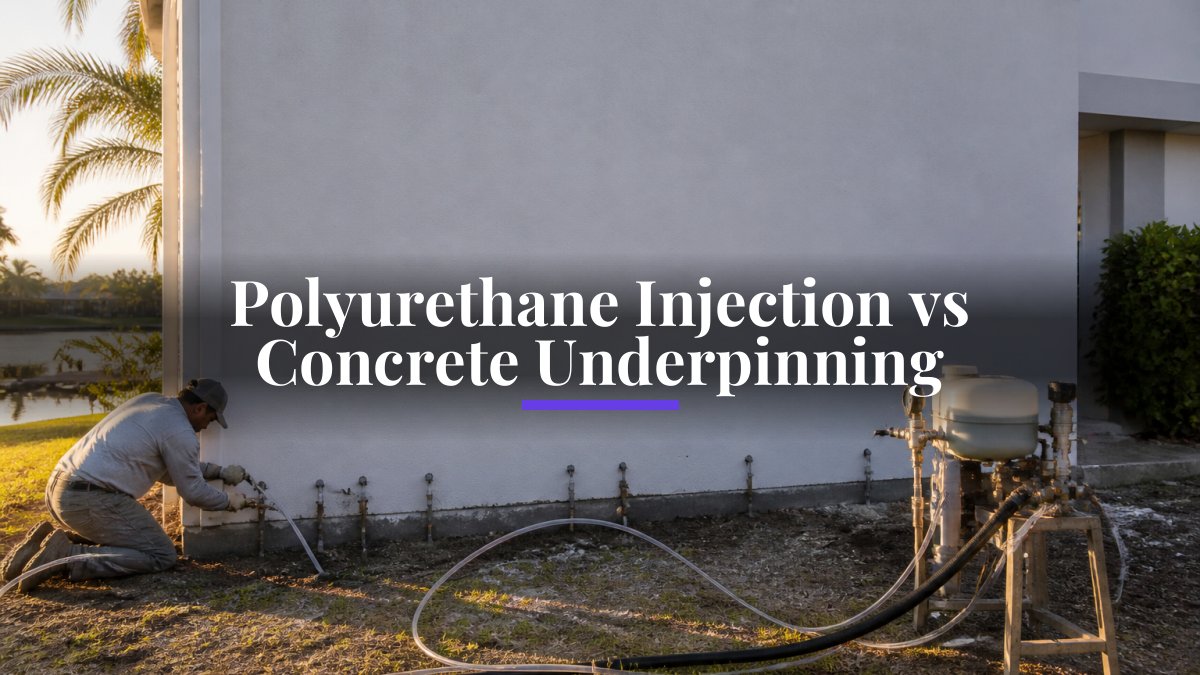
Polyurethane injection restores the ground. Crews drill ports roughly the diameter of a coin through the slab, typically on a grid spaced a few feet apart, and inject a two-part expanding resin. The foam reacts in seconds, expands many times its liquid volume, and does three things in sequence: it fills voids left by soil loss or erosion, it densifies loose granular soil by compacting it against the surrounding mass, and it lifts the slab as it cures. The footing itself never moves. The slab is re-supported by the soil directly beneath it.
Concrete underpinning restores the load path. Crews excavate access pits alongside the foundation down to or below the existing footing, then install new supports, poured mass concrete, driven or helical steel piers, or a beam-and-base system, that reach a deeper, more competent bearing stratum. The structural load is transferred from the shallow footing onto those new elements. The soil directly under the slab is left largely untouched.
That difference produces a hard rule of thumb practitioners use:
- If the slab has settled but the footing is still bearing on competent soil, the problem is the ground under the slab, injection addresses it.
- If the footing itself has lost bearing, is rotating, or is stepping down, the problem is the load path, only underpinning restores it.
- If both are true, injection alone will mask the symptom and the footing will keep moving.
FEMA guidance on foundation repair after ground movement
Concrete Underpinning Process: Excavation, Piers, and Load Transfer
The concrete underpinning process follows a fixed sequence: excavate, install, transfer, and cure. Crews dig access pits down to the footing, then either pour mass concrete beneath it, drive steel piers to a load-bearing stratum, or use a beam-and-base system. Each pier or pad is loaded incrementally so the structure settles onto the new support. The footing is then extended and the excavation backfilled.
Access requirements drive much of the cost and timeline. Crews need room to dig alongside the foundation, which rules out many interior slabs and tight property lines. Expect disruption measured in days or weeks, not hours.
Polyurethane Injection Disadvantages and Limitations
Polyurethane injection disadvantages are real and worth stating plainly. The method lifts and stabilizes, but it does not extend a footing, so it cannot fix a load-bearing structure that has lost its bearing layer. It also has a practical ceiling on settlement depth: heavily settled slabs may exceed what injection can safely raise.
Other limits to weigh:
- Not a substitute for structural underpinning on failed footings
- Requires competent soil and void space to fill; solid rock offers little to densify
- Lift capacity is finite, so deep settlement may need staged or alternative repair
- Results depend heavily on the operator's diagnosis, not just the material
None of this makes injection a weak option. It makes it a specific one. American Society of Civil Engineers on foundation performance
Polyjacking vs Mudjacking: Which Lifting Method Fits Your Slab?
Polyjacking vs mudjacking comes down to material weight and cure behavior. Mudjacking pumps a cement slurry under the slab, which is heavy, slow to cure, and adds load to already weak soil. Polyjacking uses expanding polyurethane foam that is lightweight, cures in minutes, and does not add significant weight to the soil profile.
Schedule Structural Evaluation →
For slabs on void-prone or weak soil, polyjacking is usually the better fit because the foam densifies rather than burdens. Mudjacking still works for simple, shallow leveling on stable ground.
| Method | Material | Cure Time | Added Load |
|---|---|---|---|
| Polyjacking | Expanding polyurethane foam | Minutes | Minimal |
| Mudjacking | Cement slurry | Hours to days | Significant |
Polyurethane Foundation Repair Cost and Lifecycle Value
Polyurethane foundation repair cost depends on project scope, not a flat rate, so any quote given before an on-site evaluation is a guess. What you can do is force every bid into the same itemized format so the numbers are actually comparable. Ask for these line items in writing:
- Diagnosis basis, settlement depth measured in inches, soil profile, and whether the footing is confirmed sound.
- Injection scope, number and spacing of ports, estimated resin volume, and lift target.
- Underpinning scope, number of piers, pier type (poured, driven, or helical), depth to bearing stratum, and load rating per pier.
- Access and restoration, excavation, backfill, landscaping, and interior floor repair.
- Monitoring and follow-up, post-repair elevation readings and any re-leveling allowance.
- Warranty terms, what is covered, for how long, and whether it transfers if you sell.
A single lump-sum number hides exactly what you are buying. Two bids that look similar on the bottom line can differ by thousands once scope and warranty are unpacked.
Lifecycle is where the comparison gets honest. Injection is faster, needs no excavation, and lets you use the slab the same day, so the direct and indirect costs are lower. But it is a ground-treatment method: if the underlying soil condition keeps changing, the slab can move again, and the repair may need to be revisited. Underpinning costs more upfront and disrupts the property longer, but it transfers load to a stratum that is not subject to the same shallow soil movement, so it is generally the more durable answer where the footing is the problem.
The right question is not which method is cheaper. It is which method stops the movement you actually have, and what the cost of a second repair looks like if you choose wrong.
Where Each Method Wins: Suitability by Soil and Structure
Suitability by soil and structure decides the method, not preference. Polyurethane injection wins on granular, void-prone soils where a slab has settled shallowly and the footing is still sound. It is also the right call when access is tight, disruption must stay minimal, or you need a waterproof barrier against moisture.
Concrete underpinning wins when settlement is deep, the footing has lost its bearing layer, or structural movement threatens the load-bearing structure. On weak, compressible soil with ongoing settlement, piers reach a stable stratum that injection cannot create.
Conclusion: Matching the Repair to the Diagnosis
The hardest part of this decision is not choosing a method; it is getting an honest diagnosis first. Settlement depth, soil conditions, and whether the footing is still carrying load determine everything. Skip that step and you are guessing.
At Florida Foundation Repair, we provide free emergency structural evaluations and non-excavative polyurethane injection engineered for karst geology, backed by a limited lifetime warranty and licensed, insured crews. Schedule Structural Evaluation and match your repair to the actual diagnosis, not a sales pitch.
Frequently Asked Questions
What are the disadvantages of polyurethane injection?
Polyurethane injection cannot extend a footing or add a load-bearing pier, so it is not a structural fix for every problem. It also depends on the soil profile: if the bearing layer sits too deep, the expanding foam cannot reach it. Cracks may need separate repair, and the material must be applied by a trained crew to avoid over-lifting. It works best for slab lifting and void filling, not for replacing a failed deep foundation.
Is resin injection as good as underpinning?
They solve different problems. Resin injection lifts slabs and fills voids by expanding beneath the concrete, while concrete underpinning extends a footing down to a stronger bearing layer. For shallow settlement or slab movement, resin injection often restores level quickly. For deep foundation settlement or structural movement, underpinning transfers load to stable soil. The right choice depends on the diagnosis, not on one method being universally better.
How much does polyurethane foundation repair cost?
Pricing depends on the number of injection points, settlement depth, and site access. For an accurate quote on your property, schedule a structural evaluation so the crew can measure lift points and soil conditions.
How long does polyurethane injection take compared with concrete underpinning?
Polyurethane injection is faster because it requires only small drilled holes and no excavation. Most residential slab-lifting projects finish in a day or less. Concrete underpinning involves excavating around the footing, pouring or driving piers, and letting concrete cure, which can take several days to weeks depending on the number of piers and weather. Faster completion means less disruption to your home or business.
When is polyurethane injection appropriate for foundation repair?
It fits when the foundation has settled shallowly, when voids have formed under a slab, or when you need to relevel a concrete slab without excavation. It also works well for waterproofing and stabilizing soil around waterfront property. If the settlement is deep, the footing is failing, or the structure needs load transfer to a deeper bearing layer, concrete underpinning or piers are the better route. A structural evaluation confirms which applies.