 blog
blog
Polyurethane Injection vs Traditional Underpinning
Table of Contents
- Polyurethane Injection vs Traditional Underpinning: A Direct Comparison
- The Risks of Concrete Underpinning: Why Excavation Threatens Your Home
- Polyurethane Foam Injection Benefits: Permanent Soil Stabilization
- Foundation Repair Excavation Damage: What Contractors Don't Tell You
- Long-Term Durability and Performance: Which Method Lasts?
- Soil Compatibility and Environmental Factors
- Conclusion
- Frequently Asked Questions
Last Updated: September 12, 2026
Polyurethane Injection vs Traditional Underpinning: A Direct Comparison
Choosing between polyurethane injection vs traditional underpinning is one of the most consequential decisions a property owner can make. Polyurethane injection is a minimally invasive foundation repair method that injects expanding structural foam beneath a settled slab to fill voids, compact loose soil, and lift the structure back toward level. Traditional underpinning is the older alternative: crews excavate around the foundation and pour concrete piers or footings down to stable strata. This comparison from Florida Foundation Repair breaks down how the two methods differ in risk, timeline, durability, and long-term cost, so you can evaluate contractor proposals with a clear head.
Here's the uncomfortable truth most quotes won't tell you: excavation-based repair can leave your home in worse shape than the settlement that prompted the call.
The Risks of Concrete Underpinning: Why Excavation Threatens Your Home
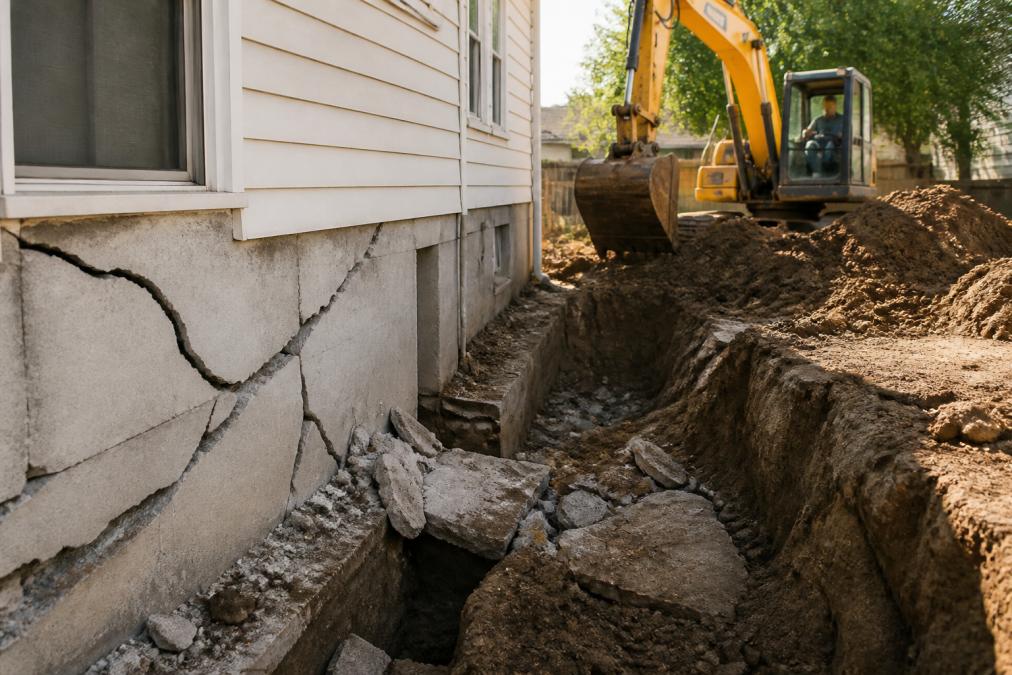
Traditional underpinning, sometimes called piering, requires digging trenches several feet deep along your foundation walls, often right beside load-bearing footings (fema.gov). That excavation removes the very soil currently supporting your home.
When crews dig adjacent to an already-settled foundation, they can trigger sudden movement. Soil that was marginally stable collapses into the trench, and the structure above loses bearing support it had been relying on. The result is often new foundation cracks, sticking doors, and cracked interior finishes that did not exist before the project started.
Consequences homeowners report include:
- New diagonal cracking in brick and drywall
- Separated patios, driveways, and walkways from the main structure
- Damaged landscaping, irrigation, and drainage systems
- Collapsed sewer or utility lines struck during digging
- Water intrusion where backfill never recompacts to original density
The FEMA guidance on foundation and soil hazards documents how adjacent excavation and soil disturbance contribute to structural movement in settled areas.
Polyurethane Foam Injection Benefits: Permanent Soil Stabilization
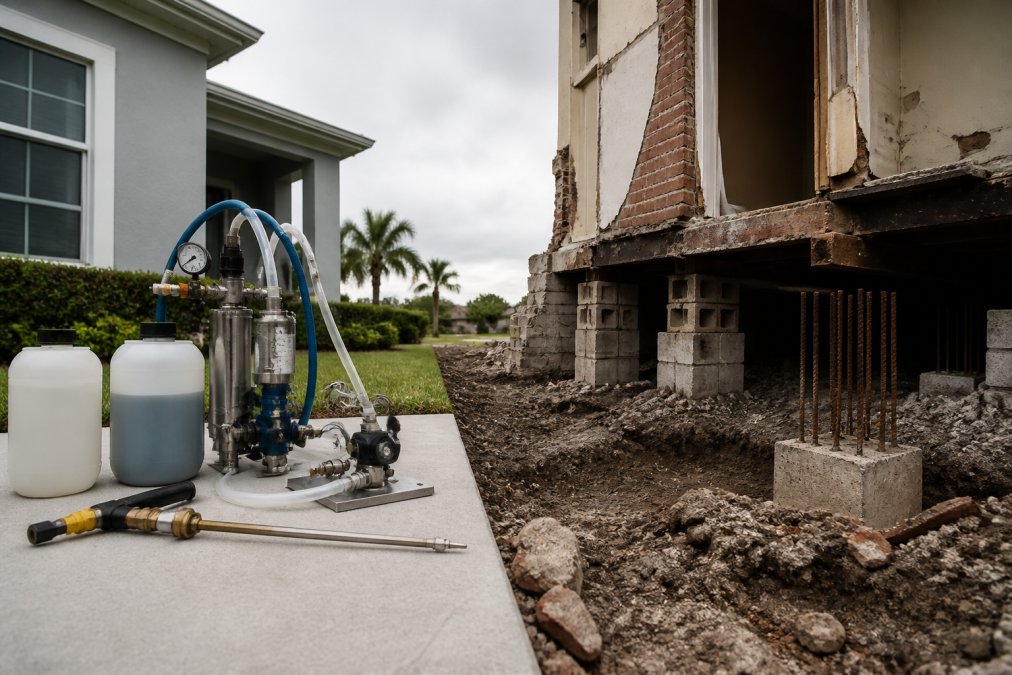
Polyurethane foam injection benefits begin with what it does not do: it does not dig. Crews drill small ports, roughly the diameter of a coin, through the slab or alongside the footing, then inject expanding structural resin at depth.
The foam fills voids, compacts loose soil, and lifts the slab as it cures. Because the material is hydrophobic, it does not absorb water or lose strength when saturated, which matters in high water-table conditions (PubMed). Expansion rate and curing time are controlled by the injection technician, so lift can be applied gradually and monitored.
Key advantages over excavation:
- Minimally invasive: no trenches, no heavy excavation equipment on your lawn
- Fast turnaround: most residential projects finish in a single day
- Immediate use: the material reaches working strength quickly, so you can walk or park on the surface soon after
- Waterproof barrier: the cured foam resists water intrusion that drives soil erosion
- Precision: laser monitoring tracks lift in real time
For homes built on karst geology, where dissolved limestone creates voids and sinkhole risk, this targeted approach stabilizes soil without opening the ground to further erosion.
Foundation Repair Excavation Damage: What Contractors Don't Tell You
Foundation repair excavation damage is the line item missing from most underpinning quotes. Trenches destabilize the soil profile, and backfill rarely returns to its original density.
What most guides miss is the second-order damage. Utility lines, irrigation, and drainage tile sit within the excavation zone. A struck sewer line or severed drain can cost more to fix than the foundation work itself. Landscaping established over decades is destroyed. And the exposed foundation wall becomes a path for water intrusion until backfill fully settles, which can take years.
Ask any contractor proposing excavation these questions before signing:
- Will you locate and mark all utilities before digging?
- How will you protect drainage and irrigation lines in the trench zone?
- What is your plan if the excavation triggers additional settlement?
- Who pays if the house shifts further during the project?
- How long until backfill reaches original density?
Long-Term Durability and Performance: Which Method Lasts?
Durability is where the two methods diverge most sharply, and where the wrong choice can leave your home in worse shape than the settlement that started the conversation. Concrete piers depend on reaching competent bearing strata. If the pier depth stops short, or if soil continues to consolidate, the pier holds while the structure keeps moving around it. Worse, the excavation required to install those piers can permanently alter the soil profile around your foundation, turning a repairable settlement problem into an ongoing structural emergency.
Polyurethane foam bonds with surrounding soil and distributes load across a wider area, which reduces point loading on the footing. Because it does not corrode, rot, or degrade with moisture, performance holds in wet conditions. The trade-off is that foam is a soil stabilization and lift solution, not a deep-load transfer system. In cases where the structure needs load carried to bedrock, a structural engineer may recommend a hybrid design.
Schedule Structural Evaluation →
How Each Method Fails
Failure scenarios matter more than marketing claims. A pier that misses bearing strata can punch through soft soil and leave the foundation unsupported. Foam injected into poorly characterized soil can migrate away from the void it was meant to fill. Most practitioners find that failures trace back to inadequate geotechnical investigation before work begins, not to the material itself.
Maintenance and Monitoring After Repair
Post-repair monitoring separates a durable fix from a temporary one. Visual inspection catches obvious cracks and sticking doors, but it misses slow settlement that has not yet surfaced. Laser leveling and periodic elevation surveys detect movement measured in fractions of an inch, long before it becomes visible damage. Homeowners who skip monitoring often discover new settlement only after it has cracked tile, drywall, and brick veneer.
Warranty and Insurance Implications
Warranties vary widely. Some contractors offer limited lifetime warranties on resin injection; others cap coverage at a few years. Insurance carriers increasingly ask whether a repair was engineered and monitored, and an unpermitted or poorly documented excavation-based repair can complicate a future claim. A documented, monitored repair supports resale value; an excavation scar with uncertain backfill density does the opposite.
| Factor | Polyurethane Injection | Traditional Underpinning |
|---|---|---|
| Excavation required | None | Extensive trenching |
| Typical project time | One day | Days to weeks |
| Impact on landscaping | Minimal | Often destroyed |
| Water resistance | Hydrophobic, waterproof | Varies by material |
| Best for | Void filling, soil stabilization, slab lift | Deep load transfer to bedrock |
| Disruption risk | Low | Moderate to high |
| Monitoring method | Laser leveling, elevation survey | Visual inspection, elevation survey |
| Common failure mode | Foam migration in poorly characterized soil | Pier misses bearing strata; excavation destabilizes adjacent soil |
Soil Compatibility and Environmental Factors
Soil type decides which method works, and this is where generic advice falls apart. Loose granular soils and voided karst limestone respond well to expanding resin, which fills irregular cavities that piers cannot reach. Expansive clay soils, common in many regions, heave and shrink with moisture cycles; foam injection can stabilize the upper profile, but deep clay movement may still require piering.
Soil-Specific Compatibility: A Technical Edge Most Guides Skip
- Sand and gravel: High permeability lets resin travel and compact efficiently. Piers can reach bearing strata, but excavation in loose granular soil is prone to collapse, a direct threat to the structure above.
- Clay: Expansive clays swell and shrink seasonally. Resin stabilizes the active zone; deep piers may be needed if movement originates below it. Excavation in clay can expose the foundation to moisture-driven heave.
- Silt: Easily eroded and prone to piping. Resin fills voids without disturbing the matrix. Trenching in silt invites washout under the footing.
- Karst limestone: Dissolution voids are irregular and unpredictable. Resin reaches cavities piers cannot. Excavation can open new pathways for erosion and sinkhole development.
- Organic or fill soils: Neither method performs well without engineered mitigation. Excavation here is especially dangerous because the soil has little bearing capacity to begin with.
A geotechnical assessment should identify:
- Soil classification and moisture behavior
- Depth to competent bearing strata
- Presence of voids, sinkholes, or eroded zones
- Water table depth and drainage patterns
Pros and Cons at a Glance
Polyurethane injection pros: minimally invasive, fast, waterproof, precise lift control, no landscaping destruction. Cons: not a deep-load transfer solution, requires accurate soil characterization, limited to certain depth ranges.
Traditional underpinning pros: can transfer load to bedrock, well understood by engineers, suitable for very deep instability. Cons: destroys landscaping and hardscape, risks utility strikes, destabilizes adjacent soil, requires weeks of disruption, and can trigger new settlement during excavation.
Property owners in waterfront or low-lying areas face additional erosion and hydrostatic pressure. In those settings, the waterproof barrier created by cured foam adds protection that excavated backfill cannot match, and the risk of trench collapse in saturated soil is significantly higher.
Conclusion
The choice between polyurethane injection vs traditional underpinning comes down to risk tolerance and soil conditions. Excavation-based repair carries real potential to destabilize an already-settled foundation, destroy landscaping, and damage utilities, while modern resin injection stabilizes soil through small ports with minimal disruption.
Florida Foundation Repair specializes in non-excavative polyurethane injection engineered for karst geology, backed by a limited lifetime warranty and licensed, insured crews (CGC# 1526152). We offer free emergency structural evaluations and use laser monitoring to verify lift in real time.
Get started with Florida Foundation Repair and schedule a structural evaluation before you commit to any method that requires digging beside your home.
Frequently Asked Questions
What are the disadvantages of polyurethane injection?
Polyurethane injection requires precise application and may not be suitable for all soil types. It works best in granular soils and is less effective in highly organic or saturated clays. However, for most residential applications, it offers a minimally invasive alternative to traditional underpinning. Unlike concrete underpinning, it does not require heavy excavation, reducing damage to your landscaping and foundation. The main limitation is that it cannot address very deep foundation issues where bedrock is far below the surface.
Is resin injection cheaper than underpinning?
Pricing depends on project specifics like soil conditions, foundation depth, and accessibility. For an accurate quote tailored to your property, schedule a structural evaluation with a licensed foundation repair specialist. They can assess your specific situation and provide a detailed comparison of both methods.
How does polyurethane injection prevent the soil instability that leads to foundation failure?
Polyurethane injection stabilizes soil by expanding and filling voids, compacting loose soil, and creating a waterproof barrier. The two-part resin reacts and expands rapidly, increasing load-bearing capacity and lifting settled foundations. This process addresses the root cause of settlement: soil erosion and void formation. By injecting at strategic depths, the foam creates a stable base that supports your foundation. It also repels water, preventing future erosion from hydrostatic pressure. This method is particularly effective in karst geology where sinkholes are a risk.
Can traditional underpinning cause secondary damage to my property's landscaping and interior?
Yes, traditional underpinning often causes significant secondary damage. The excavation process disturbs landscaping, destroys driveways, and can crack interior walls due to vibration. Heavy equipment compacts soil around the work area, potentially affecting nearby utilities. In contrast, polyurethane injection leaves your lawn, patio, and interior finishes largely untouched. There is no heavy machinery, no spoils to haul away. This makes it a preferred choice for sensitive landscapes.