 blog
blog
Helicon vs Solid Foundations: Foundation Repair Comparison
Table of Contents
- Helicon vs Solid Foundations: Service Overview and Approach
- Foundation Repair Methods: How Each Contractor Stabilizes Soil
- Comparing Foundation Repair Estimate Methodology and Pricing Factors
- Foundation Repair Warranties: Coverage, Duration, and What's Protected
- Foundation Repair Contractor Questions You Should Ask
- Licensing, Insurance, and Contractor Credentials
- Which Contractor Is Right for Your Foundation Problem
- Frequently Asked Questions
Last Updated: October 11, 2026
Helicon vs Solid Foundations: Service Overview and Approach
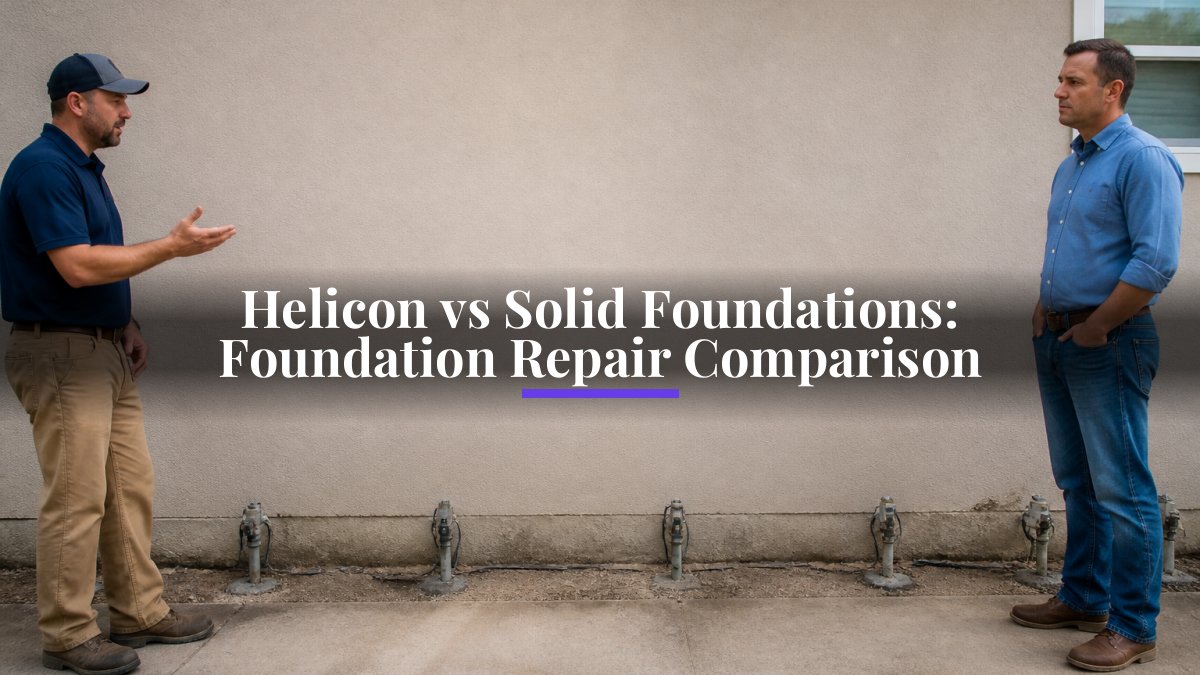
When your foundation starts settling or showing signs of stress, a foundation repair comparison between contractors can mean the difference between a permanent fix and a temporary patch that fails in five years. A foundation repair comparison between major providers like Helicon and Solid Foundations reveals significant differences in methodology, warranty coverage, and approach to stabilization.
Foundation Repair Methods: How Each Contractor Stabilizes Soil
The stabilization method chosen determines whether your repair addresses the root cause or merely masks the symptom.
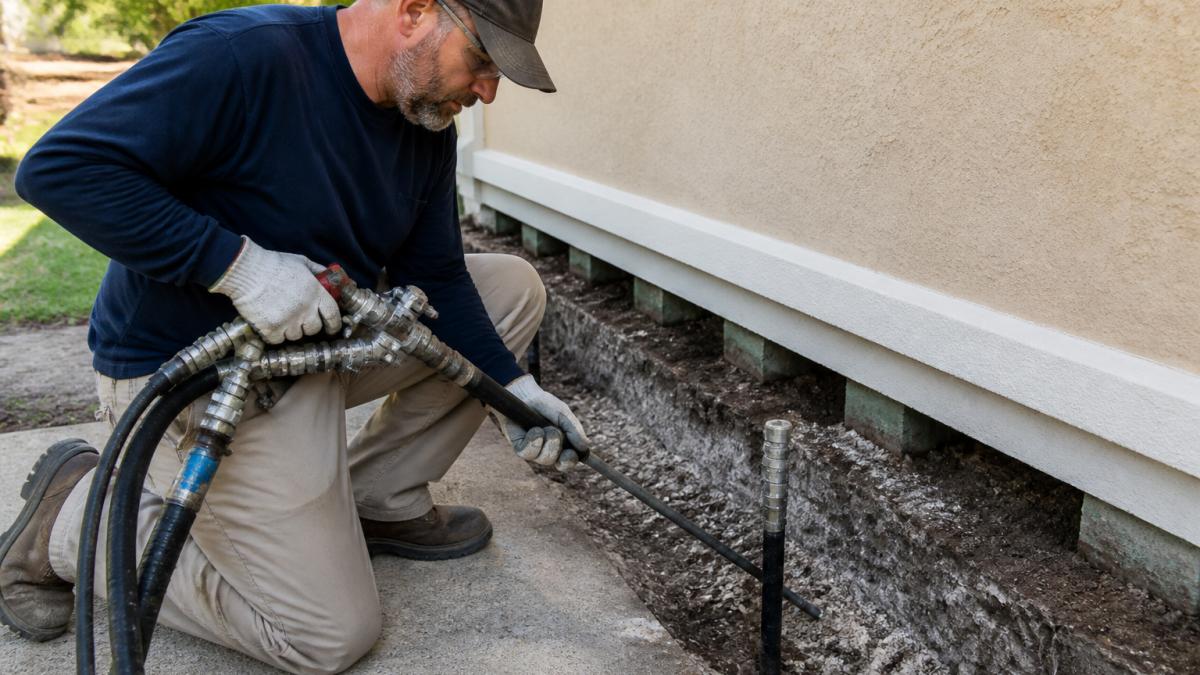
Helical Piers and Underpinning (Helicon's Primary Approach)
Helicon uses helical piers, steel shafts with helical flights twisted into the ground to depths of 20-60 feet until reaching stable bearing strata. The piers transfer the foundation's load to deeper, more stable soil or bedrock. They work best for properties with stable bedrock at accessible depth, where excavation is feasible, and for heavily loaded structures.
Slab Jacking and Concrete Leveling (Solid Foundations' Focus)
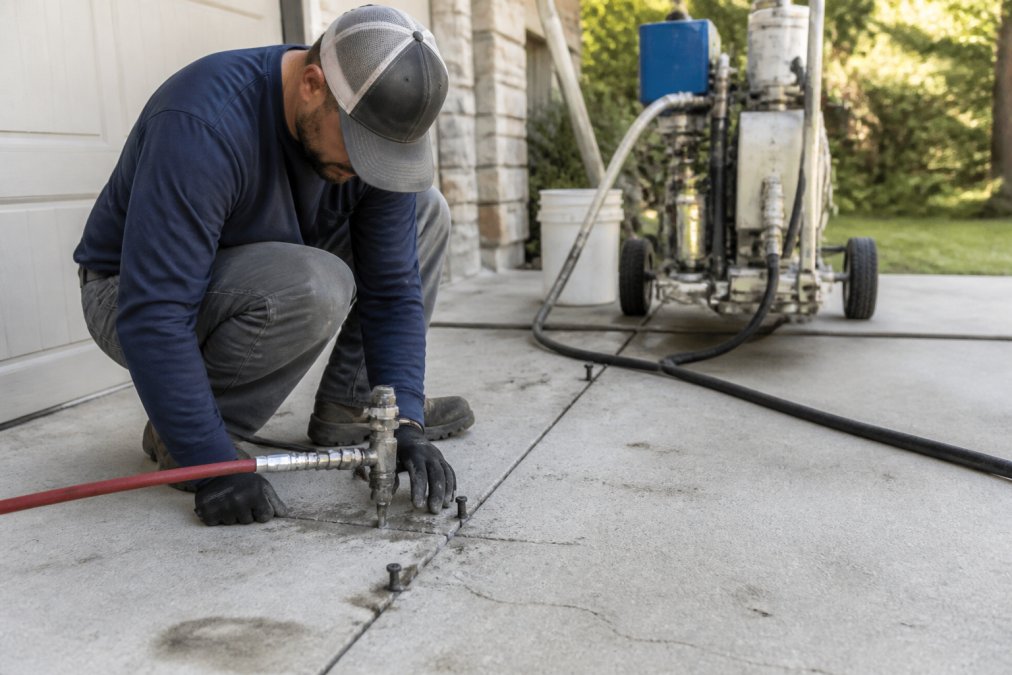
Solid Foundations uses slab jacking, injecting polyurethane foam or cement-based grout beneath settled concrete slabs through small holes to lift them back to original grade. It works best for evenly settled residential slabs on stable soil where minimal disruption is desired. Slab jacking is faster (often one day) and less invasive than pier installation. However, it restores elevation without stabilizing the underlying soil; if soil continues to fail, the slab will settle again.
Polyurethane Injection Stabilization (Non-Excavative Alternative)
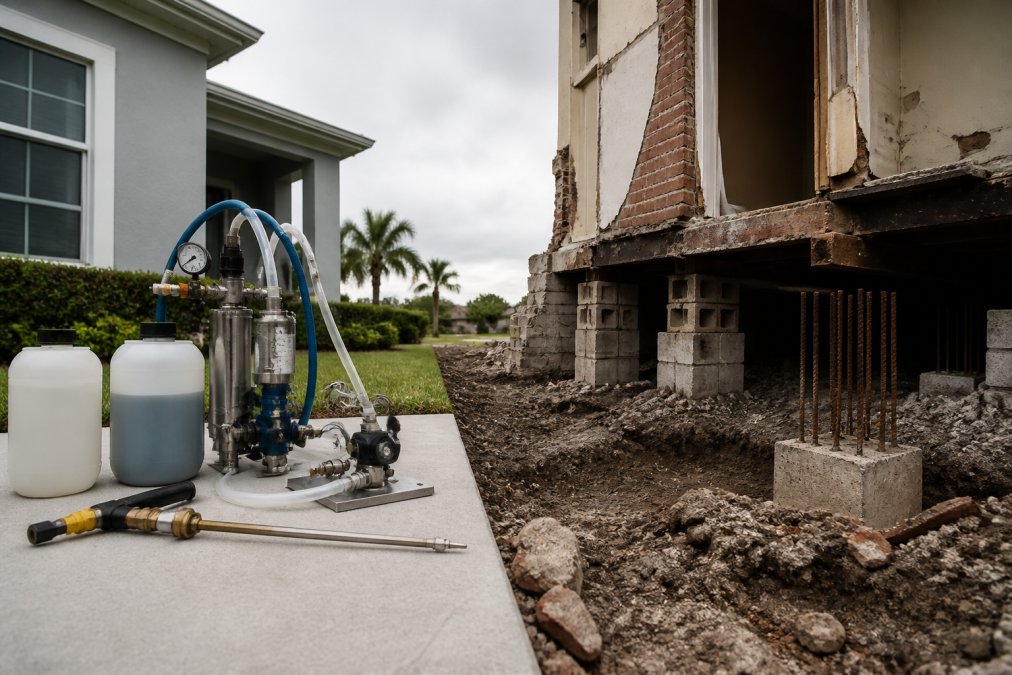
Polyurethane injection injects expanding resin directly into voids and unstable soil layers, stabilizing the soil itself rather than bridging over it. Particularly suited to karst geology (fractured limestone), it fills voids, prevents sinkhole formation, creates a waterproof barrier, and restores load-bearing capacity without excavation. It requires no heavy equipment and works in tight spaces or under occupied structures.
Choosing by Soil Type and Property Condition
Your soil type determines which method is most appropriate:
- Sandy or clay soils with stable bedrock: Helical piers are effective if bedrock is accessible at reasonable depth (under 40 feet).
- Evenly settled concrete slabs on stable soil: Slab jacking restores elevation quickly and cost-effectively.
- Karst geology, fractured limestone, or sinkhole-prone areas: Polyurethane injection stabilizes the soil itself and prevents future subsidence.
- Differential settlement (one corner lower than another): Deeper stabilization (piers or injection) is required; slab jacking alone will not resolve the underlying cause.
The best method depends on what caused settlement. Soil voids or erosion require injection-based stabilization. Inadequate soil bearing capacity requires piers. Settled slabs on stable soil require leveling. A thorough site evaluation, including soil boring, moisture analysis, and structural assessment, should precede the method recommendation.
Comparing Foundation Repair Estimate Methodology and Pricing Factors
How a contractor prices foundation repair reveals how thoroughly they've diagnosed the problem. Vague estimates or pressure to decide quickly are red flags; a professional contractor provides a detailed written estimate breaking down labor, materials, equipment, and timeline.
Helicon's Estimate Approach
Helicon bases estimates on pier count and installation depth, including structural assessment, soil boring, pier calculation, and per-pier costs. Deeper installation increases cost due to longer equipment operation and greater soil resistance.
Solid Foundations' Estimate Approach
Solid Foundations prices by square footage of concrete and material volume, including slab evaluation, depth measurement, material volume calculation, and per-square-foot pricing.
What a Detailed Written Estimate Should Include
Regardless of contractor or method, a professional estimate should itemize:
- Diagnosis summary: Soil type, bearing capacity, depth to stable strata, and the specific problem identified (settlement, void formation, erosion, etc.)
- Method justification: Why the proposed method suits your soil and property condition
- Material costs: Type and quantity of materials (piers, grout, polyurethane, brackets, etc.)
- Labor costs: Hourly rates or flat fees for installation, site preparation, and cleanup
- Equipment rental or deployment: Drilling rigs, injection equipment, compressors, etc.
- Timeline: Expected duration and any disruption to utilities, landscaping, or property access
- Warranty terms: Coverage period, what is included and excluded, and transferability to future owners
- Payment schedule: Whether payment is due upfront, upon completion, or in phases
- Contingency clause: What happens if soil conditions differ from the estimate or if additional work is discovered during repair
If an estimate omits any of these elements, ask for clarification. A contractor unwilling to provide detail is either inexperienced or unwilling to be held accountable.
Comparing Estimates Across Contractors
Compare estimates on methodology, not just price. Lower estimates may reflect less thorough diagnosis, symptom-focused methods, cheaper materials, or hidden costs. Higher estimates may reflect comprehensive evaluation, soil-specific engineering, higher-quality materials, and better warranty coverage.
Example Estimate Scenarios
Scenario 1: Evenly settled concrete slab (1,200 sq ft) on stable soil, Slab jacking: 1-2 days. Leveling restores grade without deeper intervention.
Scenario 2: Differential settlement with suspected soil voids (40 ft × 30 ft foundation), Helical piers: 3-5 days. Piers transfer load to deeper strata.
Schedule Structural Evaluation →
Scenario 3: Sinkhole-prone area with minor settling and suspected voids, Polyurethane injection: 1-3 days, limited lifetime warranty. Void filling and soil stabilization prevent future sinkhole formation.
Red Flags in Estimate Presentation
Be cautious if a contractor:
- Provides only a total price without itemization
- Refuses to explain why their method suits your soil
- Pressures you to decide immediately or offers a "limited-time discount"
- Cannot provide references from similar properties
- Quotes a price significantly lower than competitors without explaining why
- Offers financing with terms that lock you into their service
Factors That Drive Cost Variation
Beyond method choice, these factors affect pricing:
- Property size: Larger foundations require more material and labor
- Soil conditions: Harder soil (rock, dense clay) costs more to drill or inject into
- Accessibility: Tight spaces, landscaping obstacles, or utility conflicts increase labor time
- Urgency: Emergency repairs or weekend/holiday work may carry premium rates
- Warranty scope: Longer warranties and broader coverage typically cost more upfront
- Contractor experience: Established contractors with strong track records often charge more than newer firms
Request free structural evaluations from multiple contractors. Ask each one to explain their estimate in detail and justify why their method and pricing suit your property specifically. The contractor who takes time to diagnose before recommending a solution, and provides a detailed, itemized estimate, is the one most likely to deliver lasting results at a fair price.
Foundation Repair Warranties: Coverage, Duration, and What's Protected
Your warranty determines what happens if problems recur after repair.
Florida Foundation Repair backs its work with a limited lifetime warranty, ensuring lasting protection and peace of mind for your foundation.
Warranty terms vary by region and contractor reputation. A longer warranty typically indicates the contractor has confidence in their method's durability. However, a warranty is only as valuable as the company standing behind it, which is why contractor licensing, insurance, and track record matter as much as the warranty document itself.
Foundation Repair Contractor Questions You Should Ask
Before hiring any contractor for foundation repair, ask these questions to assess their competence and fit for your property:
- What is your diagnosis process, and how will you determine which stabilization method suits my soil?
- Can you provide references from properties with similar soil conditions in my area?
- What does your warranty cover, and what is excluded?
- How long will the repair take, and what disruption should I expect?
- Are you licensed and insured in Florida, and can you provide proof?
- Have you handled sinkhole-prone properties or waterfront stabilization?
- What happens if the repair doesn't achieve the expected structural lift?
These questions reveal whether the contractor has done thorough site evaluation and understands the nuances of your property's geology. A contractor who gives generic answers without referencing your specific soil type or foundation condition is likely applying a one-size-fits-all approach.
Licensing, Insurance, and Contractor Credentials
Licensing and insurance are non-negotiable. Any foundation repair contractor operating in Florida must hold a valid CGC (Construction General Contractor) license. Check the Florida Department of Business and Professional Regulation (DBPR) database to confirm active status and review any complaint history.
Insurance requirements include general liability coverage and workers' compensation. A contractor without proper insurance puts you at financial and legal risk if someone is injured on your property or if damage occurs during repair.
Florida Foundation Repair holds CGC# 1526152 and maintains current licensing and insurance, which you can verify independently. Licensing demonstrates accountability and access to dispute resolution if problems arise. Unlicensed contractors may offer lower prices, but you have no recourse if work fails or causes additional damage.
Which Contractor Is Right for Your Foundation Problem
Selecting the right contractor depends on your specific foundation challenge and property type. Helicon's pier-based systems work well for properties requiring deep structural support and are effective in areas with stable bedrock. Solid Foundations excels at concrete leveling for residential slabs that have settled evenly and don't require deep stabilization.
Florida Foundation Repair is an excellent choice for Florida properties because our polyurethane injection method is engineered specifically for karst geology, the fractured limestone and subsurface voids that define Florida's soil conditions. If your property faces sinkhole risk, requires permanent stabilization without excavation, or involves waterfront erosion, our non-invasive approach prevents future formation risks while restoring load-bearing capacity.
For commercial properties, warehouses, or multi-unit complexes, the scope of work often demands a contractor with experience in large-scale stabilization. For residential homes with minor settling, any of these contractors can deliver results, but the long-term outcome depends on matching the method to your soil type.
Request free structural evaluations from multiple contractors. Ask each one to explain why their method suits your property specifically. The contractor who takes time to diagnose before recommending a solution is the one most likely to deliver lasting results.
Choosing a foundation repair contractor is one of the most important decisions a property owner makes. The wrong choice costs thousands in failed repairs and ongoing structural problems. Schedule a free structural evaluation with Florida Foundation Repair to understand your foundation's condition and get a detailed assessment of stabilization options. Our licensed experts will explain exactly what your property needs and back the work with a limited lifetime warranty, giving you confidence that your foundation is truly fixed.
Frequently Asked Questions
What is the main difference between Helicon and Solid Foundations' foundation repair approaches?
Both companies use soil stabilization and foundation support methods, but they differ in technology focus, service areas, and warranty structures. Helicon specializes in helical piers and underpinning for deep structural support, while Solid Foundations emphasizes slab leveling. Your choice depends on your soil type, foundation damage pattern, and whether you need permanent stabilization or structural lift. Request site evaluations from both to understand which method suits your property's specific conditions.
How can I compare foundation repair estimates from different contractors?
Ask each contractor for a detailed scope of work, including the repair method, materials used, timeline, and warranty terms. Request itemized estimates that break down labor, materials, and equipment costs separately. Ensure all estimates include a site inspection and structural assessment. Compare not just price, but also contractor licensing, insurance coverage, and references from similar projects. A lower estimate without clear methodology or warranty backing often indicates incomplete assessment rather than better value.
What should I ask a foundation repair company before hiring?
Ask about their experience with your specific foundation problem (settlement, cracks, sinkholes, or seawall issues), how many years they've operated, and references from completed projects. Verify their Florida licensing and ask about their insurance coverage limits. Request details on their repair method, expected timeline, and what the warranty covers and for how long. Ask whether they offer free inspections and how they diagnose problems. Finally, confirm they're licensed to operate in your area and whether they handle emergency evaluations.
Do foundation repair companies offer warranties, and what do they typically cover?
Most reputable foundation repair contractors offer limited warranties ranging from 5 years to lifetime coverage, depending on the repair method and company policy. Warranties typically cover the workmanship and materials but may exclude damage from natural disasters, improper drainage, or additional settling beyond the original repair scope. Some warranties are transferable to new homeowners, which adds resale value. Always request warranty terms in writing and clarify what triggers coverage, what requires maintenance on your part, and whether the warranty survives property sale.