 how-to
How to Tell Why Foundation Cracks Appear Suddenly
Last Updated: November 1, 2026
Quick Summary
Foundation cracks appear suddenly because the crack was forming for months and only the last few millimeters of movement made it visible. Soil moisture shifts, temperature swings, and a hairline crack finally opening wide enough to see are the usual triggers. Most sudden foundation cracks are old cracks you just spotted.
- Concrete is strong in compression but weak in tension, so it cannot stretch when the ground moves.
- Clean edges and sharp corners suggest a new crack, while dirty edges and rounded corners suggest an older one.
- Horizontal cracks in a basement wall signal inward hydrostatic pressure and can fail suddenly.
- Extend downspouts several feet away from the foundation and regrade soil to slope away from the house.
- Photograph each crack every 30 days from the same angle and mark the ends to prove movement.
Table of Contents
- Why Foundation Cracks Seem to Appear Overnight
- The 7 Common Causes of Sudden Foundation Cracks
- Foundation Cracks After Heavy Rain: What Water Does to Soil
- Dangerous Foundation Cracks vs. Cosmetic Cracks
- When to Worry About Foundation Cracks: An Urgency Triage
- How to Monitor Foundation Cracks and Track Progression
- Your First-Response Inspection Checklist and Next Step
- Frequently Asked Questions
Why Foundation Cracks Seem to Appear Overnight
One morning the wall is fine. The next, there's a crack running half the length of the room.
The truth most guides skip: the crack was forming for months. What changed overnight was the last few millimeters.
Concrete is strong in compression and weak in tension. It can carry a house. It cannot stretch.
So why the sudden appearance? Three things tend to line up at once:
- Soil moisture shifts after a dry spell or a heavy storm
- Temperature swings cause concrete and soil to expand and contract at different rates
- A crack that was hairline finally opens wide enough to see
Below, we'll show you how to tell what caused your crack, judge whether it's serious, and track it before you call anyone.
How to Tell a New Crack From a Newly Noticed Crack
Most "sudden" cracks are old cracks you just spotted. An old, stable crack needs monitoring; a new, active crack needs attention now.
Use these signals to tell them apart:
- Clean edges, sharp corners: likely new. Concrete hasn't had time to weather or collect dust in the break.
- Dirty edges, rounded corners, dust or cobwebs inside: likely older than you think.
- Paint or drywall bridging the gap: if the paint film is stretched but intact, the crack is recent. If the paint is torn, it's been moving.
Don't judge by size alone. A wide crack can be decades old and stable; a hairline crack can be brand new and active.
The 7 Common Causes of Sudden Foundation Cracks
Seven forces cause almost every sudden foundation crack we inspect. Some act over years. Others deliver the final push in a single season.
- Soil settlement and differential settlement - the ground under part of the home drops
- Expansive clay soil - soil swells when wet and shrinks when dry
- Hydrostatic pressure - waterlogged soil pushes inward against the foundation wall
- Groundwater changes - drainage patterns shift after storms or new construction
- Temperature fluctuations - daily and seasonal swings stress concrete
- Freeze-thaw cycles and frost heave - water in soil freezes, expands, and lifts
- Concrete shrinkage during curing - new concrete shrinks as it dries
Each one leaves a different signature. Read the crack, and you can usually narrow it to two or three suspects.
Soil Movement, Settlement, and Differential Settlement
Soil movement is the leading cause of foundation cracks in most of the country: soil that was supporting a footing stops supporting it.
Differential settlement is when one part of the foundation sinks more than another. That uneven drop twists the structure. Concrete cracks. Walls move.
Watch for these signs alongside the crack:
- Sticking doors and windows that used to close freely
- Uneven floors or a slope you can feel underfoot
- Cracks that are wider at one end than the other
The key point: settlement cracks usually run diagonally and are wider at one end. For a full walkthrough, see the signs of foundation settlement in Florida.
Groundwater, Hydrostatic Pressure, and Water-Laden Soil
Water is the most underrated cause of sudden cracks. Saturated soil weighs far more than dry soil, and that weight pushes against your foundation wall as hydrostatic pressure.
Signs that water pressure is the culprit:
- Cracks appear or widen after heavy rain
- Horizontal cracks in the middle of a basement or crawlspace wall
- Bowing or leaning walls
Horizontal cracks are the ones to take seriously. Hydrostatic pressure foundation damage and how to fix it explains what water pressure does and how it's repaired. They signal inward pressure, not settling.
Temperature Fluctuations, Freeze-Thaw Cycles, and Frost Heave
Concrete expands when warm and contracts when cold. Soil does the same, but at a different rate.
In cold climates, the freeze-thaw cycle does the most damage. Water seeps into small cracks and pores. It freezes, expands, and pushes the crack wider.
In warmer climates, long dry spells shrink clay soil, then a wet season rehydrates it. The soil swells, and the foundation feels the change.
Concrete Shrinkage, Curing, and Expansive Soil
Not every crack means something is wrong. Some concrete cracks are normal.
As new concrete cures, it loses water and shrinks slightly, creating small cracks within the first weeks or months after a pour.
Expansive soil is the opposite problem. Clay-heavy soil swells dramatically when wet and shrinks when dry.
How to tell shrinkage from something worse:
- Shrinkage cracks: hairline, random pattern, often on slabs and driveways, no wall movement
- Structural cracks: wider than a hairline, diagonal or horizontal, paired with sticking doors or uneven floors
If a crack is wider than a credit card edge, or it's paired with any other symptom, treat it as structural until an inspector says otherwise.
Schedule Structural Evaluation →
Foundation Cracks After Heavy Rain: What Water Does to Soil
Foundation cracks after heavy rain are one of the clearest signals you'll get. Rain changes soil conditions fast, and fast changes turn a stable crack into a visible one.
Here's what happens underground during a soaking rain:
- Dry soil absorbs water and expands, pushing against the foundation
- Waterlogged soil becomes heavier and adds pressure to walls
- Water finds weak points and seeps into cracks
The last point is the one most homeowners miss.
Recent site changes matter too. A new patio, a regraded yard, a neighbor's new driveway, or a cleared lot uphill can all change where water goes.
Quick fixes that help:
- Extend downspouts several feet away from the foundation
- Regrade soil so it slopes away from the house
- Clear gutters before the rainy season
Dangerous Foundation Cracks vs. Cosmetic Cracks
Most cracks are cosmetic. A few are not.
| Feature | Cosmetic Crack | Dangerous Crack |
|---|---|---|
| Width | Hairline, under 1/8 inch | Wider than 1/4 inch |
| Direction | Vertical or random | Horizontal or stair-step diagonal |
| Change over time | Stable, no movement | Widening or lengthening |
| Wall condition | Flat, plumb | Bowing, leaning, or bulging |
| Paired symptoms | None | Sticking doors, uneven floors, cracked drywall |
| Water | Dry | Seeping or damp |
Cosmetic cracks are usually vertical, thin, and stable, coming from shrinkage and normal settling.
Dangerous cracks show movement. Horizontal cracks in a basement wall mean inward pressure. Diagonal cracks that widen over time mean settlement.
If you're not sure, don't guess. Crack identification helps you compare what you're seeing against known crack types.
When to Worry About Foundation Cracks: An Urgency Triage
Use this triage to decide how fast to act. It's the framework we use on our own inspections.
Call for emergency evaluation now if you see:
- A horizontal crack in a foundation wall, especially with bowing
- A crack wider than 1/4 inch
- A wall that is visibly leaning or bulging
Schedule an inspection soon, within a few weeks, if you see:
- A diagonal crack that has grown since you first noticed it
- Multiple new cracks appearing in the same area
- Cracks paired with sticking doors, uneven floors, or cracked drywall
Monitor and seal if you see:
- Hairline vertical cracks under 1/8 inch
- Cracks with no paired symptoms and no change over months
- Shrinkage cracks on slabs, driveways, or patios
When in doubt, lean toward inspection. The cost of a look is small compared with the cost of a missed structural problem. You can also read the emergency structural evaluation guide to see when to request one.
How to Monitor Foundation Cracks and Track Progression
Monitoring turns guesswork into evidence. It's the single most useful thing you can do before an inspector arrives.
Here's how to do it properly:
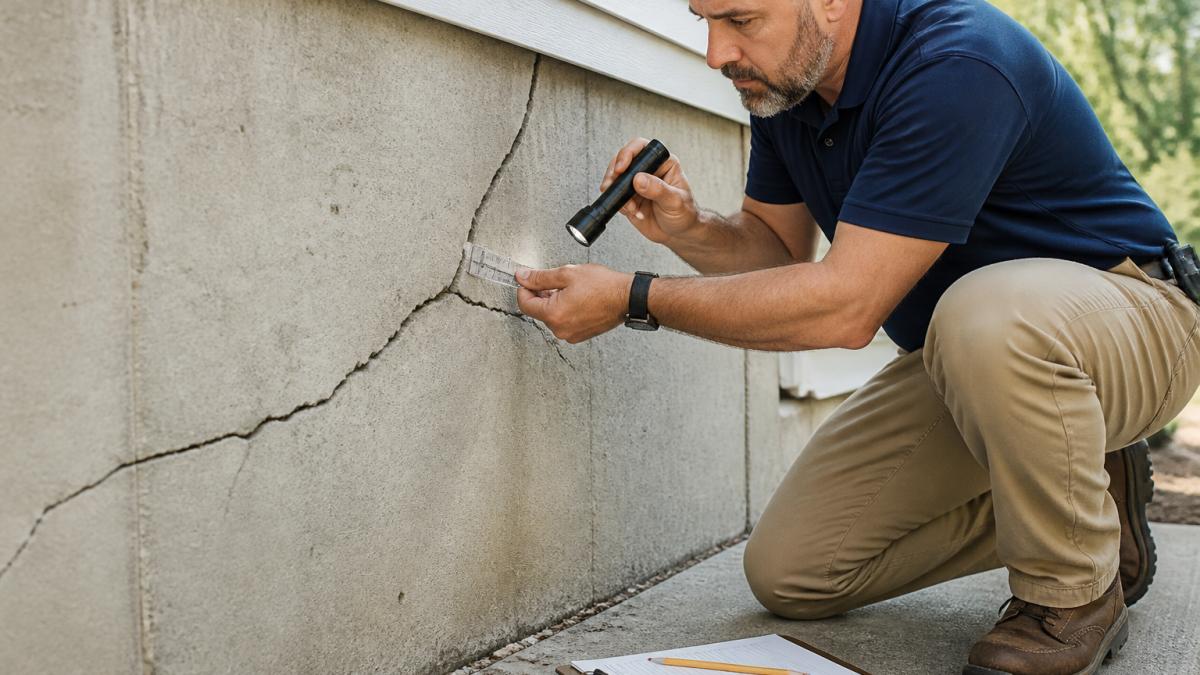
- Label each crack. Use a pencil or a small piece of tape with a number. Photograph each one with a ruler or coin for scale.
- Mark the ends. Draw a thin line across each end of the crack with a pencil. If the crack grows past the line, you have proof of movement.
- Date your photos. Take new photos every 30 days, from the same angle and distance.
- Measure the width. Use a crack gauge or a set of feeler gauges. Record the number each time.
- Log conditions. Note recent rain, temperature swings, or yard changes next to each measurement.
- Check the paired symptoms. Note whether doors stick, floors feel uneven, or new drywall cracks appear.
Track the results in a simple table:
| Date | Crack # | Width | Length Change | Weather/Site Notes |
|---|---|---|---|---|
| Example | 1 | 1/16 in | No change | Heavy rain prior week |
| Example | 2 | 1/8 in | Grew 1 in | Dry spell, then storm |
A crack that stays the same for a year is a very different problem from one that grows every month. Monitoring tells you which you have.
Your First-Response Inspection Checklist and Next Step
Use this checklist the moment you spot a crack. It takes about fifteen minutes and gives you a clear picture to share with an inspector.
- Photograph the crack with a coin or ruler for scale
- Note the direction: vertical, horizontal, diagonal, or stair-step
- Measure the width and check whether it's wider at one end
Once you've worked through the checklist, the next step is a professional look. A professional inspection can help determine whether repair is needed now or later.
At Florida Foundation Repair, we use non-invasive polyurethane injection to stabilize soil and lift settled slabs, with minimal disruption to your property. If you're ready to stop guessing, schedule a structural evaluation and get a clear answer on what your crack actually means.
Frequently Asked Questions
Why would foundation cracks appear suddenly after years?
Cracks rarely form in an instant. What changes suddenly is the stress on the soil around your foundation: a heavy rain event, a drought, a plumbing leak, or a construction project next door can shift soil pressure in days. The concrete then cracks along a line that was already under strain. In karst geology, the collapse of a void below the slab can also produce a crack that seems to appear overnight. That is why sudden foundation cracks deserve a prompt inspection rather than a wait-and-see approach.
Can heavy rain cause new foundation cracks?
Yes. Foundation cracks after heavy rain are common because water-laden soil expands and pushes inward against the foundation wall, while saturated ground around the footing can also soften and settle. Hydrostatic pressure builds fastest when gutters discharge next to the wall or the yard slopes toward the house. Check the soil line and downspouts first, then look for new diagonal cracks near wall corners. If water is still pooling within a few feet of the foundation, drainage correction is the first fix, not crack patching.
How can I tell if a foundation crack is getting worse?
Set up a simple monitoring routine. Mark both ends of the crack with a pencil line and date it, then place a crack gauge or a strip of masking tape across the widest point. Measure the crack width every two weeks and write the number on the wall. Widening of even 1/16 inch over a few months, or a crack that grows past the tape, signals active foundation movement. Also watch for doors that begin sticking and drywall cracks that spread from the same corner. Photograph each check so you have a dated record.
When should I call a foundation repair professional about a crack?
Call for an evaluation when a crack is wider than 1/4 inch, runs horizontally, is paired with sticking doors or uneven floors, or has widened since you first noticed it. Any crack in a foundation wall that lets water in also warrants a professional look. In Florida's karst geology, sudden cracking can signal soil voids forming below the slab, so a structural evaluation is worth scheduling early. A licensed inspector can confirm whether the crack is cosmetic or a sign of active settlement.
A crack that appears overnight is rarely as sudden as it looks. The stress built for months, and the last storm or cold snap pushed it into view. You don't have to solve it alone. Get started with Florida Foundation Repair and get a free emergency structural evaluation, non-invasive polyurethane soil stabilization, and a limited lifetime warranty behind the work.