 how-to
Signs of Foundation Settlement in Florida: 2026 Guide
Table of Contents
- Common Signs of Foundation Settlement
- How Florida's Soil and Climate Drive Foundation Settlement
- Signs of Sinkhole Activity vs. Normal Settlement
- DIY vs. Professional Foundation Assessment Checklist
- How to Fix a Sinking Foundation
- Foundation Repair Cost Estimates and Insurance
- Frequently Asked Questions
Last Updated: September 21, 2026
Common Signs of Foundation Settlement
Foundation settlement is the downward movement of a home's foundation caused by shifting soil beneath it. In Florida, that movement shows up fast, and it rarely fixes itself. This guide from Florida Foundation Repair breaks down the signs of foundation settlement in Florida, how the state's soil and climate drive it, and what to do next.
Interior Warning Signs
Start inside. Cracks in drywall near corners, doors that stick, and windows that jam all point to a foundation on the move.
Watch for these interior clues:
- Cracks in walls and ceilings, especially at corners
- Cracked drywall that keeps coming back after patching
- Sticking doors and jamming windows that once worked fine
- Uneven or sloping floors
- Gaps where walls separate from the frame
- Cabinets and counters pulling away from walls
Exterior Warning Signs
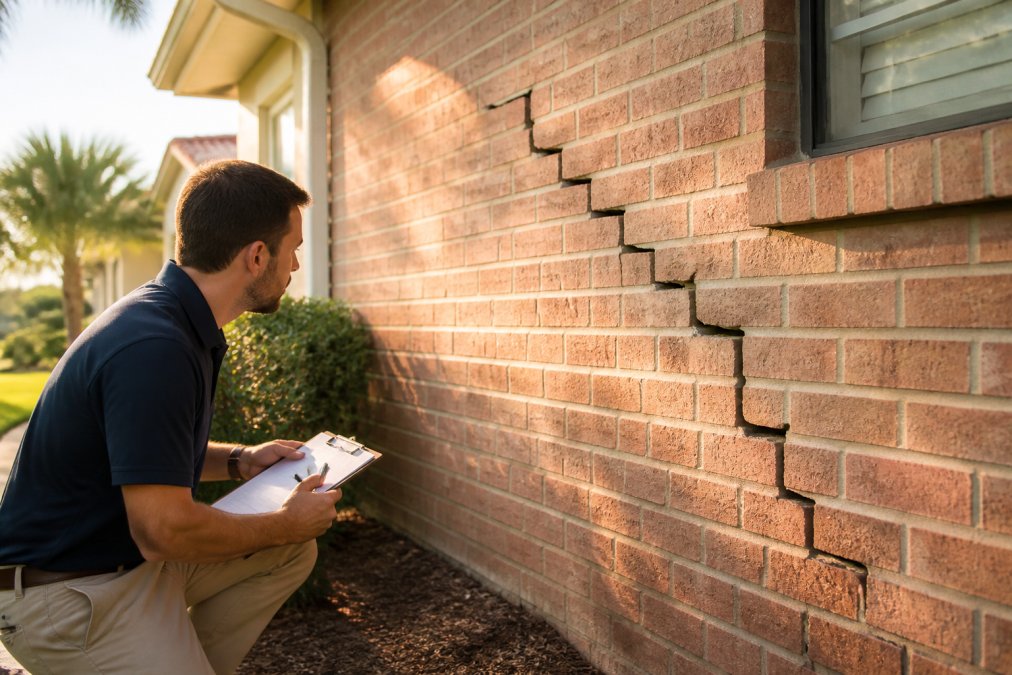
Outside, the clues are often bigger. Stair-step cracks in brick or block are one of the clearest signs of foundation settlement.
Check these exterior spots:
- Stair-step or diagonal cracks in block wall cracks and exterior brickwork
- Cracks where the foundation meets the wall
- A leaning chimney pulling away from the house
- Gaps around windows and doors
- Slab floor cracking on patios, driveways, and walkways
How Florida's Soil and Climate Drive Foundation Settlement
Florida's ground is unlike most of the country. Karst geology, heavy rain, and constant humidity create the perfect setup for foundation settlement.
Karst Geology and Sinkhole Risk
Karst topography is a landscape formed when water dissolves limestone underground, creating voids and caves. Much of Florida sits on this type of ground.
Humidity, Heavy Rain, and Soil Moisture
Florida's wet season dumps rain fast, and the ground can't always drain it. Water builds up, soil moisture spikes, and hydrostatic pressure pushes against foundations.
Signs of Sinkhole Activity vs. Normal Settlement
Not every crack means a sinkhole. But in a state built on limestone, the difference between slow settlement and active sinkhole formation is the difference between a repair and an emergency. Understanding the mechanism helps you read the signs correctly.
The Mechanism: Dissolution, Voids, and Raveling
Most of the peninsula sits on a thick sequence of carbonate rock, limestone and dolostone, laid down when the area was a shallow sea. Rainwater absorbs carbon dioxide as it percolates through soil, forming a weak carbonic acid. Over thousands of years, that acidic water dissolves the limestone along fractures and bedding planes, carving out cavities and conduits.
- Raveling: Cohesive soil spalls off the roof of the void in small increments, migrating downward through the opening. The surface may sag gradually for weeks or months before a visible depression appears.
- Collapse: The roof fails suddenly, and a void opens at the surface in minutes to hours.
Side-by-Side: Settlement vs. Sinkhole Activity
| Signal | Normal Settlement | Sinkhole Activity |
|---|---|---|
| Onset | Months to years | Hours to days, often sudden |
| Crack pattern | Diagonal, stair-step, widens gradually | New cracks appear in a single day; doors/windows bind overnight |
| Yard | Minor ponding, no depression | Circular depression, slumping, or a freshly exposed void |
| Foundation edge | Hairline separation at wall/soil line | Visible gap or drop at the slab edge |
| Trees/fence posts | Stable | Leaning without wind or soil-moisture cause |
| Water | Seasonal ponding | New ponding in a spot that never held water |
Why the Distinction Matters for Coverage
Standard homeowner policies typically exclude earth movement, including settlement. Sinkhole coverage is treated separately. Insurers must offer sinkhole coverage as an endorsement on residential policies, and a policyholder who accepts it can file a claim when a sinkhole causes structural damage. The claim process usually involves a professional geological inspection, and the insurer may require an independent report.
When to Act Immediately
Call for an evaluation the same day if you see any of the following:
- A depression in the yard that was not there last week
- Doors or windows that stopped operating overnight
- Cracks that appeared in a single day
- A fence post, tree, or utility pole leaning without an obvious cause
- Sunken ground around the foundation perimeter
DIY vs. Professional Foundation Assessment Checklist
You can spot warning signs yourself. But confirming the cause takes the right tools and training.
Use this checklist to decide your next step:
- Walk the inside and outside, noting every crack
- Mark cracks with tape and a date to track movement
- Test every door and window for sticking or jamming
- Check floors with a level or marble
- Look for gaps at walls, trim, and cabinets
- Photograph any leaning chimney or wall
- Note new depressions in the yard
How to Fix a Sinking Foundation
Fixing a sinking foundation means stabilizing the soil and lifting the structure back toward level. The right method depends on your soil and how far things have moved.
Polyurethane Injection vs. Traditional Methods
Traditional repairs often mean digging. Helical piers and concrete underpinning involve excavation, heavy equipment, and days of disruption.
| Method | Disruption | Best For | Speed |
|---|---|---|---|
| Polyurethane injection | Minimal, small holes | Slab and soil stabilization | Often same day |
| Helical piers | Excavation required | Deep load-bearing support | Multiple days |
| Concrete underpinning | Heavy digging | Major structural lift | Days to weeks |
Foundation Repair Cost Estimates and Insurance
Foundation repair pricing is not a single number. It is a function of how far the structure has moved, how much soil must be stabilized, and which method fits the geology under your slab. Understanding the drivers lets you compare quotes on equal terms instead of on sticker price alone.
What Drives the Cost
- Linear feet of repair. Most slab and perimeter repairs are priced per linear foot of affected foundation. A single wall section costs far less than a full perimeter.
- Depth of stabilization. Shallow void filling is cheaper than deep load-bearing support. Karst conditions often require deeper treatment than simple shrink-swell soil.
- Access and disruption. Landscaping, driveways, pool decks, and interior finishes all add cost if they must be removed or restored.
- Method. Non-excavative polyurethane injection is often the least disruptive when it is a technical fit. Helical piers and concrete underpinning involve excavation, equipment, and longer timelines.
- Engineering and permitting. A structural engineer's report, soil testing, and any required permits add to the project total.
- Cosmetic repair. Drywall, paint, brick, and tile repair after stabilization is usually a separate line item.
Typical Price Ranges
Exact pricing depends on the property, so treat any figure as a planning range, not a quote. Get at least two or three written estimates, and ask each contractor to itemize stabilization, engineering, permitting, and cosmetic repair separately so you can compare like for like.
What Standard Policies Cover, and What They Do Not
Most standard homeowner policies exclude earth movement, which includes settlement, shrinking, and expanding soils. That means a typical settlement claim will be denied. Two exceptions matter:
- Sinkhole endorsement. Insurers must offer sinkhole coverage as an endorsement on residential policies. If you accepted it, structural damage caused by a sinkhole may be covered, subject to your deductible and the policy's terms.
- Sudden and accidental water damage. A burst pipe that undermines a foundation is a different peril than soil movement and may be covered under the water-damage provisions.
How to File a Claim Without Wasting the Effort
- Document everything first. Photograph cracks with a tape measure or crack gauge in frame, note dates, and keep a log of when each sign appeared.
- Get a professional inspection. An engineer's or licensed contractor's report is usually required to support a sinkhole claim.
- Notify your insurer promptly. Most policies require prompt notice of a loss. Delay can be grounds for denial.
- Expect an independent evaluation. The insurer may send its own geologist or engineer. Keep your own report for comparison.
- Do not authorize permanent repairs before the claim is resolved. Cosmetic patching can be read as evidence that the damage was minor.
For current pricing on your property, request a quote from Florida Foundation Repair.
Frequently Asked Questions
What are the most common signs of foundation settlement?
The most common signs include stair-step cracks in brick or block walls, diagonal cracks in drywall, sticking doors and jamming windows, uneven or sloping floors, and separation between the foundation and the frame. Exterior indicators include cracked exterior brickwork and a leaning chimney. If you notice any of these, a professional foundation inspection can confirm whether the movement is active and whether foundation repair is needed.
How much foundation settlement is normal?
Most foundations experience some minor settlement within the first few years after construction, often due to concrete shrinkage and soil compaction. Cracks narrower than 1/16 inch that do not worsen are usually not a structural concern. However, if cracks widen, doors begin to stick, or floors slope, the settlement may be ongoing and should be evaluated by a licensed foundation specialist.
Does karst geology increase the risk of foundation settlement?
Yes. Karst topography, which is common in parts of Florida, features soluble rock layers that can dissolve over time, creating voids and sinkholes. When the subsurface soil shifts into these voids, the foundation loses support and settles unevenly. Properties in karst regions should be monitored for signs of sinkhole activity, such as circular depressions or new cracks, and may need specialized soil stabilization.
When should you call a professional for a foundation inspection?
Call a licensed foundation professional if you see stair-step cracks in exterior brickwork, doors or windows that no longer close properly, floors that slope noticeably, or cracks wider than 1/4 inch. You should also seek an inspection if you notice signs of sinkhole activity, such as a depression in the yard or a leaning fence. Early evaluation can prevent minor settlement from becoming a major structural failure.
Foundation settlement doesn't pause while you decide. The longer soil shifts, the more expensive the fix becomes. Florida Foundation Repair offers free emergency structural evaluations, licensed and insured crews, and non-invasive polyurethane injection designed for Florida's karst ground. Get started with Florida Foundation Repair and schedule your structural evaluation today.