 how-to
7 Signs of Structural Cracks in Commercial Buildings
Last Updated: November 5, 2026
Quick Summary
To identify structural cracks in commercial buildings, look for cracks that are widening, paired with movement, or running through the full depth of a slab or wall, especially near load points. Judge cracks by width, cause and movement rather than appearance alone, and monitor them over time to confirm whether they are active.
- A width near one-eighth inch is a commonly used watch threshold in concrete evaluation.
- A full commercial crack inspection takes about 60-90 minutes for a mid-size building.
- Monthly re-checks are a reasonable default for a watched crack, plus after heavy rain or excavation.
- Restrict access and call a professional when a wall is visibly bowing or leaning.
- Call a structural engineer when a crack is widening, comes with movement, or you cannot explain it.
Table of Contents
- Why Commercial Crack Inspections Differ From Residential Checks
- Structural vs. Non-Structural Cracks in Concrete and Masonry
- 7 Signs of Structural Damage in Commercial Buildings
- How to Measure and Monitor Cracks in Walls Over Time
- A Repeatable Crack Inspection Procedure for Commercial Properties
- When to Call a Structural Engineer for Cracks
- Schedule a Structural Evaluation Before Small Cracks Worsen
- Frequently Asked Questions
Why Commercial Crack Inspections Differ From Residential Checks
A commercial building carries loads a house never sees.
A hairline crack in a warehouse slab can signal something far more serious than a crack in a driveway.
So the inspection approach has to be sharper. You are not just looking for damage.
Here is how to identify structural cracks in commercial buildings without overreacting to cosmetic flaws or missing real danger.
Structural vs. Non-Structural Cracks in Concrete and Masonry
A structural crack is a break that affects how the building carries load.
That distinction drives every decision you make. The American Concrete Institute's guidance on crack evaluation treats crack width, cause and movement as the core factors, not appearance alone.
Here is the practical split:
- Non-structural: hairline shrinkage cracks, plaster crazing, surface map cracking, cracks that have not moved in years
- Structural: cracks that are widening, cracks paired with movement, cracks that break through the full slab or wall depth, cracks near load points
A common mistake is judging by width alone. A narrow crack that keeps growing is more concerning than a wide one that has sat still for a decade.
For a deeper breakdown of this split, see our guide on floor cracks: structural vs. cosmetic.
7 Signs of Structural Damage in Commercial Buildings
Structural damage in a commercial building shows up as a pattern, not a single flaw. One crack means little. A crack plus a sticking door plus a sloping floor means a lot.
Below are the seven warning signs we check first, followed by how to read each one and what makes it commercial-specific.
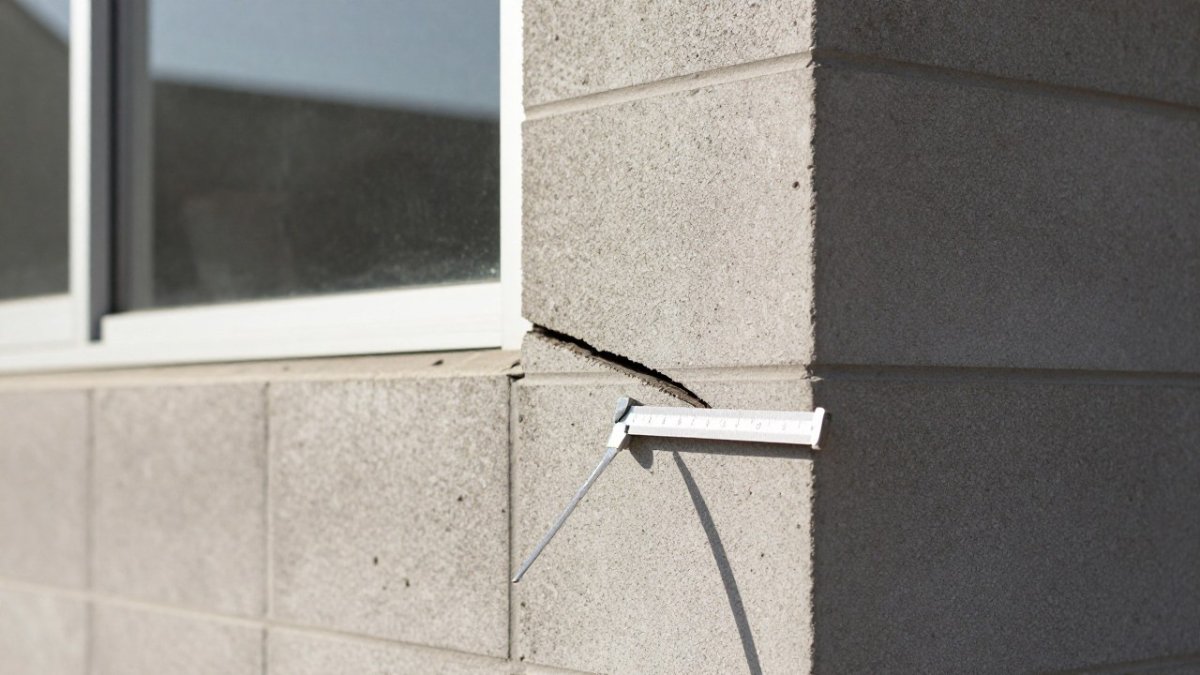
Crack Width, Length, Direction, and Pattern
Width tells you how far the break has opened. Direction tells you what force caused it. Pattern tells you whether the movement is local or building-wide.
- Vertical cracks often follow shrinkage or settlement and are frequently non-structural
- Horizontal cracks in a foundation wall can point to soil pressure pushing inward
- Diagonal cracks that step along mortar joints usually signal settlement or movement
A width near one-eighth inch is a commonly used watch threshold in concrete evaluation. Anything approaching or passing it deserves a professional look.
Watch out: judging a crack by width alone and ignoring whether it sits at a load point, a joint, or an opening will cause you to miss the cracks that matter and flag the ones that do not.
Foundation Cracks, Uneven Floors, and Sticking Doors or Windows
Cracks at the base of walls, sloping floors and doors that suddenly stick all trace back to foundation movement. When the soil under a slab shifts, the structure above flexes, and openings stop lining up.
Watch for:
- A foundation crack that widens toward one corner
- Uneven or sloping floors in a loading area or aisle
- Sticking doors and windows that used to close cleanly
These are classic settlement signs. In commercial buildings, pay particular attention to dock levelers, overhead door tracks, and racking uprights, a floor that has settled unevenly will show up first as a dock leveler that no longer sits flush or a rack leg that needs shimming. Our guide to foundation settlement signs walks through what each one means.
Bulging or Bowed Walls
A bulging wall or bowed wall is one of the clearest structural warnings you will see. The wall is being pushed or pulled out of plumb, usually by soil pressure or water.
Stand at one end of a long wall and sight down its length. Any visible curve or lean means the wall is moving. Combine that with a horizontal crack and you have a structural concern, not a cosmetic one.
Water Intrusion and Moisture
Water is the quiet cause behind many recurring cracks. Moisture weakens masonry, washes out soil and drives soil pressure against walls. If you see efflorescence, damp patches or rust staining near a crack, water is entering. Trace the water source before you treat the crack: a crack sealed while the leak continues will reopen, and on a commercial roof or plaza deck the source is often a failed membrane or joint sealant well away from where the crack appears.
Recurring or Widening Cracks
A crack you patched last year that has reopened is telling you the cause was never fixed. Recurring cracks and widening cracks both point to ongoing building movement. That is your cue to start monitoring, not patching again. Record the patch date and the date it reopened, the interval is useful evidence for an engineer.
Cracks Around Openings and at Beam-Column Connections
Openings concentrate stress, and commercial buildings have more of them, storefront glazing, overhead doors, mechanical penetrations, and expansion joints. Cracks radiating from the corners of openings, or step cracks in masonry between a window and a column, often mark where movement is being absorbed. At beam-column connections, look for cracks in the weld, bearing plate, or surrounding concrete; these are load-transfer points and warrant a closer look than a wall crack of the same width.
Schedule Structural Evaluation →
Sudden Changes and Falling Material
A new step in a slab, a crack that appears overnight, or any spalling that drops material is a different category from the slow signs above. For more on why cracks can emerge quickly, see how to tell why foundation cracks appear suddenly. Sudden change means the structure has moved quickly, and that is a safety question, not a maintenance question.
Here are the seven warning signs we check first, with what each one typically points to.
| Sign | What it can indicate |
|---|---|
| Vertical cracks | Shrinkage or settlement, often non-structural |
| Horizontal cracks in foundation wall | Soil pressure pushing inward |
| Diagonal cracks stepping along mortar joints | Settlement or movement |
| Foundation cracks, uneven floors, sticking doors | Foundation movement |
| Bulging or bowed walls | Soil pressure or water pushing wall out of plumb |
| Water intrusion and moisture | Weakened masonry and soil pressure |
| Recurring or widening cracks | Ongoing building movement |
| Cracks around openings and beam-column connections | Stress concentrated where movement is absorbed |
How to Measure and Monitor Cracks in Walls Over Time
Measurement turns guesswork into evidence. You cannot tell if a crack is worsening without a baseline, and a single photo proves nothing.
Here is a repeatable method any facility manager can run.
- Establish a baseline. Photograph the crack with a ruler, crack gauge, or coin for scale, and include a wide shot that shows the crack's location in the room or on the facade. Take the wide shot first, then the close-up, so the two are easy to pair later.
- Record the numbers. Note the crack width at its widest point and at two or three marked locations along its length, plus the crack length. Write down the date, time, and the person measuring.
- Mark the ends. Draw a pencil line across each end of the crack and date it. If the crack grows past the line, you have proof of movement without needing a gauge.
- Install a tell-tale or gauge. A crack gauge (a graduated plate with a sliding or fixed reference) or a simple tell-tale, two plates glued on either side of the crack, gives you a direct reading of movement. Mount it across the widest part of the crack, not at the end.
- Standardize the photo. Shoot from the same spot, at the same distance, with the same orientation each time. Use a fixed reference in the frame, a door frame, a column, a marked spot on the floor, so before-and-after images line up. Avoid flash-only shots that flatten depth; raking light from a flashlight held at a low angle reveals width and offset better.
- Re-check on a schedule and after events. Monthly is a reasonable default for a watched crack; re-check after heavy rain, after any nearby excavation or construction, and after seasonal temperature swings. Record the reading, not just "no change."
A widening gauge reading over weeks is far stronger evidence than a single photo.
Watch out: measuring a crack once and calling it stable.
For a practical reference on classifying and tracking what you find, use our crack identification guide.
A Repeatable Crack Inspection Procedure for Commercial Properties
Most guides stop at a list of warning signs. A commercial property needs a repeatable procedure you can run on a schedule.
Total time: about 60-90 minutes for a mid-size building.
What you'll need: a flashlight, a crack gauge, a camera, a notebook and a ladder for high walls.
- Walk the exterior perimeter. Check foundation walls, corners and any retaining walls.
- Inspect interior load points. Look at column bases, beam connections and slab edges.
- Check all openings. Test doors and windows for sticking or misalignment.
- Sight down long walls. Note any bow, bulge or lean.
- Log every crack. Record width, length, direction and location.
- Flag and date. Mark cracks you will monitor over time.
- Prioritize. Rank findings by severity, not by how alarming they look.
Safety Triage and Evacuation Thresholds
Some findings mean stop now. Treat these as triggers for immediate action:
- A wall that is visibly bowing or leaning
- A crack that has widened sharply since your last check
- Sudden floor deflection or a new step in a slab
When you see these, restrict access and bring in a professional before the building keeps operating. Do not wait for a scheduled review.
When to Call a Structural Engineer for Cracks
Call a structural engineer when a crack is widening, when it comes with movement, or when you cannot explain it. A professional assessment separates cosmetic flaws from real risk.
Reasons to escalate:
- A structural crack that is active or growing
- Foundation movement paired with sticking openings
- A bowed wall or sloping floor
A licensed engineer can run diagnostic methods, confirm the cause and recommend a repair path. That report also protects you if you need to document the condition for an owner, insurer or buyer.
Schedule a Structural Evaluation Before Small Cracks Worsen
Small cracks rarely stay small when the soil underneath is moving. The cheapest repair is the one you do before a warning sign becomes a failure.
If your inspection turns up foundation cracks, uneven floors or a bowed wall, get a professional read before you patch anything.
Do not wait on foundation issues. Florida Foundation Repair offers non-excavative polyurethane injection for soil stabilization and structural lift. Schedule a structural evaluation and get a clear answer on what your building needs.
Frequently Asked Questions
How do I know if a crack is structural or not?
Structural cracks usually run wider than a hairline, keep growing, and appear alongside other movement clues such as uneven floors, sticking doors, or bowed walls. Non-structural cracks tend to stay narrow, follow straight lines through mortar joints or surface finishes, and stop changing once the cause (shrinkage, moisture, or thermal movement) settles. A crack wider than one-eighth inch, or any crack that widens over weeks, warrants a professional assessment rather than a cosmetic patch.
What crack width should prompt a professional inspection?
Use one-eighth inch as a practical trigger point. Cracks under that width may still matter if they are diagonal, horizontal on a load-bearing wall, or paired with foundation movement signs, but a crack at or above one-eighth inch should be documented and reviewed by a licensed structural engineer. Width alone is not the whole story: a narrow crack that keeps widening is more concerning than a stable wider one.
How can I monitor a crack to see whether it is growing?
Install crack monitors or bond paper tell-tales across the crack, label each with a date, and record width with a crack gauge every two to four weeks. Photograph each location from the same angle and distance so comparisons are reliable. Keep a simple log of width, length, and any new cracks nearby. Movement over a few months, especially seasonal widening, is a clear signal to escalate to a structural engineer.
When should a building owner call a structural engineer about a crack?
Call an engineer when a crack exceeds one-eighth inch, widens over time, runs diagonally from door or window corners, or appears with sloping floors, bowed walls, or doors that no longer latch. Also call if you notice water intrusion through the crack or a horizontal crack in a foundation wall. Early assessment is cheaper than repair, and documentation from an engineer supports insurance claims and future maintenance planning.
A crack you can measure is a crack you can manage. The real risk is the one nobody logged. Get a professional assessment early, and you turn a guessing game into a documented plan. Get started with Florida Foundation Repair and protect your building before small cracks become expensive ones.