 how-to
Floor Cracks: Structural vs. Cosmetic
Table of Contents
- How to Tell If Floor Cracks Are Structural or Cosmetic
- Signs of Foundation Settlement That Accompany Cracks
- Analyzing Crack Patterns: Horizontal, Vertical, and Diagonal
- How to Measure Crack Width and Depth
- DIY Monitoring Tools and Techniques
- Understanding Foundation Crack Repair Cost
- When to Call a Structural Engineer
- Frequently Asked Questions
Last Updated: October 4, 2026
How to Tell If Floor Cracks Are Structural or Cosmetic
The difference between floor cracks structural in nature and ones that are purely cosmetic can mean thousands of dollars in repair costs. A hairline crack running along grout lines might be nothing to worry about. A stair-step pattern cutting through concrete blocks is a red flag.
Most homeowners confuse normal settling with structural damage. You can learn to tell them apart in minutes by examining a few key details.
The Key Differences at a Glance
Cosmetic cracks are surface-level and don't affect load-bearing capacity. Structural cracks indicate foundation movement, soil settlement, or failure in the concrete slab itself.
| Crack Type | Width | Pattern | Movement | Urgency |
|---|---|---|---|---|
| Cosmetic | Under 1/8 inch | Random, isolated | Stable | Monitor |
| Structural | Over 1/4 inch | Stair-step, diagonal | Active | Call engineer |
Cosmetic cracks happen everywhere as concrete shrinks, drywall settles, and wood moves with humidity. Floor cracks structural in nature signal foundation shifting, soil collapse, or water erosion, these demand attention.
Signs of Foundation Settlement That Accompany Cracks
Floor cracks rarely travel alone. When foundation settlement is happening, look for these secondary indicators:
Doors and windows that stick or jam. This happens when the foundation moves unevenly, pulling the walls out of alignment and making openings no longer square.
Gaps between the baseboard and the floor. As the slab settles, visible daylight appears under the trim.
Cracks in drywall, especially at corners. When the foundation moves, everything above it cracks too.
Sloping or uneven floors. Floors that slope more than 1/4 inch over 10 feet indicate active settlement.
Bouncy or soft spots in the floor. This often indicates delamination in the concrete or failure in the subfloor support.
Secondary Symptoms Beyond the Floor
Foundation settlement creates a domino effect. The floor cracks first. Everything else follows.
Exterior cracks in the foundation wall. Horizontal cracks in the concrete stem wall or block foundation are particularly concerning, indicating hydrostatic pressure pushing inward.
Separation between the house and the deck or porch. If the main house settles but the porch doesn't, a visible gap appears.
Cracks in the garage floor that align with cracks in the house. If garage cracks differ from house cracks, the garage foundation may be failing independently.
Spongy or soft crawl space soil. Soft, mushy soil means water is compromising the bearing capacity underneath your home. These secondary symptoms indicate something systemic is happening.
Analyzing Crack Patterns: Horizontal, Vertical, and Diagonal
The direction a crack runs tells you what's causing it.
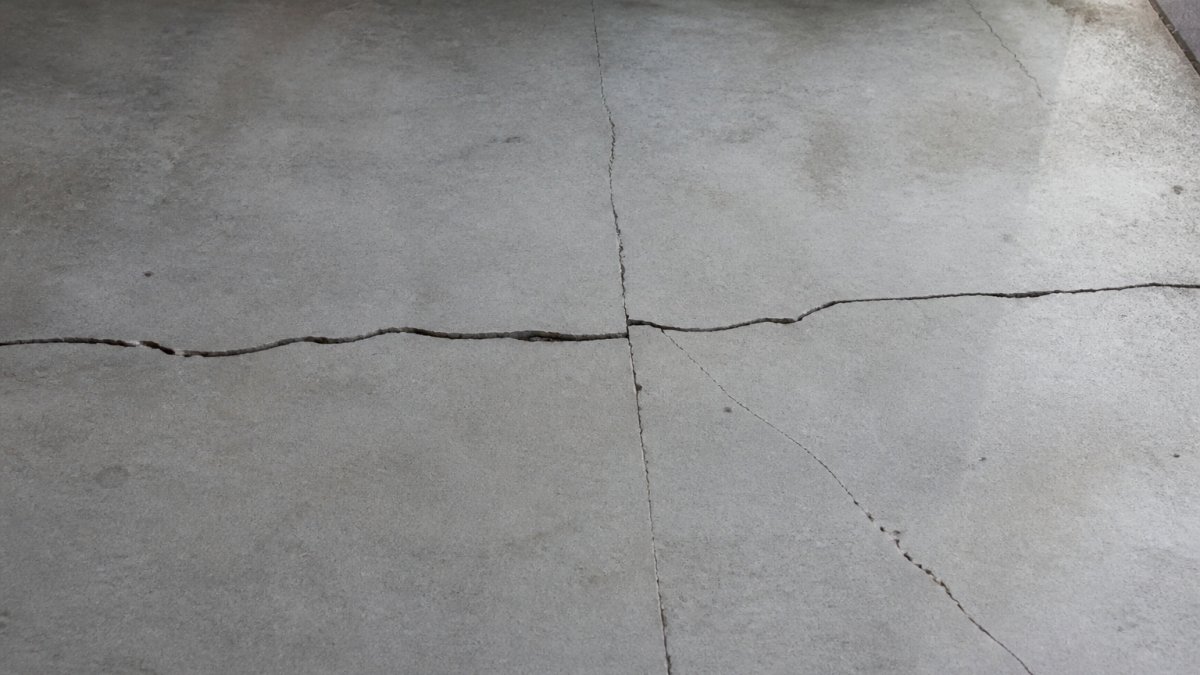
Vertical cracks run straight up and down and are usually shrinkage cracks as concrete cures. These are typically cosmetic and don't indicate movement or load failure.
Horizontal cracks are more serious, suggesting the concrete is being pushed from one side. In basement walls, they indicate water pressure building up outside; in floor slabs, they indicate soil movement forcing the slab sideways.
Diagonal cracks form when one corner of the slab settles faster than another, creating shear stress. They almost always indicate active foundation settlement.
Stair-Step and Tapering Patterns
Stair-step cracks follow mortar joints in concrete blocks, indicating the blocks are moving relative to each other. Tapering cracks (wider at one end) point to uneven settlement. Both patterns indicate active movement and warrant a structural engineer's evaluation.
How to Measure Crack Width and Depth
Measure crack width with a ruler held perpendicular to the crack at three points; record the widest measurement. Cracks under 1/8 inch are almost always cosmetic; between 1/8 and 1/4 inch are borderline; over 1/4 inch are structural. A crack that's the same width along its entire length is more stable; widening in one direction suggests active movement.
DIY Monitoring Tools and Techniques
You don't need expensive equipment to track whether a crack is growing. The key is establishing a baseline measurement and checking it systematically over time. This approach separates stable cracks (which may never need repair) from active ones (which demand professional intervention).
Crack gauge monitoring (the most reliable method). A crack gauge is a simple plastic or metal device that bridges the crack and visually displays any movement. The most common type is a tell-tale monitor: a transparent ruler-like tool with a reference line marked across the crack.
To use a crack gauge effectively:
- Photograph the gauge and crack together with a ruler in frame for scale
- Record the date and exact width measurement (use calipers or a ruler held perpendicular to the crack)
- Check the gauge every 30 days for the first three months, then quarterly
- Movement of more than 1/16 inch over three months indicates active settlement
Smartphone documentation method. Take a high-resolution photo of the crack with a ruler or coin placed next to it for scale. The phone's timestamp is your date stamp. Store photos in a dedicated folder.
Schedule Structural Evaluation →
The tape and marker method. Use painter's tape to bridge the crack on both sides. Use a permanent marker to draw a line across the tape that aligns with the crack. Write the date directly on the tape. Check every 30 days.
Depth testing with a feeler gauge. A feeler gauge is a set of thin metal blades of known thickness (available at auto parts stores for $10-$15). Insert the blade into the crack.
The sound test for delamination. Tap the concrete around the crack with a hammer or rubber mallet. Listen for the sound. Solid concrete produces a sharp, clear ring. Delaminated concrete (where the slab has separated from the soil below) produces a hollow, dull thud. Mark areas that sound hollow.
For cracks under 1/8 inch, check every 60 days; between 1/8 and 1/4 inch, every 30 days; over 1/4 inch, every two weeks. No measurable movement over six months indicates stability. Growth of more than 1/16 inch in three months or detected delamination warrants contacting a structural engineer.
Cracks often widen seasonally as concrete expands and contracts. Track measurements at the same time of year to account for seasonal variation and detect whether the crack is wider than the previous year.
These DIY methods gather objective data on whether the crack is stable or active. Stable cracks can be sealed and monitored; active cracks require addressing the underlying cause.
Understanding Foundation Crack Repair Cost
The most important distinction is whether the crack is stable or active, not its width. A wide stable crack may cost less to manage than a narrow growing crack.
A stable crack can be sealed with epoxy or polyurethane injection for $500-$2,000. An active crack requires addressing the underlying cause: soil settlement stabilization costs $3,000-$15,000; hydrostatic pressure requires exterior waterproofing and drainage work, adding $2,000-$8,000. Width alone is misleading.
Factors that affect repair pricing.
Crack length and slab area affected. Longer cracks cost more to inject due to material volume and labor time. Multiple cracks suggest widespread settlement, increasing stabilization scope and cost.
Depth and concrete thickness. Thicker slabs and deeper cracks that run through the entire slab thickness cost more to seal because injection must reach the bottom.
Accessibility. Cracks under finished floors, cabinets, or appliances cost more to repair due to obstruction removal or workaround labor.
Cause and required repair method. Shrinkage cracks cost $300-$800 to seal. Settlement cracks require soil stabilization via polyurethane injection ($2,000-$5,000), helical piers ($5,000-$15,000 per pier), or slab jacking ($1,500-$3,000 per section). Hydrostatic pressure cracks require exterior waterproofing ($2,000-$8,000).
Soil conditions and local geology. Expansive clay soil requires more complex and expensive stabilization. Karst geology (limestone bedrock with sinkholes) requires specialized assessment and grouting, which is expensive.
Active vs. stable status. This is the single biggest cost driver. Monitoring data showing stability allows deferring repair or choosing lower-cost sealing. A structural engineer's evaluation ($300-$800) confirming stability can save thousands by ruling out unnecessary soil stabilization.
Warranty and durability expectations. A temporary seal (polyurethane caulk) costs $200-$500 and lasts 5-10 years. A structural epoxy injection costs $800-$2,000 and lasts 20+ years. A soil stabilization solution backed by a structural warranty costs $3,000-$15,000 but addresses the root cause and typically comes with a 10-25 year warranty. The cheapest option isn't always the best value if the underlying problem isn't fixed.
The decision framework. Before paying for repair, ask:
- Is the crack stable? Use DIY monitoring for 3-6 months. If it's not growing, you have time to plan and budget.
- What's the cause? A structural engineer's evaluation ($300-$800) identifies whether the crack is from shrinkage, settlement, water pressure, or structural failure. The cause determines the repair method and cost.
- Is repair urgent? Active cracks that are widening or accompanied by secondary symptoms (sticking doors, sloping floors, separation from attached structures) need professional repair soon. Stable cracks can be monitored and sealed on your timeline.
- What's your risk tolerance? A stable crack sealed with epoxy is a low-risk, moderate-cost solution. Ignoring an active crack is a high-risk choice that could lead to more expensive repairs later. A soil stabilization project is a high-cost, low-risk solution that eliminates the problem.
Most homeowners benefit from getting a structural engineer's evaluation before committing to repair. The evaluation cost is small relative to the repair cost, and it provides objective data on whether you're dealing with a cosmetic issue or a structural one. With that information, you can make a cost-effective decision rather than being driven by fear or sales pressure.
When to Call a Structural Engineer
You should call a structural engineer if any of these apply:
- The crack is wider than 1/4 inch
- The crack is growing visibly over weeks or months
- You see a stair-step pattern in the crack
- Multiple cracks are appearing in different rooms
- Doors and windows are sticking or jamming
- The floor is visibly sloping or uneven
- You see secondary symptoms like separation between the house and attached structures
A structural engineer will examine the crack, measure settlement, assess soil conditions, and recommend a repair strategy. They'll tell you whether the issue is urgent or can be monitored.
This evaluation typically costs a few hundred dollars. It's money well spent because it prevents you from either overpaying for unnecessary repairs or ignoring a serious problem.
The bottom line: Most floor cracks are cosmetic. But the ones that aren't demand professional attention. If you're seeing stair-step patterns, active growth, or secondary symptoms like sticking doors and sloping floors, don't wait. A structural engineer can confirm what you're dealing with. If soil stabilization is needed, Florida Foundation Repair offers free emergency structural evaluations and engineered solutions backed by a limited lifetime warranty. Schedule Structural Evaluation today.
Frequently Asked Questions
How do I know if a crack is structural or just cosmetic?
Structural cracks typically exceed 1/4 inch in width, grow over time, appear diagonal or stair-step, and accompany secondary symptoms like sticking doors or uneven floors. Cosmetic cracks are usually hairline (under 1/8 inch), stable, and isolated to the surface. Measure the crack width with a crack gauge or ruler, monitor it monthly, and note any accompanying foundation settlement signs. If the crack widens, spreads, or appears alongside other damage, it signals structural movement requiring professional evaluation.
What are the main signs of foundation settlement?
Foundation settlement produces multiple warning indicators beyond floor cracks. Look for sticking doors and windows, gaps appearing between baseboards and walls, uneven or bouncy floors, and horizontal cracks in drywall or concrete. In crawl spaces, you may notice sagging beams or visible delamination in the concrete slab. These secondary symptoms confirm that movement is occurring throughout the structure, not just surface cracking. Document all signs with photos and dates to track progression.
How do I measure crack width accurately?
Use a crack gauge (available at hardware stores for under $10) or a ruler placed perpendicular to the crack. Measure at three points: the widest point, the narrowest point, and the middle. Record measurements in inches or millimeters. Hairline cracks are under 1/8 inch; minor cracks range from 1/8 to 1/4 inch; structural concerns typically exceed 1/4 inch. Repeat measurements monthly and document with photos showing the gauge in place. This creates a monitoring record that helps professionals assess whether the crack is active or stable.
What should I expect to pay for foundation crack repair?
Repair costs vary significantly based on crack severity, location, floor material, and the repair method required. Minor cosmetic cracks may cost less, while structural repairs involving soil stabilization or polyurethane injection represent larger investments. Pricing depends on site conditions, accessibility, and the extent of underlying foundation movement. Contact Florida Foundation Repair for a free structural evaluation to receive an accurate quote tailored to your specific situation rather than relying on generic estimates.