 comparison
What Are the Best Stable Soils Alternatives for Foundations?
Last Updated: November 2, 2026
Quick Summary
The best stable soils alternatives for foundations depend on the failure: polyurethane injection suits settling slabs on loose fill, helical or push piers handle structural settlement needing deep load transfer, micropiles fit tight access or heavy loads, and lime or cement stabilization works for poor subgrade before construction. Diagnosis comes first, since every method underperforms if water still reaches the soil.
- Polyurethane injection pumps expanding foam through small drilled ports to fill voids and compact loose soil.
- Helical and push piers bypass weak soil rather than improving it, transferring load to stable strata.
- Lime stabilization reduces plasticity and swelling in clay-heavy subgrade, but suits new construction, not occupied homes.
- Cost drivers include depth to a stable layer, number of locations, access, and restoration work.
- Choosing a method before diagnosing the cause is the most common and most expensive mistake.
Table of Contents
- What Stable Soils Alternatives Actually Solve
- Foundation Soil Stabilization Methods Ranked by Use Case
- Polyurethane Injection for Soil Stabilization: The Non-Excavative Option
- Helical Piers, Push Piers, and Micropiles: Deep Foundation Support
- Lime Soil Stabilization for Foundations and Cement-Based Alternatives
- Soil Bearing Capacity for Foundations: How Engineers Choose a Method
- Costs, Risks, and When Each Alternative Is Unsuitable
- Schedule a Structural Evaluation Before You Choose
- Frequently Asked Questions
What Stable Soils Alternatives Actually Solve
When homeowners search for best Stable Soils alternatives for foundations, they are usually trying to answer one question: my soil is moving, so what actually stops it? Settlement in karst country often traces to dissolving limestone that leaves voids under slabs, and it commonly shows up as stair-step cracks and sticking doors. The answer is rarely a single product. It is a diagnosis first, then a method matched to the failure.
Stable Soils, in this context, refers to proprietary deep soil mixing and injection systems that bind loose or weak soil into a cemented mass. Alternatives differ in how deep they reach, how much they excavate, and whether they treat the soil itself or bypass it entirely.
Weak Soil, Settlement, and the Bearing Capacity Problem
Soil bearing capacity is the maximum load a soil can support before it fails or deforms. When that capacity drops, the foundation settles, and settlement is rarely even. Differential settlement, where one corner drops faster than another, is what cracks brick and tears framing.
The usual culprits:
- Expansive clay that swells when wet and shrinks when dry
- Loose sand and silt that compacts under load or washes out
- Water infiltration that softens soil and carries fines away
- Organic or fill soils that decompose and lose volume
Fix the water and the load path, and most settlement slows. Ignore either, and every method below underperforms.
Comparing Alternatives to Stable Soils at a Glance
Here is how the main options stack up before we get into detail.
| Method | Depth of Reach | Excavation | Best For |
|---|---|---|---|
| Polyurethane injection | Shallow to moderate | Minimal | Slab lift, void filling, loose fill |
| Helical piers | Deep, stable strata | Moderate | Structural settlement, load transfer |
| Push piers | Deep, stable strata | Moderate | Heavier structures, remedial repair |
| Micropiles | Deep | Moderate to high | Limited access, high loads |
| Lime or cement stabilization | Shallow | High | Subgrade improvement, new build |
| Soil replacement | Shallow | Very high | Severely unsuitable surface soil |
Foundation Soil Stabilization Methods Ranked by Use Case
No single method wins everywhere. Ranked by the problem in front of you:
- Slab or driveway settling on loose fill: polyurethane injection. Fast, non-excavative, and it seals against water.
- Structural settlement needing deep load transfer: helical or push piers.
- Restricted access or very heavy loads: micropiles.
- Poor subgrade before new construction: lime, cement, or mechanical stabilization.
- Contaminated or unusable surface soil: replacement, the most disruptive option.
A common mistake is skipping diagnosis and jumping to the cheapest quote. A slab that settled because of a leaking irrigation line will settle again after any injection job if that line keeps running.
Polyurethane Injection for Soil Stabilization: The Non-Excavative Option
Polyurethane injection for soil stabilization is a process that pumps expanding structural foam through small drilled ports beneath a slab, filling voids and compacting loose soil as it cures. It is generally one of the less disruptive options on this list.
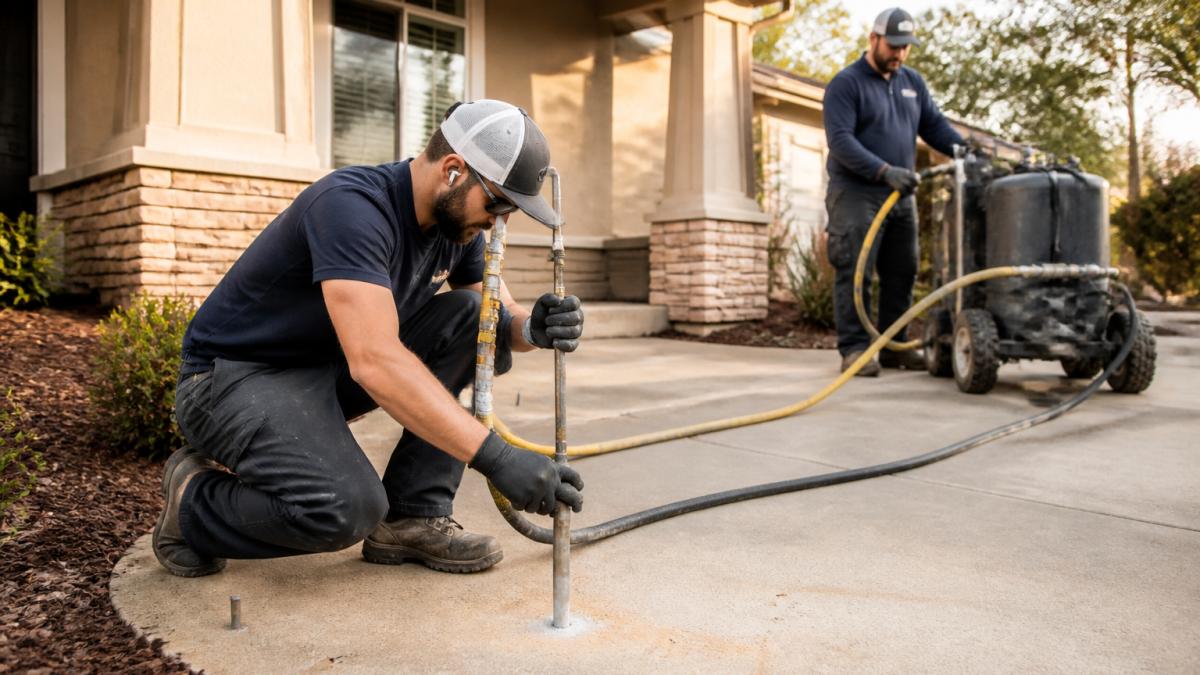
How it works, in short:
- Ports are drilled through the slab
- Foam is injected and expands to fill voids and tighten soil
- The cured foam forms a waterproof barrier
Best for: settling slabs and shallow foundations on loose or voided soil. Skip if: the failure is deep, or the structure needs load transferred to bedrock.
If you are weighing disruption, our breakdown of how messy polyurethane foundation injection really is walks through the day-to-day reality.
Helical Piers, Push Piers, and Micropiles: Deep Foundation Support
Deep foundation support transfers structural loads past weak soil to a stable layer or bedrock. Where injection treats the soil, piers and piles bypass it. That distinction matters: piers do not improve weak soil, they avoid relying on it.
Helical piers are steel shafts with helical plates screwed into bearing strata.
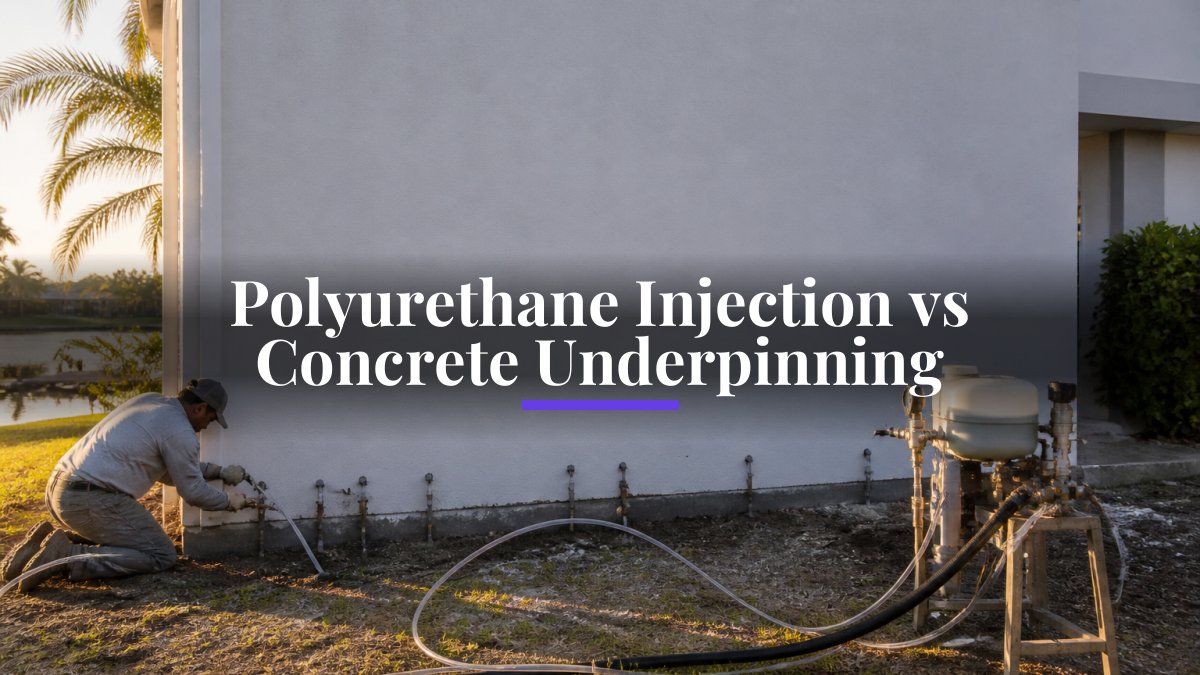
The trade-off is cost and disruption. Piers require excavation at each location, so a full perimeter repair involves more work. They also do nothing for a slab that settled on shallow fill. For a direct comparison of the two main approaches, read polyurethane injection vs concrete underpinning.
Lime Soil Stabilization for Foundations and Cement-Based Alternatives
Lime soil stabilization for foundations treats weak subgrade by mixing lime into clay-heavy soil, triggering a reaction that reduces plasticity and swelling. Cement stabilization and chemical stabilization work on similar principles, and fly ash or kiln dust are common additives.
Schedule Structural Evaluation →
These methods are ground improvement, not foundation repair. They shine before construction, when you can still rip up and recompact the subgrade. On an existing home, the excavation required makes them impractical for most homeowners.
Mechanical options round out the category:
- Compaction to increase density and bearing capacity
- Preloading to consolidate soft soil before building
- Geosynthetic fabric to reinforce and separate soil layers
- Soil cement mixed in place for a bound subgrade
Best for: new construction, roadwork, and sites with expansive clay. Skip if: the structure is already built and occupied.
Soil Bearing Capacity for Foundations: How Engineers Choose a Method
Soil bearing capacity for foundations drives every recommendation an engineer makes. The choice comes down to four inputs: soil type, depth to a stable layer, water conditions, and the load the structure must carry.
A simple decision path:
- Shallow void or loose fill under a slab → polyurethane injection
- Deep soft soil with structural settlement → helical or push piers
- Tight access and high loads → micropiles
- Poor subgrade before building → lime, cement, or mechanical stabilization
Soil type sets the baseline. Sand and gravel drain well and compact predictably. Silt is prone to washing out. Expansive clay moves with moisture. Bedrock is the ideal bearing layer, which is why deep piers reach for it. A geotechnical evaluation confirms what is actually under the slab before anyone quotes a fix.
Costs, Risks, and When Each Alternative Is Unsuitable
Cost is the question every homeowner asks first, and it is the one most articles dodge. Foundation work is typically scoped after an evaluation, so a quote depends on the specifics of the property. What you can do before that call is understand what drives the number and what you should demand as proof the work was done right.
What Drives the Price
- Depth to a stable layer. The deeper the bearing stratum, the longer the pier or pile and the higher the cost per location.
- Number of locations. Piers and piles are priced per unit, so a full perimeter repair costs more than a single corner.
- Access. Tight lots, finished landscaping, and interior slabs add labor and restoration cost.
- Disruption and restoration. Excavation-based methods require backfill, grading, and often concrete or landscape repair; injection methods largely avoid it.
- Diagnosis and engineering. A geotechnical evaluation and any required engineering stamp are part of the project cost, not an add-on to skip.
Because these factors vary so widely by property, pricing depends on the scope of each project. For current prices or a quote, contact Florida Foundation Repair directly through its website.
Lifecycle Value, Not Just First Cost
The cheapest quote is rarely the lowest total cost. Ask these questions before signing:
- Will the method address the cause, or only the symptom? If water is still reaching the soil, any repair is temporary regardless of price.
- What warranty is offered, and what does it actually cover? Ask for the warranty terms in writing before you commit.
Risks and When Each Method Is Unsuitable
| Method | Main risk | Unsuitable when |
|---|---|---|
| Polyurethane injection | Limited depth; cannot substitute for deep support | Deep structural failure, or the structure needs load transferred to bedrock |
| Helical/push piers | High cost per pier at scale; excavation at each location | Shallow slab settlement on fill, where piers do nothing for the slab |
| Micropiles | Access and cost; drilling disruption | Light loads on open sites where simpler methods suffice |
| Lime/cement stabilization | Excavation disruption; impractical on occupied homes | The structure is already built and occupied |
| Soil replacement | Highest disruption and cost | Surface soil is usable or the problem is deeper than the replacement zone |
What to Ask Before You Choose a Contractor
- What soil condition does your proposed method address, and how did you confirm it?
- Will you provide elevation readings or other measurements showing the before-and-after result?
- What is the warranty, who backs it, and what voids it?
- Are you licensed and insured, and can you provide the license number in writing?
A contractor who can answer these clearly is comparing methods on evidence, not on price alone. That is the standard worth holding every alternative to.
Schedule a Structural Evaluation Before You Choose
The right alternative depends on what is actually failing under your property, and that takes an evaluation, not a guess. Florida Foundation Repair provides non-excavative polyurethane injection engineered for karst geology, backed by a limited lifetime warranty and licensed and insured in Florida (CGC# 1526152). Emergency structural evaluations are available so you can get a diagnosis before a quote.
Frequently Asked Questions
Which soil is best for a foundation?
Dense, well-graded soil that sits on bedrock or a stable soil layer gives the most reliable support. Sand and gravel compact well and drain quickly, while clay and expansive clay shrink and swell with soil moisture changes, which drives differential settlement. Silt sits between the two and is prone to erosion. Loam holds water and is generally poor under structural loads. Whatever the surface soil, what matters most is the soil bearing capacity at the depth the foundation actually transfers load.
Is polyurethane injection a real alternative to foundation replacement?
For settling slabs, driveways, and shallow foundations on loose or voided soil, polyurethane injection for soil stabilization can lift and support the structure without excavation. The expanding foam fills voids and compacts loose layers as it cures. It is not a substitute for deep foundation support when the failure sits well below the slab. In those cases, helical piers or push piers reach a stable soil layer that grout injection cannot.
Can lime be used as a soil stabilizer for foundations?
Yes. Lime soil stabilization for foundations works by mixing lime into expansive clay to reduce its shrink-swell behavior and improve workability before construction. Cement stabilization, fly ash, and kiln dust follow the same principle with different chemistry. These methods need mixing equipment and access to the soil, so they suit new construction and site preparation better than repairing a finished home. For an existing foundation, grout injection or piers are usually the practical route.
What is the minimum soil bearing capacity required for a foundation?
There is no single national number, because the required soil bearing capacity for foundations depends on the structure's loads, the footing size, and the local building code. Engineers compare the allowable bearing capacity of the soil against the foundation loads and apply a factor of safety. A geotechnical report establishes the actual value on site. If the measured capacity is too low, the fix is ground improvement, a deeper foundation, or piers that bypass the weak layer entirely.
How do engineers choose between soil stabilization methods?
In general, the decision starts with a diagnosis: soil type, depth of the unstable layer, moisture and drainage conditions, and how much settlement has already occurred. From there, an engineer matches the method to the failure. Shallow voids point to grout injection. Deep unstable soil points to helical piers, push piers, or micropiles. Expansive clay on a new build points to lime or cement stabilization. Cost, construction access, vibration limits, and warranty terms then narrow the shortlist.
Every method on this list has a place, but only a proper diagnosis tells you which one your foundation needs. Get started with Florida Foundation Repair and schedule a structural evaluation to confirm the cause before you commit to a repair.