 how-to
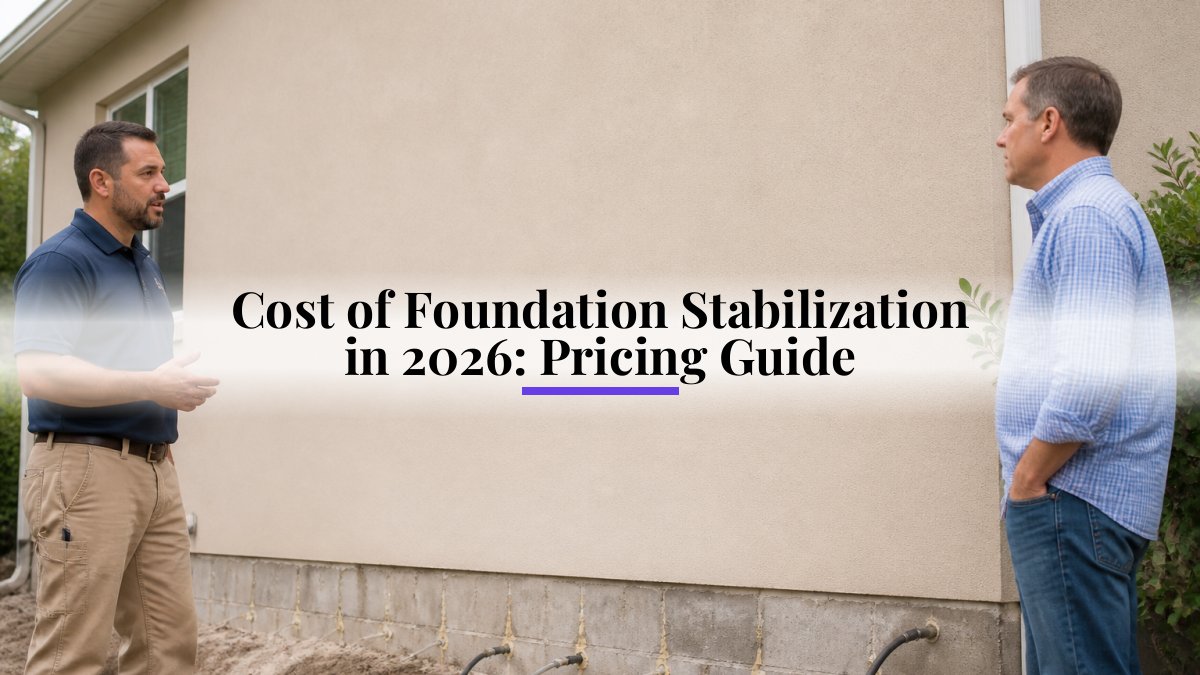
Cost of Foundation Stabilization in 2026: Pricing Guide
Table of Contents
- What Foundation Stabilization Actually Is (And What It Isn't)
- Foundation Stabilization Cost in 2026: Method-by-Method Pricing
- Foundation Repair Cost by Damage Severity and Scope
- Foundation Lifting Cost and When Raising Beats Stabilizing
- What a Foundation Inspection Cost Includes and Why It Matters
- How to Read a Foundation Repair Estimate Line by Line
- Permits, Engineering Reports, Warranties, and Monitoring
- Comparing Contractor Bids Without Getting Burned
- Frequently Asked Questions
Last Updated: October 17, 2026
What Foundation Stabilization Actually Is (And What It Isn't)
The cost of foundation stabilization restores a failing foundation's support system so the structure stops moving. It is not cosmetic crack repair, and it is not full foundation replacement.
- Stabilization: stops movement, restores load-bearing capacity
- Leveling: raises a settled section back toward its original plane
- Replacement: removes and rebuilds damaged foundation sections
The cost of foundation stabilization in 2026 depends almost entirely on which of these three you actually need. Confusing them is the fastest way to overpay.
Foundation Stabilization Cost in 2026: Method-by-Method Pricing
No single price fits every home. Pricing depends on soil conditions, access, and how many injection points or piers the job requires.
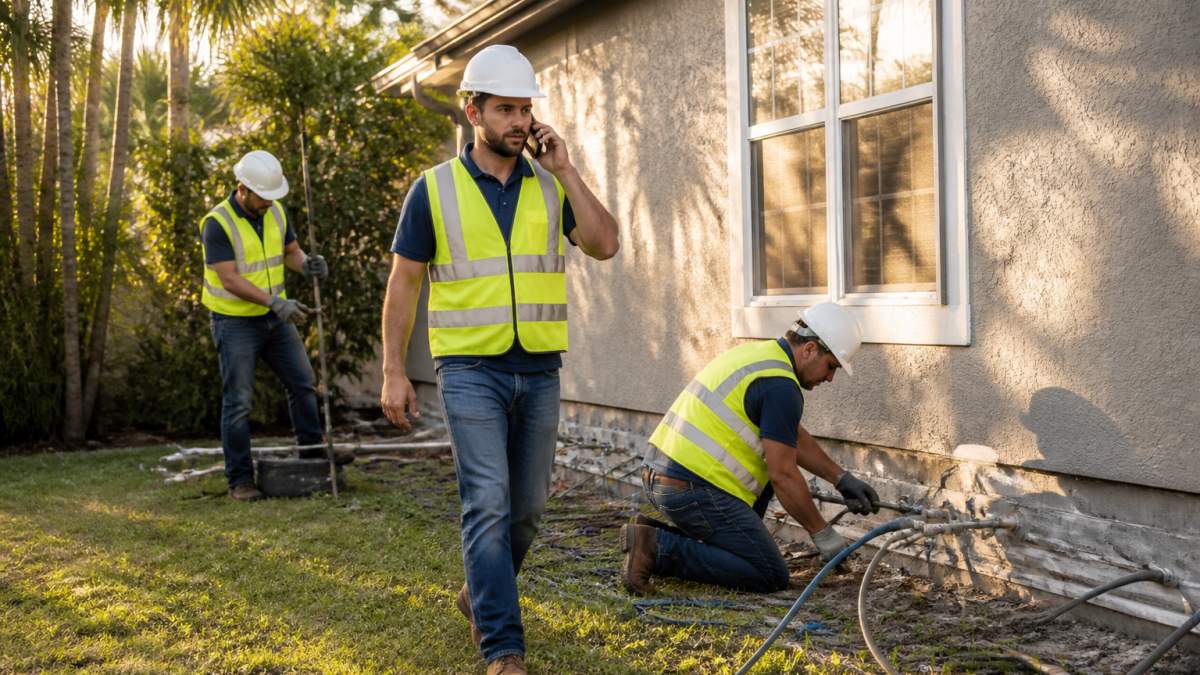
The table below compares common stabilization methods. Treat the ranges as planning figures, not bids, your engineer's report and the pier count it specifies set your final number.
| Method | Unit Priced | Typical Unit Cost (2026) | Typical Scope | Total Project Range (2026) | Best For | Disruption |
|---|---|---|---|---|---|---|
| Polyurethane injection | Per injection point | $350-$1,200 per point | 5-20 points for a typical slab section | $2,500-$12,000 | Slab voids, minor settlement, interior slabs | Minimal |
| Slabjacking (mudjacking) | Per square foot or per void | $3-$8 per sq ft | 100-500 sq ft of settled slab | $1,000-$4,000 | Driveways, patios, garage slabs, walkways | Low |
| Helical piers | Per pier plus depth | $1,500-$3,500 per pier installed | 5-15 piers on a typical perimeter | $8,000-$40,000+ | Lighter structures, tension loads, tieback applications | Moderate |
| Push piers | Per pier plus depth | $1,500-$4,000 per pier installed | 5-15 piers on a typical perimeter | $10,000-$50,000+ | Heavy vertical loads, severe settlement | Moderate to high |
| Partial foundation replacement | Per linear foot or per section | $300-$700 per linear ft | One wall or one section | $10,000-$40,000 | Severely damaged or crumbling sections | High |
| Full foundation replacement | Per square foot of footprint | $25-$75 per sq ft | Entire footprint | $40,000-$150,000+ | Structural failure, repeated repairs | Very high |
The gap between the cheapest and most expensive stabilization method is roughly tenfold, which is why the inspection and engineering report matter more than the bid itself.
Polyurethane Injection and Slab Lifting
Polyurethane injection is priced by the injection point. A crew drills small ports through the slab and pumps expanding structural foam beneath it, filling voids and lifting settled concrete. In 2026, most residential jobs land between $350 and $1,200 per injection point, and a typical slab section needs 5 to 20 points.
- Priced by: number of injection points
- Drives cost up: deeper voids, wider settlement, poor access, multiple slab sections
- Drives cost down: localized settlement, easy equipment access, a single continuous slab
Because it requires no excavation, disruption stays minimal.
Slabjacking and Mudjacking
Slabjacking, also called mudjacking, pumps a cementitious slurry under a settled slab through drilled holes. It is the lowest-cost lifting method per square foot, generally $3 to $8 per sq ft in 2026, but it adds weight and is less precise than polyurethane. It works best on exterior flatwork: driveways, patios, garage slabs, and walkways. It is a poor fit for interior slabs over a basement or crawl space.
Helical and Push Piers
Piers are priced per pier. A crew drives steel shafts down to stable soil or bedrock, brackets the foundation to those shafts, and lifts it back toward level.
- Priced by: per-pier cost plus depth
- Drives cost up: deeper load-bearing strata, more piers needed, limited access for equipment
- Drives cost down: shallow stable soil, open access on all sides, piers spaced efficiently
Helical piers suit tension loads; push piers suit heavy vertical loads. Your engineer picks based on soil data, not preference. A typical residential perimeter needs 5 to 15 piers, which is why pier jobs usually start in the high four figures and climb.
Partial and Full Replacement
When a section is too far gone to stabilize, replacement enters the estimate. Partial replacement runs roughly $300 to $700 per linear foot in 2026; full replacement runs $25 to $75 per sq ft of footprint. These numbers make stabilization look cheap by comparison, a $12,000 injection job is often the bargain on the page.
Foundation Repair Cost by Damage Severity and Scope
Severity drives scope, and scope drives the foundation repair cost. A hairline crack in a garage slab is a different project from a basement wall bowing inward.
Here's how we categorize it, with the 2026 ranges that go with each tier:
| Severity | Typical Symptoms | Likely Method | Typical 2026 Cost |
|---|---|---|---|
| Minor | Hairline cracks, no displacement, cosmetic only | Crack repair or epoxy injection | $500-$2,500 |
| Moderate | Visible settlement, sticking doors, stair-step cracks, slab voids | Polyurethane injection or slabjacking | $2,500-$12,000 |
| Significant | Differential settlement, wall rotation beginning, repeated crack recurrence | Helical or push piers, 5-10 piers | $10,000-$30,000 |
| Severe | Structural instability, wall rotation, slab separation, bowing walls | Underpinning plus partial replacement | $25,000-$75,000+ |
Severity also affects how many piers or injection points are needed, the single biggest line item on any estimate. That is why two homes with the same "moderate settlement" label can receive bids $15,000 apart.
A Worked Estimate, Start to Finish
Here is how the numbers combine on a real-world example. Suppose a 2,000 sq ft single-story home shows differential settlement along one 40-foot exterior wall, with stair-step cracks and two interior doors that no longer latch.
- Pier count: 40 ft ÷ 8 ft spacing = 5 piers, plus one at each corner for redundancy = 7 piers.
- Pier unit cost: 7 piers × $2,500 average installed = $17,500.
- Engineering report: $800-$2,500, often billed separately.
- Permit: $200-$1,500 depending on jurisdiction.
- Interior crack repair and cosmetic patching: $1,000-$3,000.
- Post-repair elevation monitoring: $500-$1,500 if not included.
Total planning range: roughly $20,000 to $26,000. Piers are about 70% of the total, which is why the pier count, not the labor rate, is where bids diverge.
Why the Same Severity Produces Different Bids
Three variables explain most of the spread:
- Pier spacing. An 8-foot spacing and a 6-foot spacing on the same 40-foot wall are 5 piers versus 7 piers, a $5,000 swing at $2,500 per pier.
- Depth to stable soil. A pier driven 15 feet and a pier driven 40 feet are not the same price, even at the same unit rate.
- Access. A wall hemmed in by a deck, fence, or mature landscaping may require hand excavation, which adds labor hours.
Compare the pier count and spacing on each bid. A cheaper bid with fewer piers is not a cheaper repair; it is a shorter repair.
Foundation Lifting Cost and When Raising Beats Stabilizing
Foundation lifting cost and stabilization cost are often quoted together, but they answer different questions. Stabilization stops movement. Lifting reverses some of it.
Schedule Structural Evaluation →
Raising beats stabilizing when:
- The foundation has settled but the structure is otherwise sound
- You need to restore drainage slope away from the house
- Door and window frames have racked and no longer close
Stabilizing alone beats lifting when movement has stopped and the goal is preventing recurrence. Lifting a foundation that is still actively settling wastes money, because it will settle again.
What a Foundation Inspection Cost Includes and Why It Matters
The foundation inspection cost is the cheapest part of the project, and the most important. A proper structural assessment includes:
- A visual survey of interior and exterior cracks
- Floor elevation measurements to map settlement
- Drainage and grading review around the perimeter
- Soil and site conditions assessment
- A written repair estimate with method and scope
Skipping the inspection to "save money" is false economy. Every reputable bid starts with one; a bid without an inspection is a guess.
How to Read a Foundation Repair Estimate Line by Line
A foundation repair estimate should separate labor, materials, and engineering. Here's what to check:
- Is the repair method named specifically, not just "foundation repair"?
- Is the number of piers or injection points stated?
- Are labor costs and material costs broken out separately?
- Is an engineering report included or billed separately?
- Are permits listed?
- Is the warranty term written out?
If any of these are missing, ask before signing. A vague estimate is where change orders come from.
Permits, Engineering Reports, Warranties, and Monitoring
Most structural stabilization work requires a permit, and many jurisdictions require a licensed engineer's report before work begins. Check with your local building department for the rules that apply to your property.
Warranties vary widely: some cover the repair for a set term, others materials only. Read the exclusions.
Post-repair monitoring matters too. Movement can continue slowly, so periodic elevation checks confirm the repair is holding. Ask whether monitoring is included.
At Florida Foundation Repair, our work is backed by a limited lifetime warranty, and we're licensed and insured in Florida (CGC# 1526152). We also offer free emergency structural evaluations when movement is active.
Comparing Contractor Bids Without Getting Burned
The lowest bid is rarely the cheapest project. Misleading low bids usually exclude engineering, permits, or enough piers to actually fix the problem.
Compare bids on scope, not price:
- Same repair method?
- Same number of piers or injection points?
- Engineering and permits included?
- Warranty terms comparable?
A bid that's cheaper because it does less work isn't a better deal. It's a second repair waiting to happen.
Foundation stabilization is a decision about stopping movement, not just fixing what you can see. If your home is showing signs of settlement, cracking, or structural instability, get a real assessment before you get a quote.
Frequently Asked Questions
How much does foundation stabilization cost in 2026?
There is no single number. Foundation stabilization cost depends on the repair method, the number of piers or injection points, soil conditions, access, and local labor rates. A single minor crack repair sits at the low end, while full perimeter underpinning on a large home lands at the high end. Ask for a written, itemized estimate that separates labor, materials, engineering, and permits so you can compare bids on equal terms.
What factors affect the cost of foundation stabilization?
The biggest drivers are the repair method, the number of piers or injection points, the severity of settlement, soil and site conditions, and access to the affected area. Interior work under finished floors costs more than exterior work. Local labor rates and whether an engineer's report or permit is required also move the number. A foundation repair estimate should list each of these separately so you can see what you are paying for.
Will homeowners insurance cover foundation stabilization?
Most policies exclude settlement, earth movement, and poor soil compaction, which is what drives most stabilization work. Coverage usually applies only when a covered event, such as a burst pipe or a plumbing leak, caused the damage. Read your policy's earth movement exclusion carefully and get any denial in writing. If a leak is involved, document it before repairs start, since that paper trail is what supports the claim.
How long does foundation stabilization take?
The duration of foundation stabilization depends on the repair method, scope, and access. Polyurethane injection for a slab or void can often be completed efficiently. Larger commercial or multi-story projects can take weeks. Ask the contractor for a written schedule with start and completion dates, and confirm how much of the crew's time is on site versus waiting on inspections or concrete cure time.