 how-to
How Long Does Sinkhole Stabilization Take
Table of Contents
- Understanding Sinkhole Stabilization Timelines
- The Sinkhole Stabilization Process Explained
- Polyurethane Injection Sinkhole Repair Duration
- Factors That Affect Sinkhole Repair Timeline
- Sinkhole Repair Timeline by Project Phase
- What to Do If a Sinkhole Opens in Your Yard
- Verifying Stabilization Completion
- Frequently Asked Questions
Last Updated: October 7, 2026
Understanding Sinkhole Stabilization Timelines
Sinkhole stabilization reinforces weak soil beneath a property to prevent settlement and structural damage. At Florida Foundation Repair, we work with homeowners and commercial property managers. Timelines vary by soil conditions, repair method, and existing damage.
Most sinkhole stabilization projects take a few days to several weeks, broken into distinct phases. Knowing each phase helps you plan for disruption.
The Sinkhole Stabilization Process Explained
Sinkhole stabilization follows a predictable sequence, and each phase has its own timeline.
Site Inspection and Damage Assessment
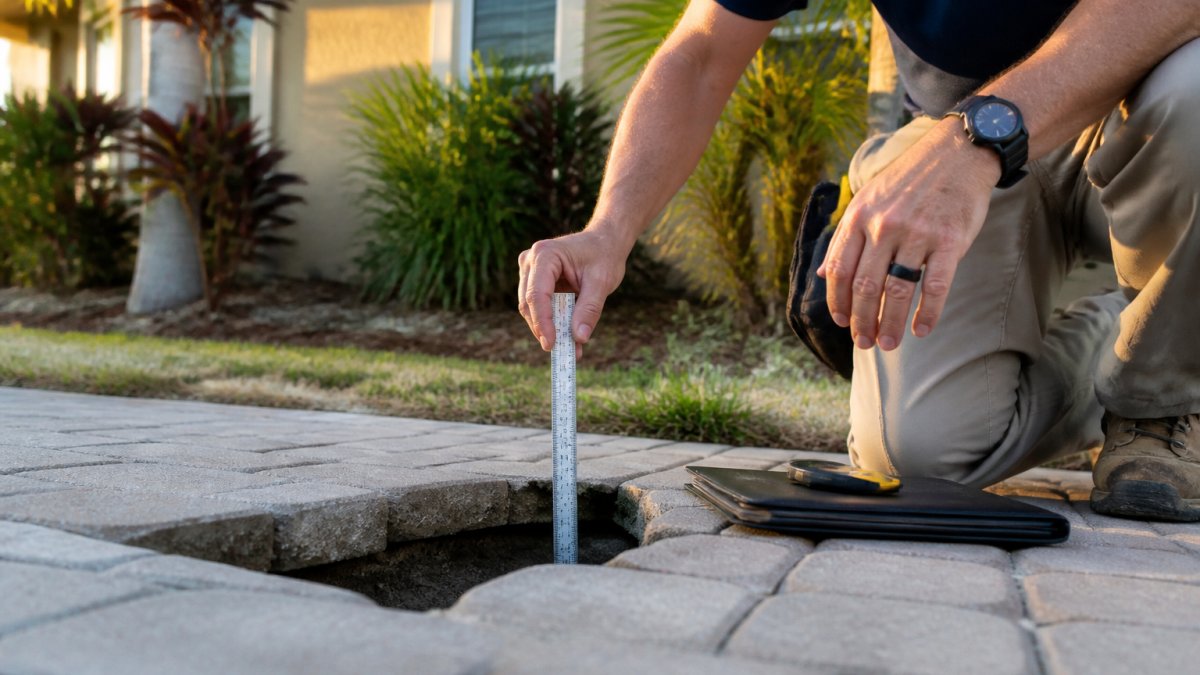
Before repair work begins, a licensed engineer or geotechnical specialist evaluates your property, typically 2-4 hours on-site. The contractor walks the perimeter, documents cracks in foundation, walls, or pavement, checks for standing water or drainage issues, takes measurements and photographs, and reviews the property's history.
Geotechnical Evaluation and Soil Analysis
This step determines what's happening beneath the surface. The contractor drills test holes and extracts soil samples to assess soil type and density, depth to bedrock, groundwater level, underground voids, and rock quality. It typically takes 1-3 days depending on site access and test hole count; lab analysis adds 3-7 business days.
Drilling Access and Void Identification
Once soil conditions are understood, the contractor drills access holes at strategic locations to inject stabilization material and pinpoint underground voids. Drilling typically takes 1-2 days for a residential property, to depths of 20-40 feet depending on local geology. Softer soil drills faster; rock slows the process significantly.
Polyurethane Injection Sinkhole Repair Duration
Polyurethane injection sinkhole repair is one of the fastest stabilization methods, injecting expanding polyurethane foam directly into underground voids and weak soil layers. The injection phase typically takes 4-8 hours for a small to medium sinkhole; the foam expands on contact, filling voids and compacting surrounding soil, hardening within minutes to hours.
The total timeline for polyurethane injection is typically:
- Site prep and drilling: 1-2 days
- Injection work: 4-8 hours
- Initial curing: 24-48 hours
Factors That Affect Sinkhole Repair Timeline
Several variables explain why two similar-looking sinkholes can have very different timelines.
Soil and rock conditions are the biggest factor.
Sinkhole size and depth directly impact duration.
Groundwater level affects drilling speed and material performance.
Property access matters more than people realize.
Weather conditions can delay projects.
Permits and inspections add time.
Sinkhole Repair Timeline by Project Phase
Stabilization is a sequence of milestones, each with its own clock. The table below shows the practical end-to-end timeline by repair method and phase.
| Phase | Polyurethane injection | Compaction grouting | Helical or resistance piers |
|---|---|---|---|
| Inspection and assessment | 2-4 hours on-site; written report in 3-5 business days | Same | Same |
| Geotechnical evaluation and lab work | 1-3 days drilling; 3-7 business days lab | 2-4 days drilling; 3-7 business days lab | 2-4 days drilling; 3-7 business days lab |
| Permitting (where required) | 5-10 business days | 5-15 business days | 5-15 business days |
| Active stabilization work | 4-8 hours injection | 2-5 days grouting | 1-3 days per pier, often 2-5 days total |
| Curing or set time | 24-48 hours | 3-7 days | Immediate structural capacity; grout cure 24-72 hours |
| Verification and monitoring | 3-10 days | 7-14 days | 7-14 days |
| Stabilization milestone (ground stable) | 3-5 days of active work; 2-4 weeks including pre-repair | 1-2 weeks of active work; 3-5 weeks including pre-repair | 2-4 days of active work; 3-5 weeks including pre-repair |
| Full repair milestone (structure and surface restored) | Add 1-3 weeks | Add 2-6 weeks | Add 3-8 weeks |
Stabilization time is not the same as full repair time
There are three separate finish lines, and they do not move at the same speed:
- Ground stabilization. The soil is densified, voids are filled, and the foundation is no longer moving.
- Structural repair. Cracked foundation walls, misaligned slabs, damaged framing, and compromised footings are repaired or replaced, a separate trade with its own schedule.
- Surface restoration. Driveways, sidewalks, patios, landscaping, irrigation, and fencing are rebuilt, often the longest tail because it waits on curing, permits, and finish trades.
A homeowner who hears "three to five days" is hearing the active stabilization window only. The realistic calendar from first phone call to fully restored yard is commonly 4-10 weeks for a residential project, longer when structural or cosmetic repairs are extensive.
Pre-repair phase: where most of the calendar goes
The pre-repair phase determines whether the rest of the schedule holds.
- Initial site inspection: 2-4 hours
- Geotechnical evaluation and drilling: 1-4 days
- Soil and rock analysis: 3-7 business days
If a contractor quotes a start date without a geotechnical report in hand, the schedule is a guess. The report tells the crew how deep to drill, how much material to plan for, and whether the chosen method will work.
Active stabilization phase: the visible work
This is the phase neighbors notice. For polyurethane injection: site prep and equipment positioning (4-8 hours), drilling access holes (1-2 days), injection (4-8 hours), and initial cure (24-48 hours). Compaction grouting takes 2-5 days as the crew works in lifts and watches for heave. Pier installation takes 1-3 days per pier, with most residential jobs at 2-5 days of active work.
Schedule Structural Evaluation →
Curing and verification phase: the part that protects the repair
Curing is not optional downtime. Polyurethane gains strength for 24-48 hours after injection; cementitious grout needs 3-7 days to reach design strength; piers reach structural capacity immediately but the grout collar needs 24-72 hours. Verification adds 3-14 days depending on method and monitoring requirements.
What makes the timeline faster or slower
Two identical-looking sinkholes can have very different schedules. The variables that move the needle most are size and depth, soil and rock conditions, groundwater level, site access, weather, permitting, and repair method. A small, shallow sinkhole in soft soil with good access can stabilize in days; a deep void under a slab with high groundwater, tight access, and a permitting backlog can take a month or more.
What to Do If a Sinkhole Opens in Your Yard
If you notice a sinkhole forming, immediate action prevents it from expanding. Here's what to do:
Stop all activity in the affected area. Don't drive over it, place heavy objects nearby, or let children or pets play in or around it. A small sinkhole can expand rapidly if the underlying void keeps enlarging.
Call a licensed geotechnical engineer or foundation repair specialist immediately. This is not a DIY situation. We offer free emergency structural evaluations to determine the urgency and best repair approach.
Document the sinkhole with photos and measurements. Record when you first noticed it and whether it's growing, which helps the engineer understand its progression.
Contact your homeowners insurance. Some policies cover sinkhole repair, though coverage varies widely.
Avoid temporary patches or DIY repairs. Filling a sinkhole with dirt or concrete without addressing the underlying void is temporary at best; it typically reopens within months.
Verifying Stabilization Completion
Drilling holes and pumping material into the ground does not, by itself, prove a sinkhole is stabilized. Completion is a documented conclusion reached after the repair meets defined criteria. Here is what a defensible verification process looks like.
Completion criteria contractors should meet
A repair is generally considered complete when all of the following are true:
- Design volume delivered. The planned injection or grout volume was placed, or the engineer documented why the actual volume differed.
- No uncontrolled migration. Material did not surface at unexpected locations, flow into utilities, or lift slabs beyond tolerance.
- Monument or elevation stability. Survey monuments, crack gauges, or floor elevation readings show no meaningful movement over the monitoring window.
Monitoring: how long and what is measured
Monitoring windows vary by method and engineer judgment. A common pattern:
- Polyurethane injection: 3-10 days of observation, with crack gauges or elevation readings at defined intervals.
- Compaction grouting: 7-14 days, often with periodic elevation surveys because grout can cause heave.
- Pier installation: 7-14 days, with pier load readings and structure elevation checks.
What matters is whether the readings are stable, not the exact number of days. Continued movement is not a passing result, even if the calendar has run out.
Documentation you should receive
Ask for a written completion package. A thorough one includes:
- Injection or pier locations plotted on a site plan
- Material type, volume, and mix design used
- Drilling depths and refusal information
If a contractor cannot produce this package, the verification claim is unsubstantiated. Documentation is also what your insurer and any future buyer will want to see.
Independent verification versus contractor self-reporting
There is a meaningful difference between a contractor saying the job is done and an independent engineer confirming it. On larger projects, a third-party engineer reviews the monitoring data and signs off. On smaller residential jobs, the same firm may do both the work and the verification. That is common, but ask who signs the completion statement and what their credentials are.
What verification does not cover
Verification confirms the ground is stable and the repair met its design criteria. It does not confirm cosmetic damage is repaired, landscaping is restored, or every crack is closed. Those are separate scopes with separate schedules, and understanding that boundary prevents the misunderstanding that completed stabilization means a fully restored property.
Questions to ask before you accept completion
- What were the completion criteria for my project?
- How long was the monitoring window, and what did the readings show?
- Who signed the completion statement, and what are their credentials?
Clear answers are the difference between hoping a sinkhole is fixed and knowing it is.
Frequently Asked Questions
How long does sinkhole stabilization typically take from start to finish?
Sinkhole stabilization timelines range from 1-3 days for active injection work, but total project duration depends on soil conditions, void size, and repair method. Site inspection and assessment may take 1-2 days, while curing and structural verification can add another 1-2 weeks. Compaction grouting typically completes faster than pier installation. For polyurethane injection sinkhole repair, the injection phase itself often finishes within 24-48 hours, though full load-bearing restoration requires proper curing time before the area returns to normal use.
What factors make sinkhole repair take longer?
Multiple variables extend repair timelines: deep sinkholes require more drilling depth and grout volume, weak or fractured bedrock demands additional stabilization strokes, high groundwater levels complicate injection and require extended curing, large voids need more injection points and hole spacing, and poor site access limits equipment mobility. Weather delays (heavy rain affects soil conditions and drilling), permit processing, and the need for structural monitoring between phases also add time. Soil densification in loose sandy soils typically takes longer than repairs in clay-based soil conditions.
How do contractors verify that sinkhole stabilization is actually complete?
Contractors use several verification methods: visual inspection of the surrounding ground for new settlement or movement, load testing to confirm soil densification and restored load-bearing capacity, ground-penetrating radar or subsurface imaging to confirm void filling and soil consolidation, and monitoring systems that track ground movement over days or weeks. The stabilization period concludes when curing time requirements are met, soil compaction measurements reach engineering specifications, and no additional ground movement occurs. A structural engineer typically certifies completion before the property returns to normal use.
Can I stay in my home while sinkhole stabilization work is happening?
Most polyurethane injection sinkhole repair work allows residents to remain on-site since the process is non-excavative and minimally disruptive. However, you should avoid the immediate work area during active drilling and injection to ensure safety. The crew typically requires access to drill holes around the sinkhole perimeter, which may involve driveway or yard disruption. Structural stability should be assessed before occupancy if the sinkhole affected foundation support or building integrity. Your contractor will provide specific guidance on restricted areas and timeline for returning to normal property use during the stabilization period.