 how-to
Fixing Uneven Floors in Florida: A Homeowner's Guide
Table of Contents
- Why Florida Homes End Up With Uneven Floors
- A Safe Diagnostic Process Before You Repair Anything
- How to Level an Uneven Floor: Repair Methods by Severity
- Uneven Subfloor Repair: Patching, Replacement, and Surface Prep
- Sloping Floors and Foundation Problems: When to Call a Professional
- The Cost to Fix Uneven Floors and What Drives the Price
- Frequently Asked Questions
Last Updated: October 18, 2026
Why Florida Homes End Up With Uneven Floors
An uneven floor is a floor surface that has lost its flatness or level plane, and in Florida it usually signals something happening underneath. Fixing uneven floors in Florida starts with understanding why they move.
Florida sits on karst geology, a landscape of soluble limestone that develops voids over time. When those voids collapse or soften, the ground above loses support. Your floor follows.
Karst Geology, Sinkholes, and Settlement
Karst terrain is ground where water dissolves bedrock and leaves cavities behind. Florida's limestone does exactly that, and settlement is the predictable result. Soil washes into voids, the surface drops, and your slab or joist system goes with it. Settlement often shows as a slope toward one wall or a dip in the middle of a room. It rarely happens evenly. The U.S. Geological Survey's karst terrain overview explains how these dissolving rock formations create the conditions for sinkholes and ground settlement.
Moisture, Humidity, and Subfloor Decay
Humidity does the slow damage. The subfloor is the structural layer under your finished flooring, and in Florida it stays damp far longer than it should. Wood swells, dries, and weakens. OSB, the glued strand board common in newer construction, crumbles when water reaches its edges. A soft spot near a bathroom, laundry room, or exterior door is usually moisture damage, not a mystery. Left alone, that decay spreads under the whole floor.
A Safe Diagnostic Process Before You Repair Anything
Diagnosis comes before demolition. A safe check tells you whether you have a cosmetic dip or a structural problem, and that difference decides everything.
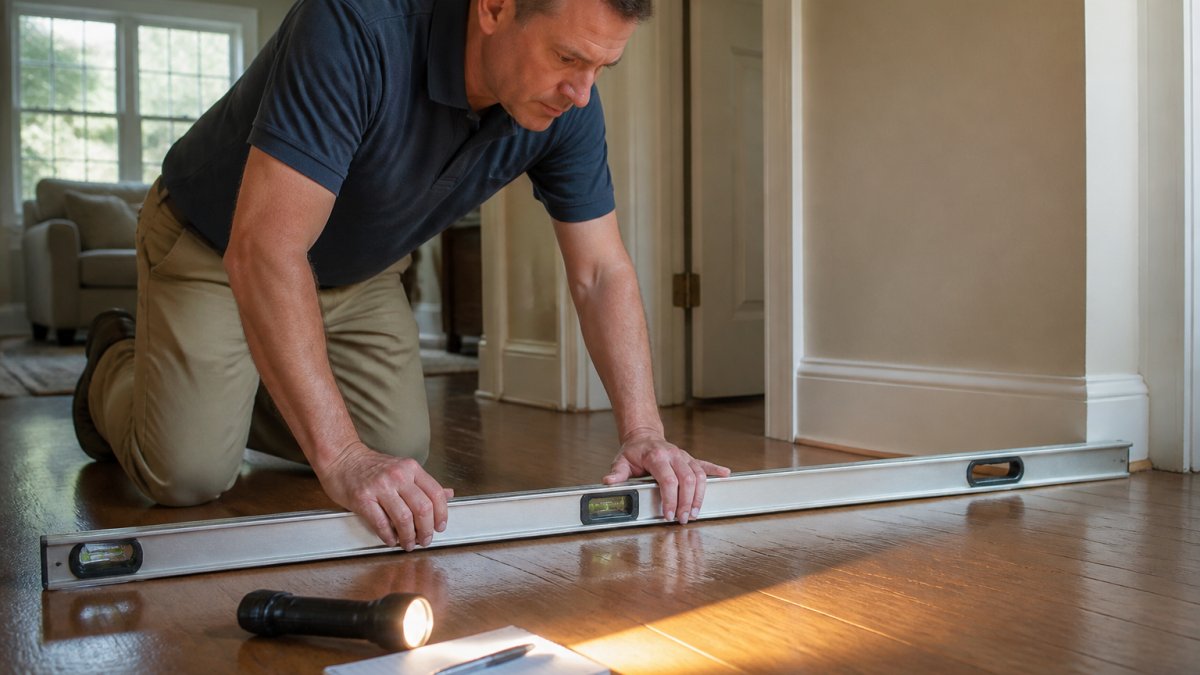
Checking Floor Slope, Dips, and High Spots
Start with a 4-foot level, a tape measure, a marble, and a roll of painter's tape. Work room by room and record everything:
- Place the level in at least five spots per room, along each wall and through the center, and record the gap under each end in fractions of an inch.
- Mark high spots and low spots with painter's tape so the pattern is visible from standing height.
- Drop a marble at the high point and trace which way it rolls; that is your slope direction.
- Press down firmly with your heel every few feet to find soft spots, and listen for squeaks that move when you shift weight.
- Check for cracks in tile grout, gaps at baseboards, and doors that swing open or closed on their own.
- Photograph everything with a ruler or coin in frame for scale, and date the photos.
A common rule of thumb in the trade is that a floor sloping more than about 1/4 inch per 10 feet is worth a closer look, and anything approaching 1 inch over 20 feet is a structural question. Flatness matters most under tile: a floor can sit perfectly level and still be too wavy for a tile installation, which is why tile setters check flatness with a 10-foot straightedge and generally want the variation held to about 1/8 inch in 10 feet.
Testing for Moisture Before You Trust the Surface
In this climate, moisture is the hidden variable. Before you accept any surface as sound, check it:
- Pin-type moisture meter. Probe the subfloor at several points, especially near bathrooms, laundry rooms, exterior doors, and any wall that backs up to plumbing. Readings that climb toward a fixture or an exterior wall point to a leak or wicking, not ambient humidity.
- Plastic sheet test. Tape a 2-foot square of clear polyethylene to the slab or subfloor for 24 hours. Condensation on the underside means moisture is moving up through the assembly.
- Calcium chloride or in-situ relative humidity testing. For slab-on-grade concrete, flooring manufacturers commonly require one of these tests before a new floor goes down, and many publish a maximum allowable moisture emission rate on the product data sheet. Ask for the test results in writing.
- Visual cues. Staining, cupping at board edges, a musty smell, or efflorescence (the white powdery residue on concrete) all point to moisture that has not been resolved.
Telling Subfloor Problems From Structural Problems
The key question: is the problem in the floor surface or in the structure below? Subfloor problems stay local. You find soft spots, stains, or delamination in one area, and the rest of the room is flat.
Escalate to a licensed structural professional, not just a flooring installer, if you see any of the following:
- A slope you can feel when walking, or a marble that rolls steadily across a whole room.
- A soft spot larger than roughly a dinner plate, or one that has grown since you first noticed it.
- Cracks in drywall at corners or above door frames, or cracks in exterior brick or stucco.
- Doors and windows that stick or won't latch, especially if they were fine a year ago.
- Any sign of active water intrusion you cannot trace to a fixture.
If the whole room tilts, stop and get a professional assessment. That is a foundation question, not a flooring one. Bring your dated photos, level readings, and moisture test results to the inspection, they shorten the visit and make the diagnosis more reliable.
How to Level an Uneven Floor: Repair Methods by Severity
Match the repair to the severity. Small dips get patching. Widespread settlement needs structural work. Choosing the wrong method wastes money and the floor moves again.
Self-Leveling Compound and Underlayment
Self-leveling compound is a pourable mix that flows across a floor and cures into a flat plane. It works well for minor dips and wavy surfaces before tile installation. Underlayment, a thin layer laid over the subfloor, smooths small imperfections and adds a barrier. Both are surface fixes. They only work when the subfloor is sound and dry. Pour compound over a rotting subfloor and it cracks within months.
Schedule Structural Evaluation →
Sistering Joists and Reinforcing Structural Support
Sistering joists means fastening a new joist alongside an existing one to add strength. It is the go-to fix for sagging wood floors where joists have weakened. For slab settlement, soil stabilization is the deeper answer. Our approach at Florida Foundation Repair uses non-invasive polyurethane injection to fill voids and lift settled ground. It is engineered for Florida's karst geology, and it avoids the excavation that tears up your yard and floors.
Uneven Subfloor Repair: Patching, Replacement, and Surface Prep
Uneven subfloor repair is about restoring a solid base before anything goes on top. Patching works for small damaged areas. Cut out the bad section, fit a new piece of matching thickness, and fasten it to the joists. Replacement is the call when damage covers a large area or the board has lost its strength. Surface preparation finishes the job: sweep clean, check for moisture, and confirm the subfloor is flat and dry. Skip prep and even a perfect patch fails.
| Severity | Typical Fix | Watch For |
|---|---|---|
| Minor dip or waviness | Self-leveling compound | Subfloor must be dry and sound |
| Local soft spot | Patch or partial replacement | Hidden moisture source |
| Sagging wood floor | Sistering joists | Rot at joist ends |
| Whole-room slope | Structural assessment | Foundation settlement |
Sloping Floors and Foundation Problems: When to Call a Professional
Sloping floors are foundation problems when the tilt runs across the whole room or keeps getting worse. Call a professional if you see any of these:
- A slope you can feel when walking
- Doors and windows that stick or won't latch
- Cracks in drywall at corners or above doors
- Cracks in exterior brick or stucco
- A floor that has moved since you last checked
These signs point to settlement below, and surface repairs won't hold. A professional assessment confirms the cause before anyone spends money on a fix.
The Cost to Fix Uneven Floors and What Drives the Price
The cost to fix uneven floors varies widely, so treat any flat quote with suspicion. Pricing depends on the cause, the square footage, the method, and access. What follows is how the numbers break down and what to ask before you sign.
What Drives the Price
- Cause and severity. A cosmetic dip and a settling foundation are different projects with different crews, equipment, and warranties.
- Square footage and access. A 200-square-foot room is not priced like a whole floor. Moving furniture, pulling carpet, and cutting out tile add labor.
- Method. Pourable self-leveling compound is a materials-and-labor job. Concrete lifting, polyurethane injection, and joist sistering bring specialized equipment and engineering.
- Moisture remediation. If the cause is a leak or poor drainage, the repair is not finished until the water source is fixed. That work is often billed separately.
- Permits and engineering. Some structural repairs require a permit or an engineer's letter, and those costs land in the project budget.
- Disruption. A surface leveling job may be a one- or two-day project. Structural work can stretch to weeks, and the disruption is part of the real cost.
How to Read a Quote
Ask every contractor for a written scope that names the cause, the method, the square footage, the materials, the warranty, and what is excluded. A quote that lists only a total is not a quote, it is a guess. Ask whether the price includes moisture testing, subfloor replacement, and cleanup, and ask what happens if the crew finds rot or a second low spot after demolition. Reputable contractors price change orders in writing before the work continues.
Planning for Timeline and Disruption
Surface leveling and patching are typically short projects measured in days. Subfloor replacement and joist work are measured in weeks, and structural stabilization can run longer depending on access and drying time.
At Florida Foundation Repair, we offer free emergency structural evaluations and back our work with a limited lifetime warranty. We are licensed and insured under CGC# 1526152. For current pricing, request a quote, and bring your photos, level readings, and moisture test results so the estimate is based on your floor, not a phone description.
Frequently Asked Questions
How can I tell whether an uneven floor is caused by the subfloor or the foundation?
Start with the scope of the problem. A dip confined to one room, soft spots, or squeaks usually points to an uneven subfloor, water damage, or worn underlayment. Problems that spread across multiple rooms, doors that stick, cracks in drywall above door frames, or a floor that slopes consistently in one direction suggest foundation settlement. A licensed inspector can confirm with elevation readings and soil assessment before you commit to a repair method.
How much does it cost to fix uneven floors?
The cost to fix uneven floors depends on the cause, the square footage, and the repair method. Because pricing varies by property, request a written repair estimate after an on-site evaluation rather than relying on national averages.
Can I level an uneven floor myself?
You can handle minor surface issues, such as patching small subfloor defects or pouring self-leveling compound over a sound subfloor. Structural work is different. Sistering joists, correcting a sloping floor, or addressing settlement requires an understanding of load paths and, in many cases, permits and inspections. If you see cracks, soft spots, or a slope that worsens over time, get a professional assessment before opening anything up.
When should I call a foundation professional about sloping floors?
Call a professional when the slope spans more than one room, when doors and windows stop latching, when you see stair-step cracks in exterior block or drywall cracks radiating from corners, or when the floor feels soft or bouncy underfoot. In Florida, karst geology and high water tables make settlement and sinkhole activity real risks, so a structural evaluation is worth scheduling early rather than waiting for the problem to spread.
An uneven floor rarely fixes itself, and the longer you wait, the more the repair tends to cost. If your floor is sloping, soft, or cracked, get it looked at before you install anything new. Florida Foundation Repair offers free emergency structural evaluations, non-invasive polyurethane injection engineered for karst geology, and a limited lifetime warranty on our work. Schedule a structural evaluation and get a clear answer on what is happening under your floor.