 comparison
Is Foam Jacking Worth the Investment for Settled Concrete
Last Updated: November 4, 2026
Quick Summary
Foam jacking is worth the investment when a settled slab still has structural value and the soil beneath it can be stabilized, because lifting costs less than tearing out and replacing concrete and restores the slab in a fraction of the time. Compare the ten-year total, not the first invoice.
- Foam jacking injects expanding polyurethane foam to fill voids, compact loose soil, and raise the slab.
- Mudjacking is reported to run roughly 20-30% cheaper upfront than foam lifting.
- One leveling provider lists foam at roughly $5-$10+ per square foot against $3-$6 for mudjacking.
- Lifting a slab without fixing the water source is the most common way a repair fails early.
- DIY concrete lifting foam is not reasonable for most homeowners; it handles only shallow, cosmetic lifts.
Table of Contents
- The Verdict Up Front: When Foam Jacking Pays Off
- How Polyurethane Foam Lifting Works
- What Foam Jacking Cost Actually Covers
- Foam Jacking vs. Mudjacking: Weighing the Trade-Offs
- How Long Does Foam Slab Jacking Last?
- Where Foam Jacking Falls Short
- Is DIY Concrete Lifting Foam a Reasonable Option?
- Schedule a Structural Evaluation Before You Spend
- Frequently Asked Questions
The Verdict Up Front: When Foam Jacking Pays Off
The case for foam jacking rests on three things: the slab is intact, the problem is a void rather than a failed base, and the repair needs to last. When all three are true, polyurethane lifting is usually the better spend.
But first, here's what most cost comparisons get wrong. They compare a lifting quote to a replacement quote and stop there. The real question is which repair you will still be living with in ten years.
Below, we break down what drives foam jacking cost, how it compares with mudjacking and replacement, and the site conditions that decide whether foam is right for your slab.
How Polyurethane Foam Lifting Works
Foam jacking is a repair method that injects expanding polyurethane foam beneath a settled concrete slab to fill voids, compact loose soil, and raise the slab back toward its original grade. The foam cures quickly and adds little weight to the ground below.
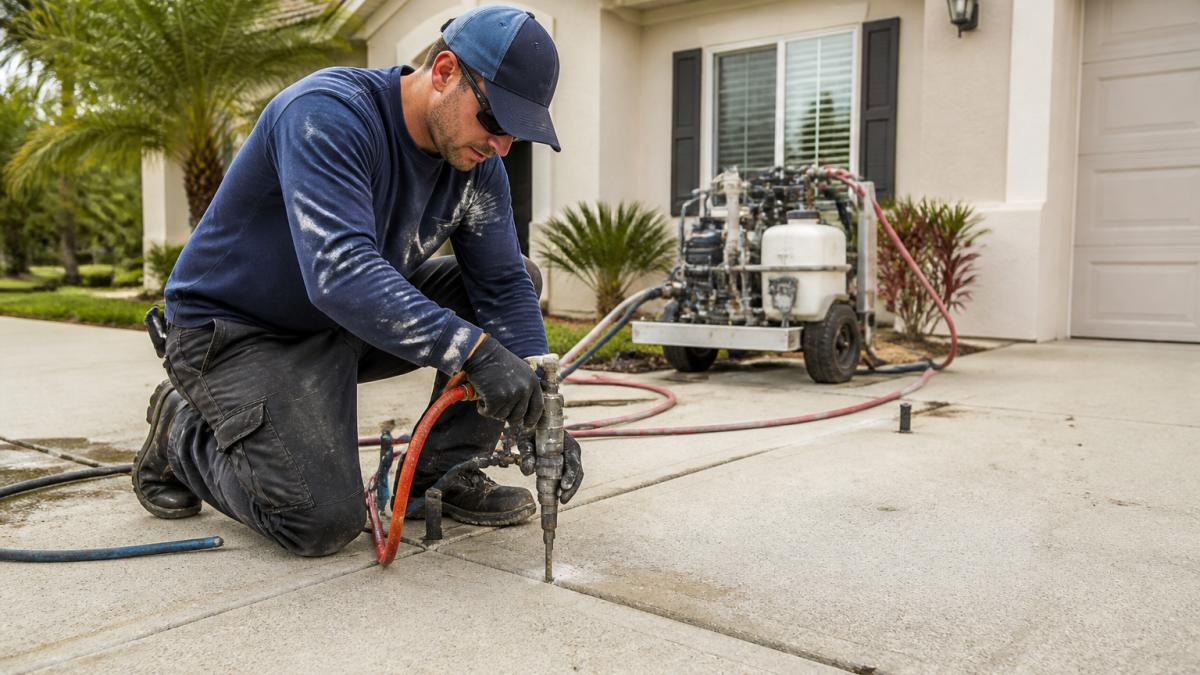
The process follows a consistent sequence:
- Drill small injection holes through the slab at planned points.
- Pump two-part polyurethane into the void, where it expands and fills gaps.
- Compact the soil as the foam presses upward and outward.
- Lift the slab in measured stages until it meets the target grade.
- Patch the holes and check the result against a level line.
Polyurethane foam is generally lightweight compared with heavy fill materials, and it sets quickly.
What Foam Jacking Cost Actually Covers
Foam jacking cost is generally driven by slab size, void depth, access, and the number of injection points, and quotes vary accordingly. Our cost of foundation stabilization pricing guide gives concrete cost context to judge whether foam jacking is worth the money.
A useful estimate itemizes these factors:
| Cost Factor | What Drives It | Why It Matters |
|---|---|---|
| Slab area | Square footage being lifted | Larger slabs need more material and points |
| Void depth | How far soil has settled | Deep voids require more foam |
| Access | Equipment reach and site layout | Tight lots slow the crew |
| Injection points | Planned lift accuracy | More points mean finer control |
| Soil condition | Stability of the base | Unstable soil changes the approach |
When you compare quotes, ask each contractor to break out these line items. A single lump sum tells you nothing about whether the work is scoped correctly.
The Like-for-Like Lifetime Cost Comparison
Most cost comparisons stop at the first invoice. That is the wrong frame for an investment question.
Path A: Lift and stabilize. You pay the lifting quote once, plus any drainage correction the evaluation recommends.
Put both paths on one page and ask the contractor to fill in the line items: initial cost, drainage correction, expected repeat work, downtime, and warranty remedy.
Watch out: a lifetime comparison built on a lift that never addressed the water source will flatter foam on paper and fail in the ground. The drainage line item is not optional.
Questions That Expose a Thin Estimate
Before you compare totals, make each bid answer the same scope questions: How many injection points, and where? What foam density is specified for this load? Is drainage correction included or excluded? What does the warranty cover, and for how long? Is disposal of old concrete included in a replacement bid? Bids that answer all five can be compared honestly; bids that do not are guesses dressed as prices.
Foam Jacking vs. Mudjacking: Weighing the Trade-Offs
Foam jacking and mudjacking both lift settled concrete, but they differ in material, hole size, and long-term behavior. For a deeper comparison of polyurethane injection against traditional underpinning, see polyurethane injection vs traditional underpinning. Mudjacking pumps a cement-and-soil slurry under the slab; foam jacking injects expanding polyurethane.
The trade-off most homeowners notice first is upfront price. Mudjacking generally costs less to start, and some comparison resources report it running roughly 20-30% cheaper upfront, according to Fix My Concrete's mudjacking vs. foam lifting comparison. Foam typically sits higher on a per-square-foot basis, with one leveling provider listing foam at roughly $5-$10+ per square foot against $3-$6 for mudjacking, per FoamWorks Concrete Leveling's cost breakdown.
Here is the part that changes the math. Slurry is heavy, and heavy material can re-settle soft soil over time. Foam is light and fills voids without adding load. Smaller injection holes also leave less visible patching.
How Long Does Foam Slab Jacking Last?
Foam slab jacking is generally considered a long-term repair, and its lifespan depends on soil stability, water control, and correct installation. When the underlying cause is addressed, the lift holds; when water keeps washing soil away, no method lasts indefinitely.
Schedule Structural Evaluation →
Durability comes down to a few conditions:
- Stable soil around the injection zone.
- Controlled drainage so water stops eroding the base.
- Proper foam density matched to the load.
- Accurate lift that does not over-stress the slab.
What most guides skip is the evidence question. No one can hand you a guaranteed service life for a lifted slab, because the slab's future depends on soil and water behavior that no contractor controls. Treat any specific "lasts X years" number as a planning assumption, not a promise. The honest way to judge longevity is to look at what the warranty actually commits to and what it excludes.
What a Foam Jacking Warranty Typically Covers
Warranties in this trade vary widely, but a common pattern is a limited warranty that covers the lifted slab returning to within a defined tolerance of its post-repair grade. Read the terms for these specifics before you sign:
- What is covered. Most limited warranties cover re-settlement of the treated area, not new cracks, new voids elsewhere, or damage to the slab surface.
- What is excluded. Water intrusion, drainage failures, soil movement from nearby construction, and homeowner-caused changes are commonly excluded. If the cause of the settlement was never fixed, the exclusion usually applies.
- Duration and transferability. A "limited lifetime" label can mean the life of the structure, a set number of years, or the original owner's tenure. Ask which one, and whether it transfers if you sell.
- Remedy. Some warranties promise a re-lift; others promise a refund or credit. Know which you are getting.
- Claim process. Ask who inspects, how quickly, and whether arbitration or a fee applies.
Watch out: a warranty that excludes the water source that caused the settlement is close to worthless if that water problem is still active. Fix drainage first, then lift.
How to Assess Longevity Claims Without Being Misled
When a contractor or a marketing page cites a lifespan, ask three questions: Is the number based on this site's soil and drainage, or is it a generic figure? Does the warranty back the number, and for how long? And what maintenance, gutter routing, grading, downspout extensions, does the warranty require you to keep up? A repair that is paired with corrected drainage and a written, specific warranty is a far better bet than a cheaper lift with a vague promise.
Where Foam Jacking Falls Short
Foam jacking is not the right repair for every slab, and we tell homeowners when it is not. If you are weighing the downsides, learn how messy polyurethane foundation injection is in practice.
Cases where lifting is the wrong call:
- Severely broken slabs that cannot be raised as a unit.
- Failed base soil that needs deeper structural work.
- Slabs with structural cracks that need replacement.
- Drainage problems left unaddressed, which will undo any lift.
Watch out: lifting a slab without fixing the water source that caused the settlement is the most common way a repair fails early. The foam does its job; the soil keeps washing out underneath it.
Is DIY Concrete Lifting Foam a Reasonable Option?
DIY concrete lifting foam is not a reasonable option for most homeowners. The kits sold for this purpose handle only shallow, cosmetic lifts, and they cannot compact soil or diagnose why the slab settled.
The limits are practical:
- No soil diagnosis. A kit cannot tell you whether the base is stable.
- Limited lift. Most kits raise slabs by small amounts only.
- No compaction. Foam needs to press into voids under controlled pressure.
- No warranty. A failed DIY lift leaves you paying twice.
We recommend a professional evaluation whenever the slab carries weight, sits near a structure, or shows more than a hairline gap. The cost of a proper diagnosis is small next to redoing the work.
Schedule a Structural Evaluation Before You Spend
The right way to decide whether foam jacking is worth it is to have the slab and soil evaluated, not to guess from a photo. A structural evaluation confirms the cause, measures the settlement, and tells you whether lifting will hold.
At Florida Foundation Repair, we offer free emergency structural evaluations and back our work with a limited lifetime warranty. Our crews use non-excavative polyurethane injection engineered for the state's karst geology, and we are licensed and insured in Florida under CGC# 1526152.
Schedule a structural evaluation with our team and get a clear answer on whether lifting is the right repair for your slab.
Frequently Asked Questions
How long does foam slab jacking last?
Polyurethane foam is durable and does not shrink or wash out the way soil-based slurry can, so a properly installed lift can hold for many years. Lifespan depends on what caused the settling in the first place. If water is still washing soil out from under the slab, the foam will hold but the ground around it will keep moving. Reputable contractors pair the lift with drainage fixes and back the work with a warranty, which is the clearest evidence of expected performance.
How much does foam jacking cost compared with mudjacking?
Foam jacking typically costs more per square foot up front than mudjacking, and published industry comparisons put polyurethane foam in a higher per-square-foot range than soil slurry. Get a written estimate that itemizes slab area, injection points, and any drainage work so you can compare quotes on equal terms rather than on headline price alone.
Which is better, mudjacking or foam jacking?
It depends on the slab and the soil under it. Mudjacking uses a heavier cement-and-soil slurry that suits large, stable slabs where cost is the priority, but the extra weight can worsen settling on weak ground. Foam jacking uses lightweight expanding polyurethane that lifts with precision and cures fast, which suits smaller slabs, tight access, and soil that cannot take more load.
Is DIY concrete lifting foam a good idea?
Rarely. Consumer foam kits exist, but they cannot diagnose why the slab settled, how deep the void runs, or whether the soil is still moving. A lift that treats the symptom without fixing the cause can fail, and the money spent on the kit may be lost. A structural evaluation by a licensed contractor can confirm whether lifting is the right repair.
Can foam jacking fix a sinking concrete slab?
In most cases, yes, provided the slab is still structurally sound and the settling has a liftable cause. Foam jacking can raise and stabilize settled concrete by filling voids and restoring support. It is not the right answer for slabs that are cracked through, crumbling, or sitting over a true sinkhole that needs deep stabilization. An on-site evaluation confirms which situation you have before any work begins.
Settled concrete rarely fixes itself, and guessing at the cause is how homeowners end up paying for the same repair twice. If your driveway, patio, or sidewalk has dropped, let our team confirm what is happening beneath it before you commit a dollar. Get started with Florida Foundation Repair and schedule your structural evaluation, backed by non-invasive polyurethane injection, a limited lifetime warranty, and licensed Florida expertise.